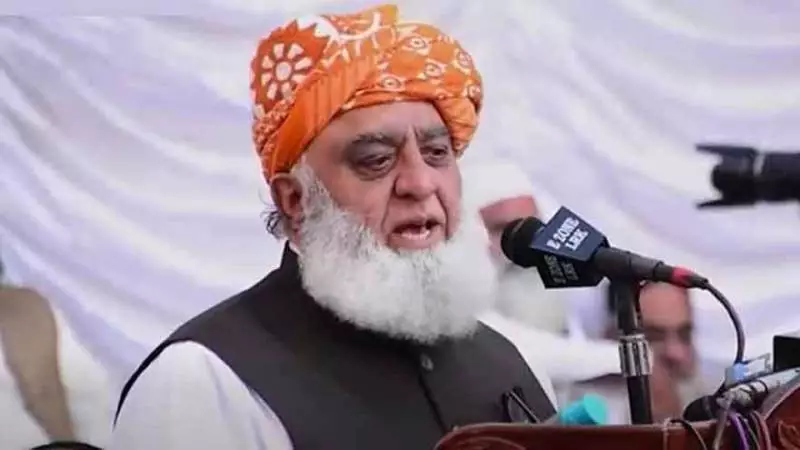
Maulana Fazlur Rehman, the prominent leader of the Jamiat Ulema-e-Islam-Fazl (JUI-F), has issued a powerful call to the nation's rulers. He demands they seek a fresh public mandate if they wish to govern the country according to Islamic principles, while simultaneously rejecting what he terms as Western cultural and political influence.
A Direct Challenge to the Ruling System
In a significant address, Maulana Fazlur Rehman presented a stark choice to those in power. He argued that the current system of governance lacks legitimacy in its claim to represent Islamic values. The veteran politician emphasized that any attempt to shape the nation's future on Islamic foundations must be explicitly endorsed by the people through their votes.
The JUI-F chief firmly stated that rulers cannot impose their version of an Islamic system without direct public approval. He positioned this demand as a fundamental democratic right, linking popular sovereignty with religious governance. This move is seen as a direct challenge to the existing political framework, which he believes is compromised by external agendas.

Condemnation of Western Influence and Current Policies
Fazlur Rehman's speech contained strong criticism of Western influence on Pakistan's domestic and foreign policy. He accused the current ruling structure of being subservient to foreign powers, which he claims dictates policy contrary to the nation's Islamic identity and sovereign interests.
He specifically lamented the state of the economy, national security, and foreign relations, attributing these challenges to a departure from Islamic principles and an over-reliance on Western models. The cleric expressed particular concern over cultural shifts that he views as alien to Pakistan's societal fabric, urging resistance against such imported norms.
The Path Forward: Constitutional Amendment and Public Will
Outlining his proposed solution, Maulana Fazlur Rehman called for a concrete step: a constitutional amendment. He believes that entrenching the supremacy of Islamic principles in the constitution is essential. However, he insists this monumental change must not be an elite project but must be pursued with the clear and unequivocal backing of the Pakistani populace.
This stance reinforces the JUI-F's long-standing political ideology, which combines religious advocacy with a form of procedural democracy. By demanding a public mandate, Fazlur Rehman is attempting to hold the government accountable to a higher ideological standard while questioning its popular support for such an agenda. The call sets the stage for increased political and ideological debate in the coming months.
The implications of this demand are far-reaching. It pressures the ruling coalition to clarify its stance on the role of Islam in state affairs and tests its claim of popular representation. Furthermore, it mobilizes Fazlur Rehman's religious-political base and could influence the discourse leading up to future electoral contests.