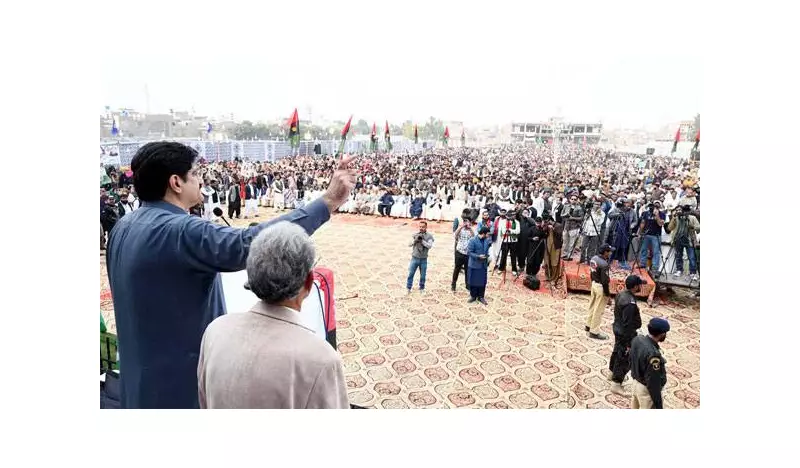
The Pakistan Peoples Party (PPP) celebrated a significant milestone on Sunday, organizing the 58th Foundation Day ceremony at the Shaheed Mohtarma Benazir Bhutto Municipal Stadium in Larkana.
Honoring the Bhutto Legacy
Addressing a passionate gathering, Sindh Chief Minister Syed Murad Ali Shah reflected on the party's origins. He stated that on this day in 1967, Shaheed Zulfikar Ali Bhutto established the People's Party as a direct challenge to dictatorship. Shah emphasized that Bhutto became a guiding force for the poor, peasants, students, journalists, and all oppressed classes, with the public supporting his vision from the very beginning.
The Chief Minister paid tribute to the sacrifices made by the Bhutto family, noting the martyrdom of both Zulfikar Ali Bhutto and Shaheed Mohtarma Benazir Bhutto. He credited President Zardari for continuing their struggle and successfully steering the party forward. This enduring commitment, Shah asserted, is why the people of Larkana and Sindh have consistently trusted the PPP in every election since 2008, granting it more seats than before.

Bilawal Bhutto Zardari: The Future
Looking ahead, CM Shah declared Chairman Bilawal Bhutto Zardari as the party's future, describing him as the voice of the country's poor and a guarantor for the youth and peasants. He highlighted one of Bilawal's major achievements: the initiation of the world's largest project to construct 2.1 million houses for flood victims, an endeavor he claimed no one else had even considered.
Shah called for a collective pledge to strengthen the People's Party further and continue its struggle. He expressed a firm resolve to replicate the success of 1988, when Shaheed Benazir Bhutto became Prime Minister, by making Chairman Bilawal Bhutto Zardari the Prime Minister. He also noted the scale of the celebrations, with Foundation Day gatherings being held simultaneously in 133 districts across Pakistan.
A History of Struggle and Resilience
MPA Jameel Ahmed Soomro, also addressing the event, reinforced the party's founding principles. He stated the PPP was created to fight for the working class. He detailed the party's long journey, having been in government for a total of 15 years while struggling for 40 years.
Soomro poignantly noted that during this struggle, a Bhutto was martyred every decade, leading to the sacrifice of four Bhuttos over 40 years. He honored the countless PPP workers who were hanged, faced false cases, and were imprisoned for the restoration of the constitution and democracy, yet never abandoned the party's manifesto.
He affirmed that even today, the PPP's struggle continues for the youth, the sanctity of the constitution, parliament, and public rights. Soomro declared that no other political party in Asia has faced such adversity, including bomb attacks and the killing of its leadership and workers through judicial murder and assassinations, yet it never bowed down and consistently fought against every dictator.
He concluded with a powerful statement of the party's historical role, asserting that the Pakistan Peoples Party transferred power from Yahya Khan to the people and stood firm against General Zia, Musharraf, and terrorists. The true rulers, he said, are the PPP, its leadership, and its workers.