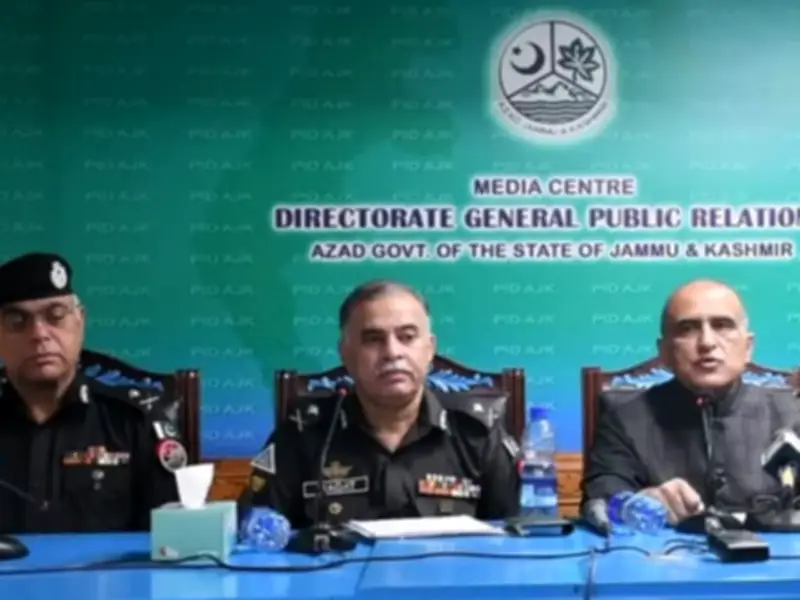
The Azad Jammu and Kashmir (AJK) government on Tuesday issued a stern warning to leaders of the proscribed Joint Awami Action Committee (JAAC), stating it would proceed according to the law if they surrender, while blaming the group for a series of violent attacks on law enforcement and public property that destabilized the region.
Background of the Conflict
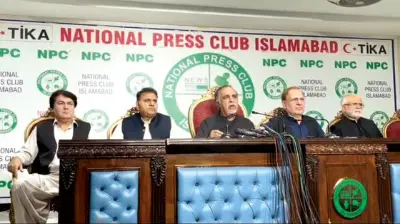
For the past two years, the local administration and JAAC have been locked in a dispute over the abolition of 12 reserved seats in the AJK Assembly allocated to refugees from Indian-occupied Kashmir who settled in Pakistan after 1947. Addressing a joint press conference, AJK Chief Secretary Flight Lieutenant (Retd) Khushal Khan and Inspector General of Police (IG) Captain (Retd) Liaqat Ali Malik outlined the government's stance on the law and order crisis that led to a negotiation deadlock.
Khan urged citizens to avoid what he termed "misleading protests" and focus on their own welfare. He directly addressed JAAC members and supporters, promising due legal process if they voluntarily surrendered to authorities.

Financial Burden of Demands
According to Khan, the government accepted key demands of the movement, including subsidized electricity tariffs, resulting in a financial burden of Rs8-9 billion on the exchequer. He added that after gaining public support, the JAAC expanded its demand list from three to eight and eventually to 38 demands, creating a cycle of continuous agitation. Khan maintained that 36 of the 38 demands included in an agreement with the Action Committee had been fully implemented, costing the governments of Pakistan and AJK between Rs20 billion and Rs25 billion.
"The committee was expected to oversee the implementation process, but instead chose to sabotage it," he alleged. The chief secretary said the group's objections initially centered on the composition of the implementation committee, prompting the government to make changes. Despite repeated boycotts and new demands from the JAAC, the government continued implementing agreed measures and launched development projects that had reached the tendering stage.
Unacceptable Demands
Explaining why some demands could not be accepted, Khan said certain proposals were financially unviable. "For example, the removal of advance income tax would have caused a loss of Rs35 billion to the AJK government," he elucidated. He noted that while AJK's annual revenue stood at approximately Rs70 billion, the region relied heavily on financial support from the federal government. "The Government of Pakistan contributes around Rs300 billion to cover AJK's budget deficit, while we also benefit from several indirect forms of support in the form of projects and other resources."
Dispute over Reserved Seats
The chief secretary addressed the controversy surrounding 12 reserved seats in the AJK Legislative Assembly, claiming that the JAAC refused to participate in a committee formed to resolve the matter. According to Khan, the committee insisted that the reserved seats be abolished before any further dialogue could take place. He further said that the JAAC demanded the removal of the "accession to Pakistan" clause from the AJK Interim Constitution and from the oath taken by AJK parliamentarians. "They also spoke about revisiting the Karachi Agreement, which exposes their actual intentions under the guise of public welfare," the chief secretary highlighted. The Karachi Agreement, signed in April 1949, transferred administrative control of Gilgit-Baltistan and subjects including defense, foreign affairs, and communications from the AJK government to Pakistan.
Khan said discussions between the government and the committee on May 30 had been marked by what he described as an "offensive" attitude from JAAC representatives. "They threatened to launch a long march, while some participants even referred to it as an armed incursion." The chief secretary said the government proposed three options for resolving the reserved seats dispute: convening an all-parties conference, referring the matter to the Supreme Court, or debating it in the Legislative Assembly. "All three options were rejected," he lamented.

Violence and Casualties
Following the collapse of negotiations, Khan alleged that JAAC supporters began mobilizing across the region and attempted to disrupt supplies to border areas. They stopped food supplies from reaching border posts and called on citizens to shut down markets after June 9 in support of their strike. The administration subsequently sought assistance from paramilitary forces to maintain law and order. The chief secretary thanked the business community for continuing commercial activities despite calls for strikes and blockades. "People in Muzaffarabad and Mirpur divisions stood with the government, while residents of Rawalakot also pledged support and distanced themselves from the protesters," the top bureaucrat maintained.
The AJK IGP detailed that the incidents of violence led to the deaths of at least four law enforcement personnel, while 97 were wounded. To hold the miscreants responsible, 155 suspects were placed under the fourth schedule, Malik said, adding that at least 145 cases were registered against those involved in the unrest. Providing an update on retaliatory law enforcement actions, the police chief further stated that police had arrested 572 suspects and all previously dismissed cases had been "reinstated." Malik maintained that the government's priority remained the restoration and preservation of peace throughout AJK. He stated that authorities had not prevented peaceful demonstrations and had expressed willingness to address legitimate public demands. The police chief also noted that the federal government had provided approximately Rs120-125 billion to the AJK government to meet its administrative requirements.
Mediation Efforts
Meanwhile, AJK Prime Minister Faisal Mumtaz Rathore said that the JAAC sought mediation from Jamiat Ulema-e-Islam-Fazl (JUI-F) Chief Maulana Fazlur Rehman to resolve outstanding issues with the government. Rathore shared a video message on X from Fazl, which outlined the message from the group. "Isn't this what we've been asking from them since Day 1?" Rathore asked, maintaining that the government always insisted on the continuity of dialogue. He added that he personally appealed to JAAC on numerous occasions to call off their lockdown, end its campaign of agitation, and return to the table. The premier lamented that it raised slogans against "so-called political interference in AJK's affairs" and had now approached the JUI-F chief to overcome the negotiation deadlock. Remarking on the new JAAC stance, he said, "This required no mediation until they decided to bully the state."
In the video shared by the AJK PM, the JUI-F leader accepted the role of a mediator and said he needed time to convince the government to convene negotiations. Fazl said he received a letter from JAAC leaders Sardar Umar Aziz, Khawaja Mehran, and Shaukat Nawaz Mir to arbitrate in the tense conflict with the AJK government. He called on the committee to quit protesting while he tried to bring the government to the table for talks. Additionally, he urged the JAAC to abandon all actions that could lead to the intensification of the conflict so that a "pathway for talks" could be carved out. The JUI-F chief hoped the JAAC, as well as the government, would show flexibility to pave the way for a peaceful resolution.
On the other hand, Defence Minister Khawaja Asif also shared his views about the ongoing unrest in AJK and said, "The nefarious and external agenda-driven voices coming out of AJK against Pakistan and the Kashmir cause must be responded to in the strongest possible terms." The minister highlighted that the Kashmiris were the ones who paid the price for migration and continued "to pay the price in IIOJK." "The people of AJK, who live here in peace and tranquillity for many decades guarded by soldiers from all over Pakistan, and surely brave hearts from AJK too, need to recognize the sacrifices of Kashmiris of IIOJK and the muhajirs of 1947 and later years. Belittling these sacrifices is negating the Kashmir cause." Asif further said that in his opinion, the Kashmiri identity was defined by the "sacrifices and struggles waged over almost eight decades by Pakistanis, including Kashmiris and all others, not by birth certificates."
Background of the Unrest
The recent unrest and deadly clashes broke out in areas including Rawalakot, where the JAAC had been holding a sit-in outside the Combined Military Hospital Rawalakot. AJK police allege that armed JAAC members opened fire on deployed law enforcement in a planned attack, leaving four personnel dead and around 20 injured. JAAC, however, disputes this account, claiming security forces used tear gas and fired shells toward the hospital. According to the AJK police, three individuals linked to the JAAC and four law enforcement personnel were killed during the protests. JAAC, however, said in a statement on X that seven individuals were killed and dozens were injured when street firing was carried out in the dark after electricity was allegedly cut off. The clash came as the AJK government and the JAAC witnessed a face-off, as the election date for AJK was announced for July 27.
AJK's 53-member legislative assembly includes 12 seats reserved for Kashmiri refugees — people who fled Indian-controlled Kashmir in 1947 and 1965 and are now scattered across Pakistan. Six seats represent refugees from the Jammu division (~434,000 people) and six from the Kashmir Valley (~30,000 people) — an already lopsided arrangement that many see as unfair. The region witnessed one of its most turbulent periods in October last year when protests led by the JAAC erupted over demands for constitutional and governance reforms. At least nine people, including three policemen, were killed during the unrest. The JAAC, which organized the protests and strike, had presented a wide-ranging charter of demands, including an end to the privileges enjoyed by the ruling elite, the abolition of 12 assembly seats reserved for refugees, and the scrapping of the quota system. Two days after the violence, the government and the JAAC reached an agreement covering 12 core and 13 additional points. Under the accord, both sides agreed to constitute a high-level committee to examine the issue of refugee seats in the AJK Legislative Assembly.