The Punjab government unveiled on Tuesday a Rs5.903 trillion surplus budget for the coming fiscal year, showing reduced current expenditures despite a 7% increase in salaries and a 3.5% hike in pensions, while allocating a substantial Rs803.88 billion for local governments.
Budget Highlights
Punjab Finance Minister Mian Mujtaba Shujaur Rehman presented the budget in the provincial assembly amid strong protests from the opposition. The session was also attended by Chief Minister Maryam Nawaz Sharif. He stated that the budget outlay is 10.7% higher than the budget for the outgoing year.
According to budget documents, current expenditures are estimated at Rs1,962.93 billion, which is 3.1% lower than those of the ongoing fiscal year. This reduction is primarily attributable to the government's austerity drive and prudent fiscal management measures. Similarly, capital expenditure is projected at Rs679.01 billion.

In the next fiscal year, a 7% increase in salaries of government employees is proposed, along with a 3.5% increase in pensions for retired employees. However, overall salary expenditure will rise only by 1.4% to Rs638.93 billion, reflecting the government's sound rightsizing and financial management policies, the minister said, adding that the province's pension expenditure is projected to reach Rs500.12 billion.
To provide public services at the grassroots level, a substantial allocation of Rs803.88 billion is proposed for local governments under the Provincial Finance Commission (PFC) Award, reflecting an increase of 5.2%. Service delivery expenditure is estimated at Rs783.62 billion, of which Rs578.62 billion is earmarked for routine operational expenses of government institutions. Owing to the government's effective policy measures, this amount is 5.1% lower than that of the previous fiscal year.
"We did not make hollow promises; we delivered what we committed," Finance Minister Mian Mujtaba told the house. "Under the leadership of Chief Minister Maryam Nawaz Sharif, despite prevailing economic challenges, the government has ushered in a new era of development through strong fiscal discipline, effective planning, and people-centric policies."
In 2025–26, the government completed 2,638 development projects with an estimated cost of Rs1,150 billion — a 16% increase over the development expenditures of 2024–25 fiscal. "The landmark public welfare initiatives are a practical manifestation of this vision," the minister said.
Mian Mujtaba informed the house that owing to a substantial increase in provincial revenues, efficient utilisation of resources, and implementation of an expenditure rationalisation policy, an amount of Rs752 billion is being allocated for the development budget.
Revenue and Fiscal Framework
In the coming fiscal year, the province will receive Rs4,390.94 billion in federal transfers under the National Finance Commission (NFC) Award – up 8.1% over the previous fiscal year – while provincial revenue receipts are estimated at Rs1,209.86 billion and another Rs461.17 billion as non-tax revenues. Under this framework, the Punjab Revenue Authority (PRA) has been given a revenue collection target of Rs528.50 billion, which is 55.4% higher than the outgoing fiscal. Similarly, the Board of Revenue (BoR) has been given a target of Rs86.19 billion and the Excise and Taxation Department Rs124 billion – up 77%.
"We fully recognise that meaningful investment in productive sectors and public welfare initiatives is not possible without a substantial increase in provincial revenues," the minister said in the budget speech. He expressed hope to achieve 99% of the revenue targets set for the current fiscal year, 2025–26. "It is important to clarify that our government has achieved the highest level of own-source revenue collection in the history of Punjab without imposing any additional tax burden on the public. This achievement has been made possible through a historic expansion of the tax base and the introduction of positive reforms in tax laws."

Additionally, the minister stated that Rs49.84 billion is expected under Foreign Funded Programme Loans, while an additional Rs140.06 billion will be received under Foreign Project Loans. To comply with the fiscal framework agreed upon with the federal government and the International Monetary Fund (IMF), an Estimated Provincial Surplus (EPS) of Rs910 billion has also been incorporated into this budget. "This reflects the government of Punjab's commitment to national economic stability and demonstrates its spirit of collective responsibility and national solidarity."
Education
The budget allocates Rs750 billion for the education sector, including Rs63.3 billion for development expenditures and Rs686.8 billion for non-development expenditures. The allocation for education accounts for more than 15% of the total provincial budget. Through this budget, the government aims to improve educational infrastructure, promote modern skills, expand digital facilities, and enhance access to quality education for all.
Among major initiatives in the coming year, the government will establish an Autism School in Lahore at a cost of Rs670 million. Later, more such schools will be established in every division of Punjab at an estimated cost of Rs4.5 billion. To support this initiative, an allocation of Rs1.9 billion has been proposed. Another project is being launched in the upcoming fiscal year for the establishment of 244 information technology (IT) laboratories in colleges at a cost of Rs6.9 billion. This initiative is expected to benefit more than 447,000 students. Rs40 billion has been proposed for the Maryam Nawaz Sharif Centre of Academic Leadership, Nawaz Sharif Centres of Excellence, and STEAM Laboratories Programmes. The implementation of these initiatives will provide quality education opportunities to millions of children across the province.
Health
The budget allocates Rs500.62 billion for the health sector, including Rs424.32 billion in non-development expenditures and Rs76.30 billion in development expenditures. The allocation for the health sector accounts for more than 10% of the total provincial budget.
During the current year, numerous initiatives have been completed, including the establishment of modern hospitals, cardiology and cancer treatment centres, upgradation of basic health units (BHUs), enhancement of emergency and dialysis healthcare services, expansion of organ transplantation facilities, provision of mental health services, and the delivery of free, quality healthcare to the public.
At present, construction work on the Nawaz Sharif Institute of Cancer Treatment and Research is under way at an estimated cost of Rs75 billion. An allocation of Rs20 billion has been proposed for the upcoming fiscal year to support its continued development. Furthermore, projects for the construction and provision of modern medical equipment at the Jinnah Institute of Cardiology, Lahore, and the Nawaz Sharif Institute of Cardiology, Sargodha, have been undertaken at a total cost of Rs28.94 billion. Similarly, rehabilitation and upgradation of the old blocks of the Punjab Institute of Mental Health (PIMH), Lahore, has been initiated at a cost of Rs2.45 billion. Upgradation of the Emergency and Outpatient (OPD) Blocks of Nishtar Hospital, Multan, has also been implemented at a cost of Rs5 billion.
Another significant initiative is the Maryam Nawaz Health Clinics Programme, implemented during 2025–26 at a cost of Rs21 billion. Under this programme, 2,508 basic health units (BHUs) and 115 rural health centres (RHCs) were outsourced to ensure quality and timely healthcare services to the public. To strengthen the healthcare delivery system across the province, 20,000 community health inspectors and more than 60,000 lady health workers were recruited. More than Rs12.58 billion has been spent on these initiatives and related healthcare interventions.
In addition, Rs3.50 billion was spent on the Clinic-on-Wheels Programme during the current fiscal year, benefiting more than 30.7 million patients. For the upcoming fiscal year, an allocation of Rs3.85 billion has been proposed for the continuation of the programme. At present, two Air Ambulance services are operational in Punjab, through which 270 patients have benefited to date. Furthermore, the chief minister's initiative for Dialysis Programme is being implemented at a cost of Rs8.66 billion, while the Chief Minister's Transplant Programme is under way at a cost of Rs3.64 billion. Collectively, these initiatives have benefited more than 1.4 million patients. Under the Children's Heart Surgery Programme, more than 13,000 children have undergone life-saving surgeries at a cost of Rs3.21 billion. In addition, Rs1.05 billion was spent to ensure the uninterrupted supply of insulin and other essential medicines to diabetes patients in 2025–26.
In the upcoming fiscal year, work will commence on the Nawaz Sharif Medical District at an estimated cost of Rs169 billion. The project will include a children's hospital, orthopaedic and surgical units, centres of excellence, a plastic and burn care unit, and several other specialised healthcare institutions.
Industries, Commerce and Investment
During the current fiscal year, the provincial government implemented the Asaan Karobar Card, Asaan Karobar Finance, and Asaan Karobar Export Finance programmes at a cost of Rs47.70 billion to promote business activity, investment, and employment generation. Under these initiatives, more than 110,000 entrepreneurs and business owners were provided interest-free loans amounting to Rs125 billion. Similarly, under the Sanati Taraqi and Export Promotion (STEP) Financings Programme, financial assistance will be extended to 463 industrial projects at a cost of Rs193 billion. Under this programme, subsidised loans of up to Rs5 billion will be made available to medium and large-scale enterprises, with a repayment period of up to 10 years. This initiative is expected to mobilise Rs300 billion in private investment, create approximately 294,000 jobs, with export potential of $5.6 billion.
Agriculture & Livestock
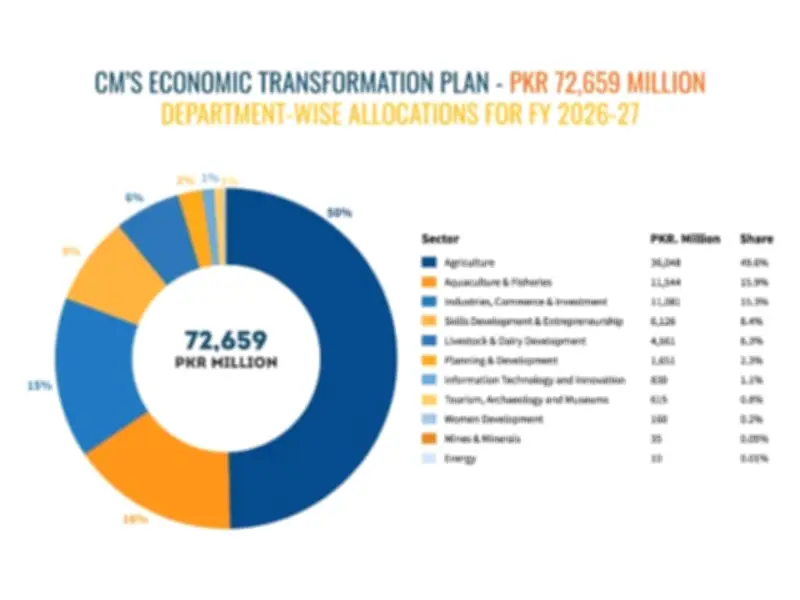
To fully utilise the potential of agriculture, livestock, and aquaculture sectors and transform them into key drivers of economic development, the government has allocated Rs132.54 billion for the upcoming fiscal year. Under the government's economic transformation initiatives for the next three years, Rs481 billion will be invested in agriculture value-addition, livestock value chain, and aquaculture sectors. This is expected to attract an additional Rs134 billion in private investment, bringing the total investment in these sectors to over Rs615 billion. This investment will create new opportunities for increased productivity, value-addition, exports, employment generation, and rural prosperity.
The Punjab chief minister's Herd Transformation to Enhance Livestock Productivity programme has been implemented at a cost of Rs5.20 billion to improve animal breeding and productivity. In the upcoming fiscal year, Rs4.44 billion has been allocated under Phase-II of the Livestock Card programme to provide interest-free loans to 300,000 livestock farmers. Additionally, under the Livestock Support Programme, Rs3.12 billion will be spent to distribute dairy animals among 10,000 rural women to strengthen household income and milk production.
Roads
Multiple road rehabilitation and maintenance projects are being implemented across Punjab in fiscal year 2025–26 at a total cost of Rs290 billion. In the current budget, Rs36 billion has been proposed for the completion of ongoing schemes. A new initiative for road infrastructure has been launched at a cost of Rs100 billion. Under this programme, construction, rehabilitation, and upgradation of roads will be carried out in various districts of the province.
Opposition Protest
As the budget speech started, opposition lawmakers assembled near the chair of the speaker, tore the budget books, and chanted slogans against the budget. Later, Opposition Leader Moin Riaz Qureshi completely rejected the provincial budget, describing it as an "anti-people and anti-farmer budget."
Addressing a press conference, Qureshi said the budget was nothing more than "a jugglery of words and numbers" and reflected the government's non-serious attitude toward addressing public issues. He termed the budget "ridiculous" and said it lacked any meaningful vision for economic development. Qureshi stressed that political stability was essential for economic growth, adding that the ongoing Iran-Israel conflict had already reshaped the global economic landscape. He reiterated that Pakistan could not move forward without political stability.
He further claimed that the entire leadership of the Pakistan Tehreek-e-Insaf (PTI) remained behind bars, while PTI founder Imran Khan had spent more than 1,000 days facing "political victimisation." The opposition leader also criticised the government's handling of the budget process. He said the opposition had requested printed copies of the budget during the Advisory Committee meeting, but the demand was ignored. According to him, the government distributed the budget on USB drives. Qureshi accused the government of excessive secrecy, questioning why every major decision was being kept confidential. Referring to the purchase of a government aircraft, he said the opposition had repeatedly asked under which budget allocation it had been acquired but had yet to receive any answer. He alleged that the current budget had also been kept secret and predicted that the government would be forced to introduce a supplementary budget within the next four months.