For the past four years, writing in these pages, I have argued that the economic crisis in Azad Jammu and Kashmir (AJK) must be understood through a political economy lens. The prevailing political settlement in AJK has major inadequacies that limit its ability to build productive economic sectors. In 2022, I provided a bird's-eye view of AJK's economic development. The numbers were grim then, and they have not improved: a labor force participation rate of just 22.9 percent, barely half the national average; a female participation rate of 7.9 percent against a national 23 percent; unemployment at 11 percent, twice the national figure; youth unemployment at 27 percent. Agriculture, the largest employer, received around one percent of the budget, and tourism remained a rounding error at 0.27 percent. The conclusion was that AJK was generating a growing reserve army of young unemployed people, and it has only gotten worse.
The 2024 Protests and Political Economy
In 2024, when mass protests erupted under the umbrella of the Joint Awami Action Committee (JAAC) across the territory's districts, I offered a political economy explanation of why a nationwide inflationary shock produced sustained mobilization in AJK. I argued that this movement was led not by traditional political parties but by grassroots action committees operating on a non-hierarchical basis in villages and markets. In 2025, as the ruling coalition in Islamabad engineered yet another political reshuffle in Muzaffarabad, our political economy analysis made it clear that no carousel of elites would restore legitimacy. This is because the crisis flows from two interlocking conditions: symbolic autonomy and economic exclusion. Elites in Muzaffarabad and Islamabad made no structural reforms in this regard, and pressure from below has grown, now arriving in its most formidable form.
Elite Response and the Grants Narrative
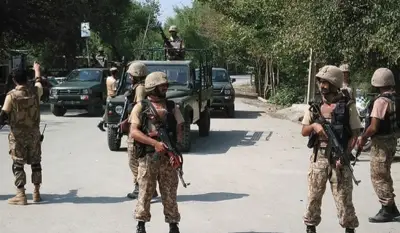
What has been the latest response from elites? A communications blackout and a brutal crackdown across AJK, with the loss of multiple lives, especially in Rawalakot. Instead of correcting course, a new narrative has been churned out: that the residents of AJK live on grants and subsidies from Islamabad. I underscore that this narrative does not reflect ground reality. Second, it will produce further alienation among the people of AJK. Let me deconstruct it based on facts and historical and political context.

Why Kashmir Is More Than an Identity Struggle
When Punjab or Sindh receives its NFC transfer, no one calls it a grant or a favor, and rightly so. It is true that when you open AJK's budget for fiscal year 2025–26, you will see that the largest single source of revenue is a grant from Islamabad. Against total revenue receipts of Rs260 billion, the government projected about Rs149 billion from what is officially called the Federal Variable Grant from Islamabad. It is more than half of all projected revenue, excluding capital receipts. The standard reading, without a deeper understanding of political economy, would lead to the conclusion that AJK cannot pay for itself. It would also suggest that it survives on Islamabad's grants, and therefore, the people of AJK should appreciate Islamabad's generosity rather than complain.
But here is the catch. Look closely at how every province is financed across Pakistan, and the word grant begins to look like a sleight of hand. Under Article 160 of the 1973 Constitution, the four provinces receive their money through the National Finance Commission Award, a constitutionally mandated formula that hands them the majority of the federal divisible pool. When Punjab or Sindh receives its NFC transfer, no one calls it a grant or a favor. It is their entitlement, protected by the Constitution, indexed by formula, and since the 18th Amendment, legally shielded against reduction. A province does not thank Islamabad for its NFC share any more than a worker thanks an employer for wages already earned. AJK receives nothing through this mechanism because of its disputed status, pending the unresolved Jammu and Kashmir question.

Fiscal Exclusion and Symbolic Autonomy
In simple terms, AJK sits outside the NFC framework entirely. The four provinces split the divisible pool among themselves; AJK is not a claimant. What it gets instead is a discretionary transfer that Islamabad is free to set, vary, delay, or condition, and which the official vocabulary refers to as a grant. The same flow of public money that is a right when it goes to a province becomes a favor when it goes to AJK. As a result, the four million people of AJK are recast not as rights-bearing citizens but as recipients of metropolitan generosity.
The variable in Federal Variable Grant is the giveaway. Provincial shares are fixed by formula, but AJK's share is variable, which is to say discretionary. A population whose money arrives as a favor can have that favor withdrawn. To state the obvious, a province negotiates with the federal government as a rights-holder. AJK is made to petition as a supplicant. The power asymmetry is obvious if one wants to see it. This is the fiscal face of what I have referred to as the contradiction of symbolic autonomy. AJK has its own president, prime minister, and legislative assembly, and its people prize that distinct identity. But the autonomy is heavily constrained and regulated by the Ministry of Kashmir Affairs. Unlike the residents of the four provinces, the people of AJK have no vote for the federal government, the National Assembly, or the Senate that decides their fate.
AJK does not need a more generous grant; it needs a fair, formula-based entitlement, and the local autonomy and federal support to invest in the sectors that can generate economic growth and employment for its people. The lived experience of AJK is a dialectic of being neither fully autonomous nor fully integrated. The grant is precisely how that in-between status (hybridity) is fiscally manifested. This in-between status does not just shape budgets; it shapes the consciousness and subjectivity of AJK's residents. Out of this hybridity grows a peculiar political subjectivity, unique to the residents of AJK. This identity has been one of the factors behind the successful political mobilization of its people across party and ideological lines.
Electricity Generation and Resource Extraction
If the grant framing obscures what is taken, the issue of electricity generation is even more stark. AJK hosts one of the great concentrations of hydropower in Pakistan, and almost all of this power flows into the national grid. AJK was, for years, paid a token water-use charge, as little as 15 paisa per unit, while Punjab and Khyber Pakhtunkhwa collected net hydel profit of more than a rupee per unit for power from their own dams. Only after sustained agitation was AJK's rate dragged towards parity at around Rs1.10 per unit. Here again, the entitlement-versus-favor pattern repeats itself. What the provinces receive as a settled right, AJK has to fight for, belatedly and partially, as a concession.
Political Representation and Elite Capture
Despite all their limitations, PML-N, PPP, PTI, MQM, and other mainstream parties do have their political bases and try to secure as much as possible for those bases within the constraints of an elite-centric political settlement across Pakistan. AJK's versions of these mainstream parties, including the Muslim Conference and JKPPP, are incapable of representing local aspirations because they know their route to power comes through elsewhere. This makes the crisis of representation worse in AJK vis-à-vis mainland Pakistan.
Now let's look at AJK's elites and their governance priorities. First, the political elites of AJK have mastered the art of leveraging the Kashmir conflict to keep state and political elites of Pakistan onside while pursuing their own governance agendas, or lack thereof, unchecked. Over 80 percent of AJK's budget goes to recurrent expenditure—salaries, pensions, and administration—leaving less than 20 percent for development. The productive sectors that could absorb AJK's reserve army of unemployed remain underdeveloped. Agriculture has not modernized; industrial production capacity is non-existent.
Human Cost of Exclusion
The human cost of this exclusion is written into the population's demographics themselves. AJK's male-to-female ratio is around 95 men for every 100 women, against a national average closer to 105. In districts such as Kotli, Bagh, and Poonch, it falls to 90, 91, and 92. These are AJK's missing men—not the disappeared of conflict, but working-class men compelled to emigrate for survival, leaving women to shoulder subsistence farming alongside unpaid care work. Remittances are the mainstay of AJK's economy, propping up Pakistan's foreign reserves at the macro level while fueling a consumption economy at home that generates no durable employment and accelerates brain drain. Unemployment in AJK stands at around 11 percent against a national 5 percent, with youth unemployment at 27 percent. A discretionary transfer designed to keep the administrative machine running was never going to build an economy out of this. It was designed to maintain a dependency, not to end one.
The JAAC Movement and a Way Forward
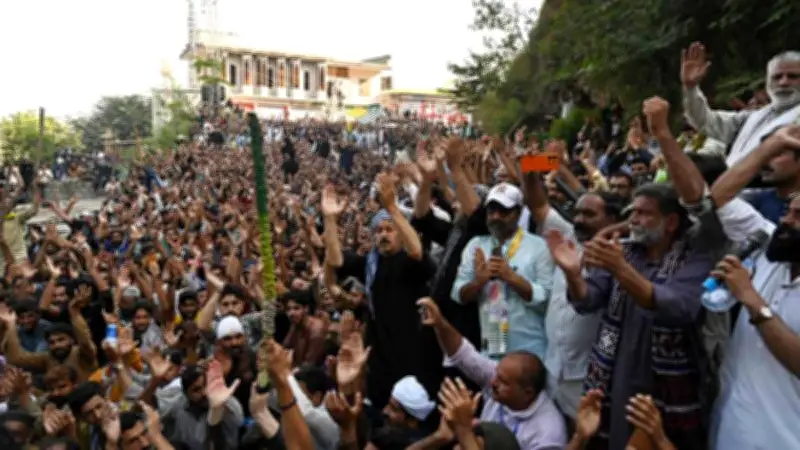
When we see this in totality, the picture is clear. AJK is denied its fair fiscal share and handed a discretionary substitute that funds little beyond the state's own upkeep. Its productive sectors, and with them the prospects of its young people, are left to wither. And the political machinery that might contest all this is itself captured, partly through the same discretionary money and partly through the political patronage networks of Islamabad. This is why the current political uprising, under the now-banned JAAC, succeeded where conventional politics could not. It is a movement organized through bazaar and district committees, demanding cheaper flour, electricity at generation cost, an end to elite privileges, and the abolition of seats reserved for voters outside AJK. The movement is, in effect, a de facto vote of no confidence in all of AJK's mainstream parties, whose politics of convenience and inability to imagine an alternative to patronage, neoliberalism, and opportunism have drained their legitimacy.
The way out of this crisis has not changed across these four years; it has only become more urgent. It requires what I have called a New Progressive Vision: democratizing AJK's bureaucratic structures; replacing elite perks with transparent, participatory, performance-based budgeting aligned with local priorities; guaranteeing universal access to basic public goods through public works in roads, bridges, and digital connectivity. It also requires promoting community-led development, cooperative farming, and State Bank-mandated affordable credit for small processing units, eco-industry, and tourism. But it begins with refusing the language of charity. AJK does not need a more generous grant; it needs a fair, formula-based entitlement, and the local autonomy and federal support to invest in the sectors that can generate economic growth and employment for its people. Islamabad faces the same simple choice: to remain wedded to the entrenched elites or to listen to the people of AJK. Until it chooses the latter, the conditions that produced the current political movement will remain in place.