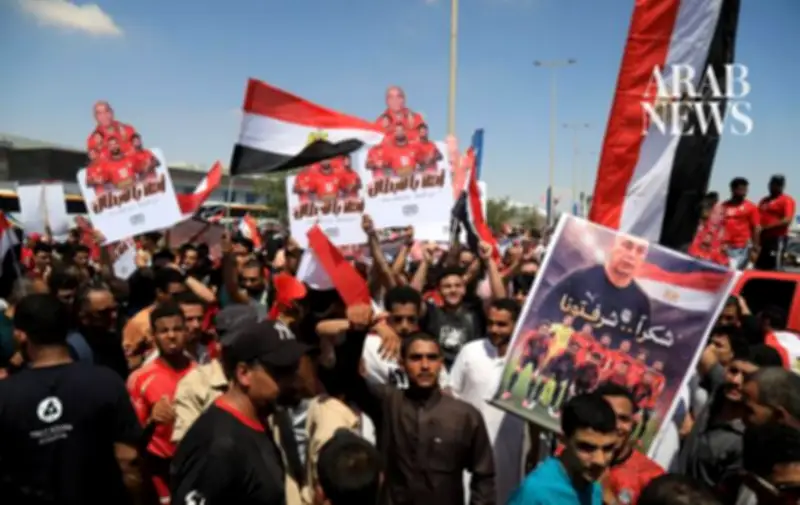
For a moment, it felt real. Egypt had been in control against defending champions Argentina for nearly 80 minutes, inching closer to uncharted territory: the final eight of the FIFA World Cup. In hindsight, Egyptian fans’ refusal to accept that their nation could see this through proved well-founded. Argentina managed to overturn a 2-0 deficit in 13 minutes to seal a 3-2 victory and progress to the quarter-finals. The result was marred by various controversies: the performance of referee Francois Letexier was severely called into question, the behaviour of the Argentinian fans toward Egypt was condemned, alongside the taunting of Palestine-supporting Hossam Hassan and the discriminatory treatment of Egyptian fans at the stadium entrance. But there is an avenue that went unnoticed throughout all the chaos. What does the future look like for Egypt after this historic World Cup campaign?
A New Approach Under Hossam Hassan
“I grew up watching the Golden Generation of the early 2000s,” said Egyptian fan Khaled Azzam. “Yet I sit here astonished — I don’t think I’ve ever seen anything like this in my life. This new approach to the national team being led by Hossam and Ibrahim Hassan — where they broaden the horizons and look for talent everywhere instead of relying on just the traditional names — has been great,” he added.
That new approach was highlighted by the excellent performances of three players: Emam Ashour, Haissem Hassan and Mostafa Zico. Had you read any Egypt preview before the tournament, finding anything that did not place Mohamed Salah and Omar Marmoush as the focal points of the team would have been a rare event. But the performances of this trio opened a new door to the future of Egyptian football.

Emam Ashour: Finding Focus
What is striking about the three is that each represents a different aspect of Egyptian football and culture. Ashour rose to prominence as one of the most talented players in Egyptian football before securing a move to giants Zamalek. A short spell in Europe at FC Midtjylland preceded one of the most controversial transfers in Egyptian football — to Zamalek’s fierce rivals Al-Ahly. Ashour’s career has long been riddled with disciplinary and attitude problems, which hindered his performances with the national team.
“I think what Hossam Hassan did with Emam Ashour is, he was able to calm him down and keep him settled,” Azzam told Arab News. “We have never seen Emam Ashour this focused. He never had a good relationship with the federation. They fined him frequently, suspended him often — and to be fair, some of those decisions were well-deserved — but now he seems to have settled down and come into his own,” he continued.
Mostafa Zico: Late Bloomer with Grit
Mostafa Zico came through the same path as Ashour — grinding through the lower divisions of Egyptian football. But unlike Ashour, he had to wait until 29 before earning a chance with the national team. His father passed away during his teenage years, prompting his older brother Mohamed to set aside his own football career to push Mostafa toward fulfilling his potential — all while they both worked at a clothes shop to support the family.
“A player with Zico’s background usually has to prioritize,” Azzam said. “They have to focus on taking care of the family in the present, as opposed to holding out for a move to a bigger club. Eventually that big move came and Hossam Hassan took notice. I really have to give credit to Hossam Hassan — that eye for talent is what sets him apart.”
Haissem Hassan: The Dual-National Dribbler
That same eye also brought in a player Egypt are not accustomed to having in the national team: one born and raised in France who spent most of his time in Spain. The man whose dribble against Argentina was heard around the world: Haissem Hassan. Known as one of the most dangerous dribblers in Europe during his time at Real Oviedo, he finally made his mark on the Pharaohs this summer.
“We’ve never really gone out and tried to find a player who is a dual national,” said Azzam. “The fact that he's 24 is also huge. It represents a different kind of shift, something you don’t often see in this national team. I think it can create a pipeline for the Egyptian national team going forward.”

Mohamed Salah's Promise and Fan Trust
That future is what hopeful Egyptian fans are looking forward to — a sentiment underscored by the man himself, Mohamed Salah. On Friday, the captain posted on X: “I know you’re still upset, but I promise you that I'll do everything in my power to ensure this marks a fresh start for Egyptian football on the international stage. Qualifying for the World Cup won’t be enough, and just participating won’t cut it either. This team deserves your trust.”
Evidently, the Pharaohs had gained the trust of their fans after a disappointing start to the year during which they suffered an underwhelming exit at AFCON 2025. While Egypt did reach the final four, it was their lack of attacking intent against Senegal in a 1-0 defeat that left fans with a bitter taste in their mouths. Azzam believes the World Cup changed that. “I think we saw an organized team, one with a plan and a defined style of play. They played with a lot of courage, heart and effort. And honestly? I’m so proud of this team,” he concluded.