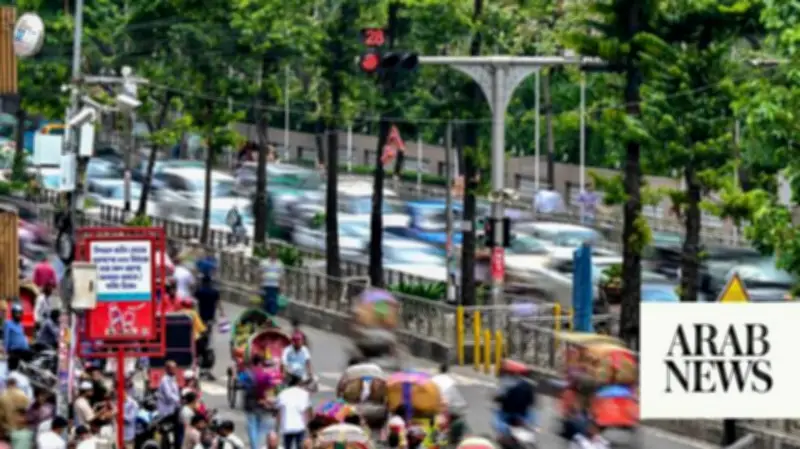
Bangladesh's capital Dhaka has launched a pilot AI-based traffic management system that is already showing signs of easing the city's notorious congestion. The system, which links traffic cameras to artificial intelligence software, has not only detected road-rule violations but also helped unclog some of the busiest intersections, according to police officials.
AI System Detects Five Types of Violations
The software, developed entirely in Bangladesh, can identify five categories of traffic offences: running red lights, blocking the left lane, driving on the wrong side, stopping in non-designated areas, and picking up or dropping off passengers randomly. Anisur Rahman, additional police commissioner for traffic at Dhaka Metropolitan Police, told Arab News that the system cost only around $50,000 to implement, with half spent on software development and the rest on server storage and cameras.
As part of the pilot, Automatic Number Plate Recognition (ANPR) and Pan-Tilt-Zoom (PTZ) cameras have been installed at seven major intersections. When an offence is detected, digital case files are created using footage as evidence, and notices are sent to the registered vehicle owner via SMS and post. However, the process is not yet fully automated—cases are reviewed manually to avoid errors, such as when a driver might be wrongly accused while facilitating pedestrian or auto-rickshaw movement.

Average Speed Increases from 4.2 km/h
Dhaka is widely regarded as one of the world's most traffic-congested cities, and a 2023 study by the US National Bureau of Economic Research labelled it the "slowest" city. According to Rahman, the average vehicle speed in 2024 was just 4.2 km per hour. Since the AI system's introduction, speeds have increased significantly—an improvement visible to the naked eye. The system operates as a semi-automatic traffic signal, with the ability to switch to manual mode and adjust signal timings as needed.
Police plan to expand the system to 60 camera installations across the city this year and double that number in 2025, aiming to bring the entire city under AI-based traffic management.
Driver Behavior Undergoes Major Shift
The most notable impact has been on driver mindset. Previously, drivers often ignored traffic signals, pedestrian crossings, and road signs, especially when no police were present. Now, they think twice before violating rules. Professional driver Abul Bashar told Arab News that many drivers were used to "free-style driving," but since the AI cameras were installed, they have become more cautious because the system records movements and can file cases without warning.
Ride-share driver Karimul Mawla noted that waiting times at signals have dropped from four to five minutes to two to three minutes, reducing ride completion times and slightly improving his daily earnings. "If a 10 km ride takes two hours, eventually it reduces my earnings," he said. The system has also reduced opportunities for bargaining with traffic officials, making enforcement more consistent.