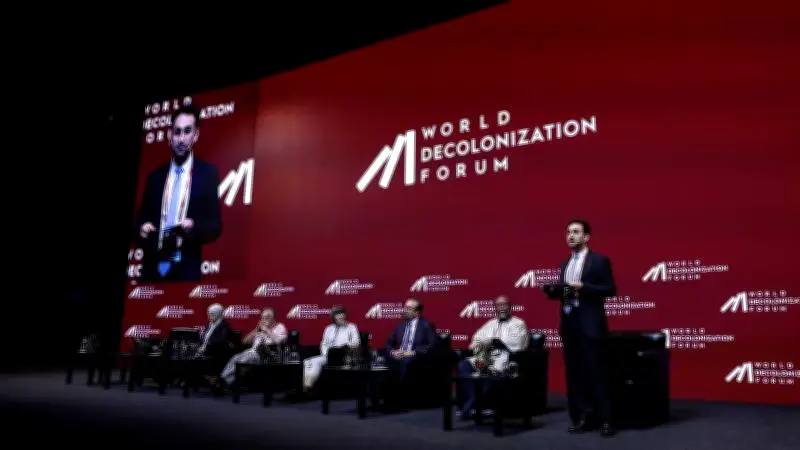
The World Decolonization Forum, held in Istanbul in May, highlighted that despite the withdrawal of colonial powers, the task of decolonizing education remains. This is significant, as Indian intellectual Pankaj Mishra argues that the most consequential event of the 20th century was not the world wars, the Cold War, or the collapse of communism, but rather decolonization. The authors of Decolonizing Economics, published last year, argue that this issue is long overdue in economics. Their approach challenges the Eurocentric foundations of economic theory. Economists Sam de Muijnck and Joris Tieleman contend that economics textbooks often sideline topics of racism, colonialism, exploitation, and unequal life chances. They call for decolonizing economics by including minority and global South voices that address these topics.
Decolonizing Economics in the Classroom
I incorporate such critical perspectives in my microeconomics and macroeconomics classes, as well as elective courses like Economics of Religion and Economics for Everyone. Here, I elaborate on how I decolonize economics in my classes. My understanding of decolonizing economics comes from distinguished global South economist Akmal Hussain, whose economic outlook is bolstered by politics, history, religion, philosophy, and folk poetry. He highlights the colonized minds of the elite who extract the nation's resources for conspicuous consumption. His solution is to connect with a folk cultural tradition that resists injustice and nurtures universal human solidarity. Accordingly, decolonizing economics is about shifting from an economy that benefits the elite to building the capabilities of the people.
Problematizing Economic Concepts
One way I decolonize economics is by problematizing economic concepts. My focus is on human welfare, not just numbers. In some cases, I provide a brief history of the Eurocentric origin of economic concepts. For instance, I challenge the principle that people face trade-offs or choices. Bonded labor in the global South and the precariat in advanced economies do not have meaningful choice. Economic freedom precedes freedom of choice. I also question the assumption of rationality. As Erik Angner argues, psychological stress diminishes the ability of the poor to process information and make good decisions. This explains why the working poor get trapped through fine print. We cannot expect everyday folks to behave as rationally as the privileged men who founded economic theory. David Ricardo was one of the wealthiest economists in history. He developed the case for free trade with the example of England and Portugal. But the role of British naval power in extracting advantageous terms of trade is ignored in textbooks. Economist Ha-Joon Chang uses the metaphor "kicking away the ladder," arguing that advanced economies preach free trade to the global South only after they gained technological superiority under protectionism.

Vilfredo Pareto was born into an aristocratic European family. There are concerns about his proximity to fascism, although the connection is problematized. I question his concept of Pareto optimality, which suggests that one cannot be made better off without making others worse off. As economist John Komlos argues, according to this criterion, slaves could not be emancipated without making the slave owners worse off. It paralyzes any action for change.

Highlighting Muslim Thinkers
Another way I decolonize economics is by highlighting the contributions of thinkers who have been sidelined in the history of economic thought. Economist Abdul Azim Islahi challenges Joseph Schumpeter's Great Gap thesis, which ignores the contribution of Muslim thinkers by jumping over 500 years from Greco-Roman economic thought to Christian scholastics with St. Thomas Aquinas. Islahi's work meticulously details many Muslim thinkers who were forerunners of economic concepts credited to European thinkers. For instance, al-Shafi'i (d. 820) said that while a poor man assigns great value to a dinar, a rich person may impute trivial value to hundreds of dinars. This idea of diminishing marginal utility was shared by many Muslim thinkers. Islamic thought attributes success to Allah beyond individual effort and prescribes that the poor share in the wealth of the rich. It emphasizes the idea that the rich are dependent on the poor for the purification of their wealth. As another example, Ibn Taymiyyah (d. 1328) rejected tampering with prices in the market. He recognized the role of increase in population or decrease in the supply of commodities, thus accepting the role of supply and demand. However, he allowed fixing prices under unjust behavior (exercise of market power).
Systems of Oppression
I also decolonize economics by assigning books that highlight systems of oppression. For instance, Jason Hickel's book The Divide shows that developing countries are not poor because of "backward cultural values" but because of an extractive global system. This includes financial assistance conditions of the International Monetary Fund (IMF). Hickel argues that more is extracted from the global South than they receive in foreign aid. Recently, social entrepreneur Muhammad Amjad Saqib published an anthology of stories that centers the voices of the oppressed. Like Hickel, he comes from the global South, rejects charity, and emphasizes agency and participation. He shifts the blame from individual failings to systems of oppression like compound interest and bonded labor. In a Canadian context, Carol Anne Hilton critiques the economic displacement of indigenous people in her book Indigenomics. She centers indigenous participation, values, and the indigenous sustainable economy. While presenting their book reviews, students go beyond customary land treaty acknowledgments. One student with origins from the DRC became passionate about Hickel's book, learning about the gruesome assassination of Patrice Lumumba. Another student wept while watching a video on minimum wage workers—it struck a chord. I feel accomplished when they engage with their books in the age of cellphones and social media. However, this is one approach among many to decolonize economics. Overall, students appreciate this approach, which rests on problematizing economic ideas, noting their Eurocentric roots, highlighting global South voices, and recognizing systems of oppression.