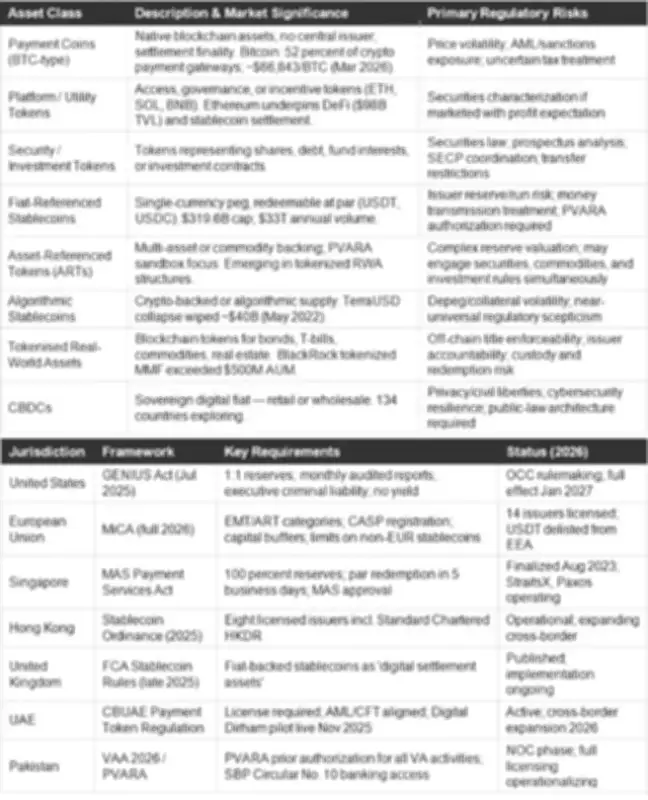
Ikram Sehgal: The global digital asset ecosystem has undergone a fundamental transformation. What began as a niche experiment in peer-to-peer electronic cash has matured into a $2.96 trillion asset class commanding the attention of sovereign states, multilateral institutions, and the world's largest financial intermediaries. Stablecoins alone moved $33 trillion in transaction volume during 2025 — surpassing Visa and Mastercard combined. Over 134 countries, representing 98 percent of global GDP, are actively developing or piloting Central Bank Digital Currencies. And 562 million people worldwide now hold some form of digital asset.
Pakistan's Legislative Shift
Against this backdrop, Pakistan's legislative pivot — from outright prohibition to structured, supervised integration — is not merely timely; it is strategically essential. The Virtual Assets Act, 2026 (VAA 2026) and PVARA represent the most consequential structural reform to Pakistan's financial-services architecture in over a decade. The SBP's BPRD Circular Letter No. 10 of 2026, authorizing regulated banks to onboard PVARA-licensed VASPs, operationalizes the framework and signals institutional resolve.
The Rise of Digital Assets
The digital asset ecosystem has traversed five structural phases: the proto-currency era (2009–2013), speculative bubble cycles (2014–2019), the DeFi and NFT explosion (2020–2022), institutional legitimization (2023–2024), and the current regulatory maturation phase (2025–present). The global market was valued at $2.96 trillion in 2025, projected to reach $7.98 trillion by 2030 at a 30 percent CAGR. Over 562 million people hold digital assets, surpassing PayPal and American Express in global user count. Institutional investment exceeded $52 billion in 2025; exchanges processed over $8.4 trillion in trades.

Institutional Adoption
The most significant structural shift of 2024–2026 is the unambiguous entry of institutional capital. Citigroup announced a Bitcoin and Ethereum custody service (October 2025); Fidelity launched an Ethereum-based institutional stablecoin (January 2025); BlackRock, Vanguard, and State Street activated Bitcoin ETF products. DeFi TVL reached $98 billion by mid-2025, up 22 percent year-on-year. The US GENIUS Act passed both chambers with rare bipartisan supermajorities; EU MiCA entered full enforcement in 2026. The convergence signal is unambiguous: licensed issuance, full reserves, enforceable redemption, and AML/CFT controls are now the global minimum standard — and Pakistan's VAA 2026 is structurally aligned with it.
The Stablecoin Revolution
No segment of the digital asset ecosystem has grown faster, or attracted more regulatory urgency, than stablecoins. The market expanded from $205 billion at the start of 2025 to $319.6 billion by April 2026 — a 56 percent increase in 16 months. Annual transfer volume reached $33 trillion, exceeding the combined settlement volume of the two largest global card networks. Tether (USDT) leads with $189.6 billion at a 60 percent share; USD Coin (USDC) holds $77.6 billion, up 73 percent in 2025. Together they represent 93 percent of total stablecoin market cap; 97 percent of issuance is USD-denominated. Usage extends beyond crypto trading: 15 percent of activity is cross-border remittances, 10 percent inflation hedging, and 5 percent merchant payments — all of direct relevance to Pakistan's $30–33 billion annual remittance economy. The rapid growth of stablecoins has precipitated an equally rapid legislative response. Global frameworks have converged on a common core — licensed issuance, full reserve backing, enforceable par redemption, and AML/CFT controls — constituting the emerging international standard against which Pakistan's own framework will be benchmarked.

Central Bank Digital Currencies
CBDCs represent the state's answer to the stablecoin challenge: sovereign digital fiat carrying the full faith and credit of the sovereign, not a private issuer's promise. Per BIS 2026 data, over 135 countries are exploring CBDCs; 77 are in advanced development, pilot, or launch phases. Every G20 country except the United States is engaged; 14 are in active pilots. Only three have fully launched — the Bahamas (Sand Dollar), Nigeria (eNaira), and Jamaica (JAM-DEX). China's e-CNY has processed $250 billion in transactions; India's e-Rupee reached Rs 1,016 crore in circulation by March 2025; Brazil launched DREX in January 2025; and the UAE's Digital Dirham pilot went live in November 2025 on the mBridge multi-CBDC platform. The mBridge project — co-developed by the central banks of the UAE, China, Hong Kong, and Thailand — carries direct strategic significance for Pakistan. With over 3.5 million Pakistanis in the GCC, Pakistan's decision on CBDC architecture — domestic digital rupee, multilateral corridor participation, or PVARA-licensed stablecoin intermediaries — will have first-order balance-of-payments consequences and warrants urgent SBP analysis.
Digital Asset Taxonomy
Under Section 3(xxxi) of VAA 2026, a Virtual Asset is a digital representation of value that can be digitally traded, transferred, or used for payment or investment. This function-over-form approach mirrors the FATF standard replicated in MiCA, the GENIUS Act, and Singapore's MAS framework. Regulatory treatment turns not on a token's label but on its economic function — issuance, custody, transfer, exchange, redemption, investment return, governance rights, and user reliance on an issuer or intermediary.
Pakistan's Strategic Opportunity and Systemic Risks
Pakistan ranked in the global top-10 for grassroots crypto adoption despite the prior prohibition — quantifying the shadow economy PVARA must now formalize. On Pakistan's $30–33 billion annual remittance base, stablecoin rails delivering T+0 settlement at sub-$1 fees versus the conventional 6–8 percent cost on South Asian corridors would retain $600 million–$1 billion per annum in the domestic economy. Approximately 100 million Pakistani adults remain unbanked; mobile-first digital asset infrastructure offers a credible inclusion pathway that branch-banking has not delivered. Pakistan's IT exports crossed $3.2 billion in FY2024, and a regulated VA ecosystem creates adjacent revenue through VASP licensing fees, blockchain services, and Bitcoin mining on surplus electricity. The systemic risks are equally real. Widespread USD-stablecoin adoption may erode PKR monetary transmission, mirroring informal dollarization in Argentina, Turkey, and Lebanon. Without real-time PVARA–SBP–FBR data-sharing, fiat-to-crypto ramps can bypass Foreign Exchange Regulations and drain reserves through non-custodial wallets. Chain-hopping and privacy coins present AML/CFT evasion vectors beyond conventional monitoring. And fraudsters increasingly convert illicit funds into virtual assets at the first or second layer, making recovery exponentially harder. These risks are manageable — but only with the dedicated supervisory infrastructure the six-pillar framework in Part II is designed to deliver.