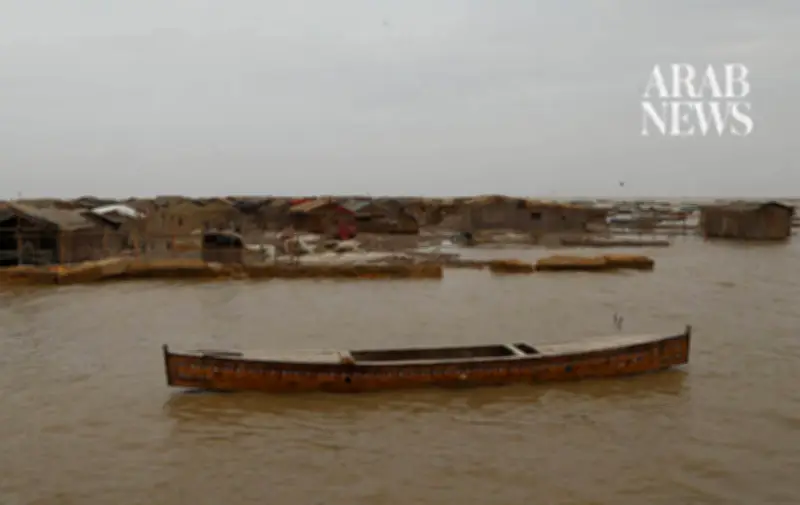
Every heavy rain in Badin, Sindh, revives the same fear for Mariyam: another flood could destroy the fragile life she rebuilt after Pakistan’s devastating 2022 monsoon. The 35-year-old farmer lost her house and four animals in that disaster. Now, as the 2026 monsoon intensifies, she fears losing even the little she has, including a goat bought with borrowed money.
Constant Fear of Embankment Breaches
“I am very afraid. I feel very helpless. I have small children, and we live in constant fear,” Mariyam told Arab News. “We just bought a small goat with a loan. If anything happens to it, I will be left in debt.”
Mariyam’s fears are shared across Badin, a flood-prone district where low-lying villages are vulnerable to heavy rains and embankment breaches along the Left Bank Outfall Drain (LBOD). This drainage system carries excess water from farmland but often overflows.

Deadly Monsoon Season
This year’s monsoon has already turned deadly. The National Disaster Management Authority (NDMA) reports that since June 26, rain-related incidents have killed at least 23 people, injured 90, damaged 115 houses, and killed 163 animals across Pakistan.
The government’s Emergency Response Committee warned that “shrinking glaciers and increasing droughts/dry monsoon in most part of Pakistan are likely to trigger stress situation for agriculture sector leading to gross food security hazard.”
Agriculture at Risk
Agriculture contributes 23 percent to Pakistan’s GDP, but the sector faces increasing climate shocks. The Economic Survey 2025-26 shows that five major crops grew only 0.7 percent last fiscal year, while cotton and maize production fell by 3 percent and 0.5 percent, respectively.
For Mariyam, the greatest fear is the drainage system overflowing. “If the embankment breaches, our village will be flooded and our home will be damaged,” she said. Her house is still not fully rebuilt. “We are poor and work as daily wage laborers. We struggle to keep a roof over our heads and food on the table.”
Cycle of Destruction
Other residents describe the same cycle. Neelam, a 30-year-old farmer from Hajji Ali Muhammad Khoso village, said repeated flooding destroys farmland, kills livestock, and deepens poverty. She and her husband Mevo have planted rice on two acres. “The floods hit us, ruin our agricultural land and kill our animals. The losses are huge,” she said.
Mevo, 35, said floodwaters regularly submerge entire fields. “The floods hit here and submerge all the land. They don’t leave any space on this land dry.”
Shepherd Muhammad Urs, 40, from Hajji Khaskheli village, owns 70 cows and 120 sheep and goats. “When it rains, we move our animals into tents. But if a storm strikes, the tents can collapse and the animals die. Sometimes, by the grace of Allah Almighty, they survive.” He added, “We did not lose any animals during the most recent floods, but we suffered heavy losses in the floods of 2011 and 2022.”
Infrastructure Needs
Development workers say vulnerability stems from poverty and inadequate flood protection. Zareen, a human resource development officer at the Sind Rural Support Organization (SRSO), said reinforcing LBOD embankments is urgent. “The most difficult thing for them is that their riverbanks should be made concrete and stronger. When the drain is full, the flood water flows into the village.”
SRSO is preparing a new German-backed project through GIZ for flood-affected communities, though details remain unclear.
For Mariyam, long-term plans offer little comfort. “I appeal to the government to repair this embankment,” she said. “We need assistance to rebuild our home, or financial support to start a small business so that we can provide for our children.”