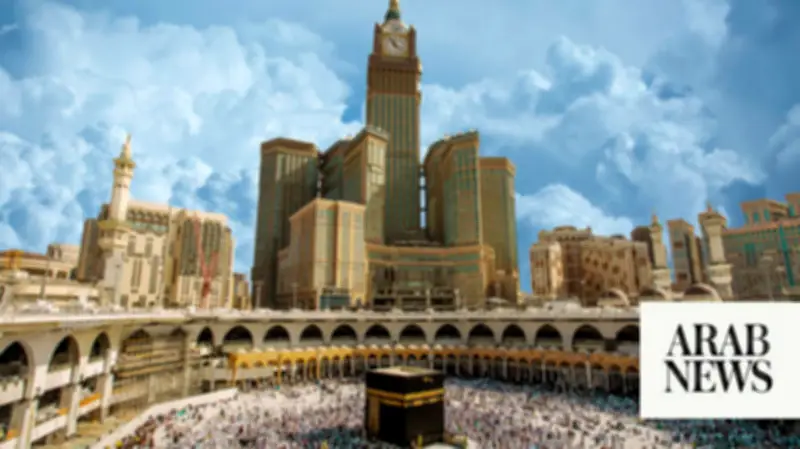
Makkah and Madinah's hospitality sectors demonstrated resilience in early 2026, weathering regional travel disruptions as the Kingdom continues to expand accommodation capacity for religious visitors, according to Knight Frank.
Strong Hotel Performance in Holy Cities
The consultancy's Saudi Hospitality and Religious Tourism Report found that Makkah remained the Kingdom's strongest-performing hotel market during the first four months of the year, recording average daily room rates of SR775 ($209) and annual revenue per available room growth of 4.7 percent. Madinah also maintained strong performance, with occupancy averaging 76 percent and room rates rising 2.7 percent year on year.
Vision 2030 Driving Religious Tourism Investment
The findings come as Saudi Arabia accelerates efforts to position religious tourism as a key pillar of its Vision 2030 economic diversification strategy. The Kingdom is investing heavily in hotel, transport and real estate infrastructure in Makkah and Madinah to accommodate rising numbers of Hajj and Umrah pilgrims, while also opening new opportunities for private and foreign investment in the hospitality sector.

Knight Frank said more than 105,225 hotel rooms are currently under construction or in advanced planning stages across the Kingdom, which would increase total hotel inventory from 176,260 rooms to more than 281,500 by 2030.
Regulatory Reforms Attract International Investors
“The Holy Cities have long benefited from strong underlying demand, but recent regulatory reforms are creating new opportunities for international investors to participate in their long-term growth story,” Amar Hussain, associate partner for research in the Middle East and North Africa at Knight Frank, told Arab News, adding: “This is likely to become an increasingly important driver of investment activity over the coming decade.”
Religious tourism continues to underpin much of that growth. The report found that 1.71 million pilgrims performed Hajj in 2026, up 2.2 percent from a year earlier, with pilgrims arriving from 165 countries. International pilgrims accounted for approximately 1.55 million of the total, with Indonesia, Pakistan, India, Bangladesh and Nigeria remaining the largest source markets.
Major Developments Underway
The report also showed that more than 218,000 hotel rooms, branded residences and serviced apartments are planned across major developments in Makkah and Madinah, including Rua Al Haram, Rua Al Madinah, and Dar Al Hijrah Pilgrim City, as well as Knowledge Economic City, Masar Makkah and Thakher Makkah.
Saudi Arabia welcomed 37.2 million domestic and international visitors during the first quarter of 2026, while visitor spending reached SR82.7 billion, according to the analysis. Domestic tourism remained the primary growth driver, with visitor numbers rising 16 percent year on year to 28.9 million and spending increasing 8 percent to SR34.7 billion.
Tourism Sector Contribution to GDP
The report said the travel and tourism sector contributed $178 billion to Saudi Arabia's gross domestic product in 2025, accounting for about 46 percent of the Middle East's tourism economy. Tourism GDP expanded by 7.4 percent during the year, outperforming both the regional average of 5.3 percent and the global average of 4.1 percent. The Kingdom welcomed approximately 123 million domestic and international tourists in 2025, up 6 percent from 2024, according to a recent Ministry of Tourism report.
Faisal Durrani, partner and head of research for MENA at Knight Frank, said the Kingdom's hospitality market is entering a new phase of development. “The market is entering a new phase where product diversification will become increasingly important,” Durrani said. He noted that more than half of the future hotel pipeline is concentrated in luxury and upper-upscale properties, creating an opportunity to expand midscale and budget accommodation as demand increasingly comes from domestic travelers, regional visitors and religious tourists.

Mixed Performance Across Saudi Hospitality
Performance across Saudi Arabia's hospitality sector was mixed. While the Holy Cities continued to benefit from strong pilgrimage demand, Riyadh's hotel market experienced softer conditions as new supply entered the market and business travel slowed amid regional geopolitical tensions. According to Knight Frank, hotel occupancy in the capital fell 17.9 percent year on year to 49.3 percent during the first four months of 2026, while revenue per available room declined 18.3 percent.
Despite those near-term pressures, the consultancy said the long-term outlook for Saudi Arabia's hospitality sector remains positive, supported by continued government spending, major infrastructure projects, airport expansion programs and the launch of Riyadh Air. Recent reforms allowing greater foreign participation in property investment are expected to attract additional international capital into Makkah and Madinah, supporting the expansion of hospitality capacity as the Kingdom works toward its goal of welcoming 30 million Hajj and Umrah pilgrims annually by 2030.