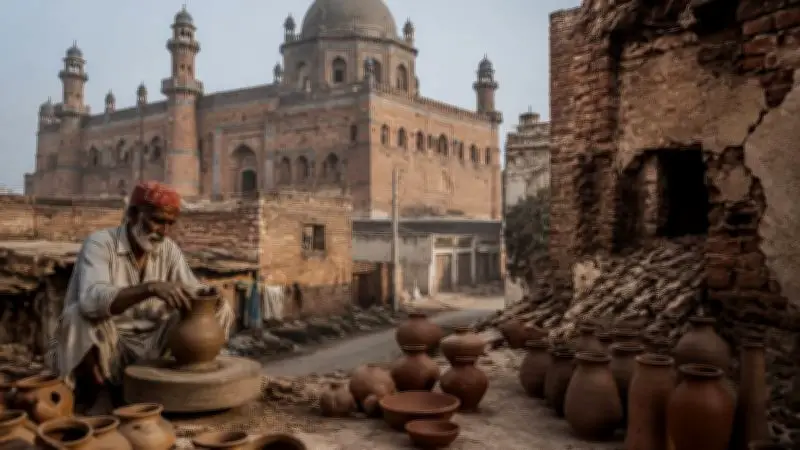
The distinctive blue associated with Multan appears on shrine tiles, ceramic vessels, decorative panels, and household objects, carrying the memory of a city shaped by trade, spirituality, migration, and craftsmanship. Multan has long been known as a city of saints, but it is also a city of makers. Its blue pottery and Kashigari traditions form an important part of Pakistan’s cultural inheritance, linking southern Punjab to wider artistic movements across Persia, Iran, Central Asia, China, and the subcontinent.
The Depth Beyond Decoration
Multani blue pottery is often admired for its surface beauty: turquoise glazes, floral patterns, geometric discipline, and a visual softness that makes the work instantly recognisable. Yet to see it only as decoration is to miss its deeper value. It is a technical and cultural practice involving clay preparation, drying, drawing, glazing, firing, and finishing. Each stage requires patience and correction. A line that looks effortless may be the result of years of training.
Challenges in the Modern Market
Craft revival must go beyond individual success stories. It needs documentation, design education, artisan recognition, export support, fair compensation, and serious cultural journalism. This is why the future of Pakistan’s craft traditions cannot be discussed only in terms of nostalgia. The question is not whether these traditions are beautiful—they clearly are. The more difficult question is whether they can survive as living practices in a market that often rewards speed, cheap reproduction, and decorative consumption.

Nauman Mirza: Bridging Tradition and Contemporary Design
It is within this context that the work of Nauman Mirza becomes relevant. His practice draws from the discipline of traditional blue pottery workshops and the Ustad-Shagird model through which many South Asian arts have historically been transmitted. This is not merely a romantic apprenticeship system. At its best, it is a demanding method of learning through observation, repetition, and correction. It teaches the hand, the eye, and the temperament of the material. His vessels, panels, and lighting pieces carry the familiar language of Multani craft: controlled borders, floral motifs, balanced arrangements, and shades of blue that remain connected to the region’s ceramic identity. But his work is most interesting when it moves beyond repetition. Rather than treating tradition as a fixed pattern book, he attempts to place it in contemporary exhibition and design settings. A vessel is not presented only as a vessel.
Balancing Preservation and Innovation
This balance is important. Traditional craft can easily be weakened in two opposite ways. It can be frozen in the name of preservation, becoming distant from younger audiences. Or it can be over-modernised until it loses the discipline and cultural memory that gave it meaning. Pakistan’s wider craft landscape faces similar challenges. The country has extraordinary traditions: Sindhi Ajrak, Chiniot woodwork, Balochi embroidery, camel-skin lamps, Swati carving, Kashmiri shawls, truck art, miniature painting, calligraphy, and ralli quilts. These are not minor decorative practices. They are regional archives of memory, skill, and identity. Yet many remain dependent on scattered patronage, seasonal exhibitions, and uncertain markets. The artisan is praised in speeches, but often remains economically vulnerable.

Institutional Efforts and Workshop Traditions
Public institutions have made some efforts to address this gap. In Punjab, TEVTA’s work in technical and vocational training, including its blue pottery-related training and display initiatives in Multan and elsewhere, is part of an attempt to keep traditional skills connected to livelihood. Such programmes matter because craft traditions decline when young people no longer see a future in them. Training centres, display spaces, and market linkages cannot solve every problem, but they can help create pathways for new artisans and bring some structure to skills that might otherwise remain unsupported. There are also long-standing workshops and craft families that continue to sustain Multani ceramics through practice rather than publicity. Names associated with older workshop traditions, including those linked to Ustad Alam and Manzoor Blue Pottery, have helped keep the craft visible across generations. Alongside them, newer sellers, design studios, and online platforms are taking blue pottery into urban homes and, in some cases, international markets.
Responsibility of Artists and Designers
This is where artists and designers working with craft have a responsibility. They must not treat artisans as anonymous labour or tradition as a visual resource to be borrowed without context. The strongest contemporary craft practice is collaborative and transparent. It recognises the workshop as a place of knowledge, not just production. Mirza’s emphasis on process—clay preparation, glazing, drying, and firing—is valuable for precisely this reason. It reminds the viewer that craft is not simply handmade beauty. Tradition does not always have to remain tied to every old material practice. If the visual language and cultural reference can be preserved while responding to modern concerns about animal welfare and sustainability, then innovation can become a form of respect.
International Market Opportunities and Pressures
The international market offers both opportunity and pressure. In Europe and other design-conscious markets, there is growing interest in handmade, sustainable, and culturally rooted objects. Pakistani crafts have the qualities such markets often value: provenance, visual distinctiveness, regional identity, and human skill. But access to these markets requires more than beauty. It requires consistent quality, safe packaging, documentation, fair pricing, reliable delivery, and credible storytelling. A fragile ceramic object cannot succeed abroad only because it is traditional; it must also meet professional standards. For Pakistan, this means craft revival must go beyond individual success stories. It needs documentation, design education, artisan recognition, export support, fair compensation, and serious cultural journalism. Art schools and design institutions should engage more deeply with regional crafts. Government bodies should support training and market access. Private galleries and collectors should treat craft as serious cultural work, not secondary art. International exhibitions should present Pakistani craft with the same care given to contemporary painting or sculpture.
The Enduring Blue of Multan
The blue of Multan has survived for centuries because it is more than pigment. It is discipline, memory, and imagination fired into form. If Pakistan wants its craft heritage to remain alive, it must avoid both neglect and shallow celebration. These traditions need markets, but they also need dignity. They need innovation, but also continuity. They need artists, artisans, institutions, and audiences willing to see them not as relics of the past, but as part of the country’s creative future.