Punjab's 2026-27 budget allocates Rs 8,895,756,000 for the Irrigation Department's repairs and maintenance, a sum that represents only one-tenth of the Rs 80-160 billion annual lifecycle investment needed to preserve a Rs 4 trillion public asset, according to accepted engineering practice. This underinvestment in asset preservation, buried within the budget, threatens the reliability of one of the world's largest contiguous irrigation systems, which includes 13 barrages, 25 main canals, 13 inter-river link canals, and thousands of kilometres of distributaries.
Neglected Infrastructure: Signs of Deterioration
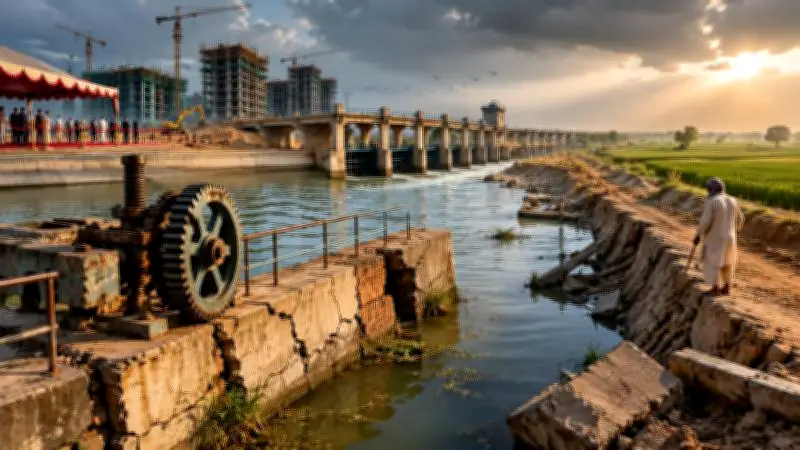
Walk along any distributary in Punjab, and the evidence of neglect is visible: cracked canal linings, vegetation forcing through masonry joints, gates that no longer close properly, inspection roads washed away by previous floods, and silt slowly reducing carrying capacity. None of these defects make the evening news, but collectively they determine whether millions of acres receive water when needed. The system is not merely another government department; it is a portfolio of public assets accumulated over more than a century, with an estimated replacement value of Rs 4 trillion after accounting for inflation in steel, cement, machinery, fuel, transport, and labour.
The Arithmetic of Asset Preservation
Accepted engineering practice for mature hydraulic infrastructure typically requires annual expenditure of 2 to 4 per cent of current replacement value on asset preservation and preventive upkeep. For Punjab's irrigation system, that translates into Rs 80-160 billion annually. The province has allocated about Rs 8.9 billion. This gap represents a form of infrastructure debt: every year that asset preservation is deferred does not eliminate a liability but converts it into a larger future obligation. Governments appear to save money today while quietly increasing tomorrow's bill.

Political Economy of Underinvestment
Governments underinvest in asset preservation not because they dislike engineers, but because preserving existing assets has almost no political constituency. Voters see new projects, not the repairs that prevent disasters. Political rewards flow towards new construction, while asset preservation competes for whatever money remains after ribbon-cutting projects are funded. This political economy explains why lifecycle investment is often the first casualty of fiscal restraint. What appears to be a saving in one year's budget is frequently a transfer of costs into future years, where deteriorated infrastructure demands far more expensive rehabilitation or complete replacement.
Post-Flood Vulnerabilities
The budget allocation is particularly concerning after a year of devastating floods that imposed extraordinary stresses on the irrigation system. Floodwaters scoured foundations, weakened embankments, damaged canal linings, and undermined hydraulic structures. Every engineer knows that the years immediately following major floods require increased inspection and preventive upkeep. Instead of increasing investment, Punjab has budgeted Rs 8.9 billion against an engineering requirement of Rs 80-160 billion. Deferred asset preservation is not fiscal prudence; it is infrastructure debt that does not appear on the government's balance sheet.
Stewardship vs. Creation
Good governments measure success not only by the assets they create but also by how responsibly they preserve the assets they inherit. The Punjab budget tells us that the province remains willing to invest billions in creating new infrastructure but only a fraction of what prudent engineering practice suggests is necessary to preserve the infrastructure it already owns. Every canal breach begins long before the water escapes—with an asset preservation budget that was never approved, a repair that was postponed, an embankment left unattended, and a belief that public infrastructure can somehow preserve itself. The future of Punjab's irrigation system will be decided in the budgets for asset preservation that attract no cameras, no ceremonies, and almost no public debate.