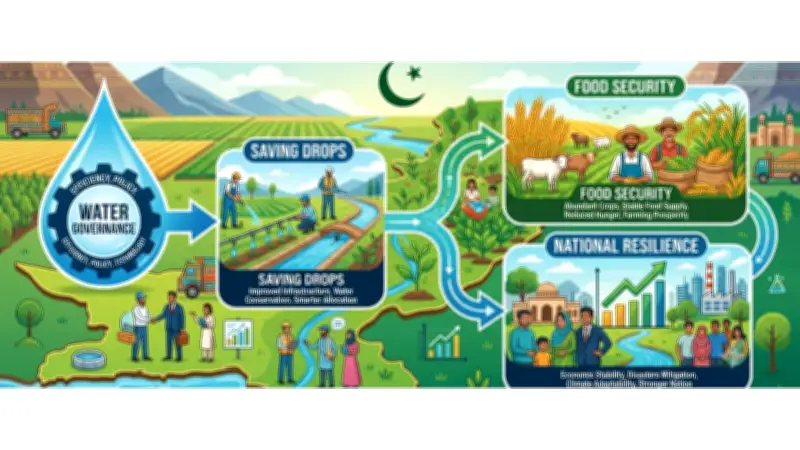
The World Bank's Global Water Monitoring Report 2025 has placed Pakistan at the center of a global freshwater emergency, highlighting the country's inefficient use of agricultural water as a key factor in continental drying. The report warns that 324 billion cubic meters of freshwater are being lost annually worldwide, with Pakistan's Indus Basin irrigation system—once a celebrated lifeline—now faltering due to sedimentation, outdated practices, and inequitable distribution.
Pakistan's Water Crisis: A Political Challenge
According to the report, Pakistan's water crisis is not merely a technological issue but a deeply political challenge requiring urgent reform. The report aims to spotlight inefficiencies and propose solutions, but questions remain about why Pakistan is being singled out when similar inefficiencies exist across South Asia. Some critics argue that the emphasis on agricultural waste may push the country toward expensive modernization projects that benefit contractors more than communities.
The report proposes strategies of managing demand, augmenting supply, and improving allocation, but there are concerns that these may reinforce elite control over scarce resources rather than ensure equitable reforms. Water policy in Pakistan has often been shaped by short-term political agendas, leaving ordinary farmers and rural communities vulnerable.

Comparative Lessons from Around the World
Comparative examples underscore the urgency of Pakistan's predicament. California's groundwater depletion demonstrates how unchecked agricultural demand can destabilize economies, while the collapse of the Aral Sea warns against over-extraction. In contrast, India's participatory groundwater management shows how community-led monitoring can slow depletion, and Morocco's adoption of drip irrigation has improved yields while conserving water. Pakistan's continued reliance on flood irrigation, where more than half of the water is wasted, stands in stark contrast.
The lesson is clear: Pakistan's crisis is not inevitable but results from policy inertia and misplaced priorities. Countries that invested in transparent monitoring and innovative practices have adapted, while those relying on ad hoc crisis responses have suffered ecological and social collapse.
Challenges and Solutions
Agriculture consumes more than 90 percent of Pakistan's freshwater, yet inefficiency drains billions from the economy. Rural farmers, especially smallholders, lack access to modern irrigation technologies, deepening inequality. Legal and institutional frameworks remain fragmented, with provincial disputes undermining national water governance. Sedimentation reduces storage capacity, and groundwater extraction remains largely unchecked.
The World Bank warns that without intervention, freshwater decline will disrupt jobs and ecosystems globally. For Pakistan, this means food insecurity, rural poverty, and heightened risk of conflict. Solutions must move beyond rhetoric: modernizing irrigation from flood to drip and sprinkler systems, supported by subsidies and training; strengthening community stewardship through local water-user associations; prioritizing nature-based solutions like wetland restoration and aquifer recharge; and adopting satellite-based monitoring with public data access.
Regional and Policy Imperatives
At the regional level, dialogue with India under the Indus Waters Treaty must be revitalized to address climate-induced variability. Successful models include Singapore's integrated water recycling, Morocco's drip irrigation, and Australia's transparent water accounting. Pakistan's inclusion in the World Bank report is both a warning and an opportunity. Continental drying is already reshaping Pakistan's agriculture, economy, and society. The path forward requires governance reforms, community-led stewardship, and modern irrigation practices to avert catastrophe.
If freshwater decline continues unchecked, the economic and social costs will far exceed investments required today. Pakistan's water crisis is solvable, but only if policymakers act decisively. Continental drying should not define Pakistan's future; instead, it must serve as a catalyst for sustainable water governance that secures livelihoods and strengthens resilience.