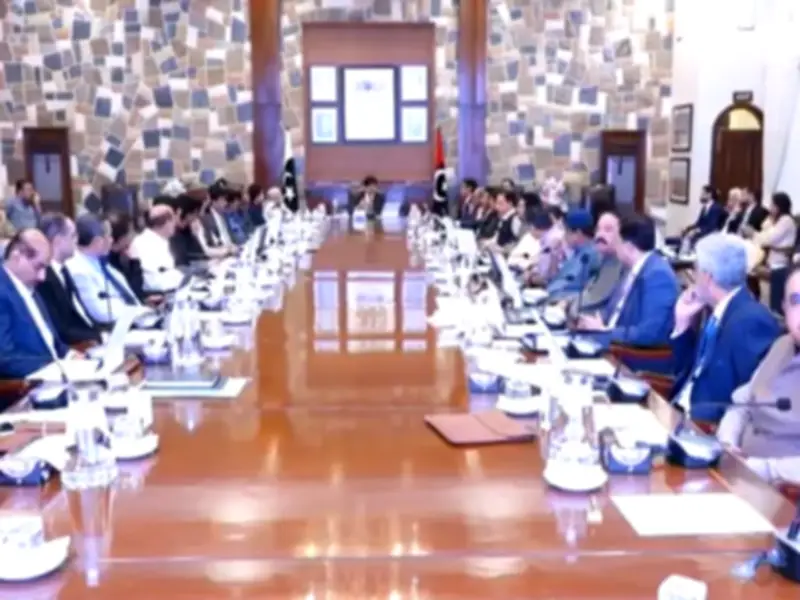
The Sindh cabinet on Wednesday approved the provincial budget for the 2026-27 financial year, which Chief Minister Murad Ali Shah will present during the provincial assembly’s budget session later in the day. According to a statement issued by the Chief Minister’s House, CM Murad chaired the provincial cabinet’s budget meeting, attended by provincial ministers, advisers, special assistants, the chief secretary, secretaries and senior officials.
“The cabinet approved the Sindh Budget 2026-27, reaffirming its commitment to inclusive development, poverty reduction and public welfare. Special measures have been introduced under the guidance of Chairman Bilawal Bhutto Zardari, including support for workers through an increase in the minimum wage,” the statement said.
According to Chief Minister’s Spokesperson Abdul Rasheed Channa, the cabinet also praised CM Murad’s efforts to carry out record development work during the current 2025-26 financial year. “We will continue to serve the people under the guidance of the PPP leadership. God willing, we will undertake even more work for the people of Sindh in the new financial year,” CM Murad said.

The chief minister said the new budget had been prepared with the interests of all sections of society in mind, adding that the provincial government was taking special measures to reduce poverty under the direction of PPP Chairman Bilawal Bhutto Zardari. CM Murad said the provincial government had also decided to increase the minimum wage for workers in the new budget.
The cabinet meeting also highlighted that education and health remain top priorities in the development agenda. According to the CM House, for the education sector, Rs50.12 billion had been allocated under the development programme, while the health sector had been allocated Rs38.89 billion, with multiple ongoing schemes included.
According to the details shared by the Public Sector Development Programme (PSDP), the total development outlay for Sindh for 2026–27 had been set at over Rs656 billion. Of this total, Rs641 billion has been allocated for the Provincial Development Programme, while Rs15 billion has been earmarked for district development schemes across the province. The development portfolio includes 3,715 ongoing development schemes, reflecting continuity of existing infrastructure and social sector projects.
For ongoing development initiatives, more than Rs350 billion had been allocated, while Rs34.58 billion had been set aside for transferred and unapproved schemes. Under foreign project assistance (FPA), an allocation of over Rs256 billion had been included. For targeted regional uplift, Rs1 billion has been proposed for the socio-economic development of the Katcha areas, while Rs250 million has been earmarked for special development initiatives in underdeveloped districts.
Within the education allocations, Rs38.21 billion has been specifically earmarked for School Education and Literacy. In addition, substantial funds have been proposed for colleges, universities, and technical education projects across the province. Other major departmental allocations include Rs9.22 billion for the finance department development projects, Rs6.30 billion for the home department, and Rs5.18 billion for energy sector development projects.
In the agriculture, supply and price control sector, Rs4.90 billion has been proposed under the development programme. Culture, tourism and archaeology projects have been allocated Rs2.78 billion, forestry and wildlife Rs2.39 billion, environmental protection, climate change and coastal development Rs541 million, and food department development schemes Rs101 million.

The agriculture sector development programme alone included 31 development schemes with a total allocation of Rs4.9 billion, focusing on agricultural productivity, modernisation, mechanisation, water management and improvement of agricultural markets across the province. Within the agriculture sector breakdown, Rs4.899 billion has been allocated for the Agriculture, Supply and Prices Department. This includes 9 projects worth Rs656.7 million for agricultural extension, 3 projects worth Rs1.319 billion for agricultural marketing, and 5 projects worth Rs709.6 million for agricultural mechanisation. Furthermore, Rs255.2 million has been allocated for agricultural research, while Rs1.884 billion has been earmarked for agricultural water management projects. In addition, Rs3.07 million has been allocated for supply, prices, weights and measures projects, and Rs4.38 million for agricultural training and research initiatives.
Around Rs14.11 billion has been proposed for 25 ongoing mega development schemes in Karachi. These projects fall under the Local Government, Housing and Town Planning departments, where work is currently underway. An additional Rs6.94 billion has been suggested for 17 unapproved ongoing projects, while Rs7.17 billion is proposed for 8 carry-forward schemes in the city. The total throw-forward volume of Karachi’s mega development projects stands at Rs35.81 billion, according to official figures. The development programme for 2026–27 prioritises Karachi’s infrastructure projects, with a focus on improving urban facilities and accelerating work on major schemes.