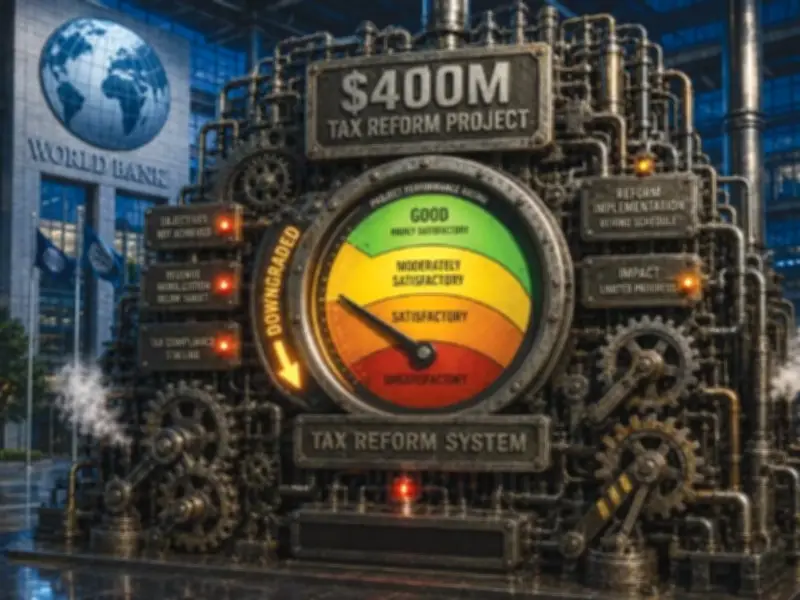
The World Bank has downgraded the $400 million Pakistan Raises Revenue programme to "moderately satisfactory" due to slow progress towards achieving even the downwardly revised goals of enhancing revenues and simplifying the tax system. The Washington-based lender's decision to downgrade the loan programme by a notch once again underscores that increasing taxes and facilitating taxpayers does not require any foreign funding and advisory; rather, it takes strong political will and administration.
Programme Performance and Goals
"Overall progress towards the project development objectives is moderately satisfactory," reads the Implementation Status and Result Report of the $400 million Pakistan Raises Revenue loan package. The World Bank had earlier given the programme a satisfactory rating. The loan was taken in 2019 for a period of five years to increase the tax-to-GDP ratio to 17%. However, after the programme failed to achieve its objectives, the complacent World Bank not only lowered the key goal to 10% of GDP but also granted an extension.
The report stated that the Federal Board of Revenue's (FBR) tax-to-GDP ratio increased from 9% in fiscal year 2024 to 10% by the end of last fiscal year. The FBR collected Rs11.7 trillion in the last fiscal year, Rs1.2 trillion less than its envisaged target. The implementation report stated that tax-to-GDP "targets were revised in recent restructuring".

Taxpayer Compliance and Registration
The World Bank said the number of income tax return filers rose from 4.7 million to 7 million over the same period. The report also revealed that the FBR was unable to ensure compliance from even registered taxpayers. It stated that "during July 2024-June 2025, the number of registered taxpayers increased to 16.2 million but 7 million filed returns for this period". Despite tall claims, the FBR ensured only 43% of the total 16.2 million registered taxpayers filed their annual returns in the last fiscal year.
The World Bank said the FBR has published a detailed tax expenditure report, and the Track and Trace System is being extended to a fourth sector. It added that the single returns portal for GST and GST on services has been rolled out with four provincial authorities covering the telecom, microfinance, and oil and gas sectors.
Implementation Challenges
The World Bank said that progress data remains unavailable for two project development objective indicators related to customs clearance and taxpayer compliance facilitation, and some intermediate indicators are lagging behind targets. The World Bank said the FBR was actively working to address implementation challenges, but progress is subject to independent third-party review.
The tax authorities said the programme has been downgraded because there was limited fiscal space to implement some conditions. They said reducing withholding tax lines was not possible due to heavy dependence on them for tax collection. The FBR collects about 60% of its revenues through these withholding taxes. The FBR was also shifting from the Track and Trace system to production monitoring, which was one of the outstanding issues. There were also issues related to the availability of rupee cover for procurement under the programme.
Infrastructure and Modernisation
The World Bank said installation of data centre equipment at the primary site has been completed, with work at the disaster recovery site underway. It said customs modernisation initiatives are advancing through procurement, with technical consultants now engaged across key work streams. The World Bank team will conduct an implementation review in July 2026.
The government was also struggling to meet the condition of minimising the number of withholding taxes after reducing it to 33. These withholding taxes not only create refunds but also cause an undue burden on taxpayers. Information technology and IT-enabled service providers were also facing hardships at the hands of the FBR. The major expenses of these companies comprise internet and mobile phone services. Internet service provider and telecommunication companies withhold tax at the rate of 15%. These customers also withhold tax on payments made to these companies. Consequently, the same transaction suffers withholding tax at both the expense and receipt ends.

Although the tax collected under Section 236 is adjustable and refundable under the law, the refunds are not issued by the FBR. Consequently, substantial amounts remain blocked with the tax authorities, creating severe liquidity and cash flow constraints for the IT industry. The resolution of this issue does not require a $400 million loan from the World Bank but the will to either pay refunds or amend the law to address the issue.
Regulatory and Arrears Management
The World Bank report stated that against the indicator of simplified regulations for tax administration, the draft for unified tax administration provisions is not yet approved. The report added that some administrative provisions are being aligned in the laws of different FBR taxes. Service standards, as a separate document, are not available for taxpayers and traders.
The report also revealed that six years ago no regular monitoring and reporting system on tax arrears was in place. Today, "consolidated arrears data is not available". The World Bank said that an arrears tracking system was piloted in a large taxpayers' office in Karachi. A comprehensive arrears management system is being reviewed before its launch.
Against the target of e-services for taxpayers and traders, the World Bank said that tax filing through mobile and online payment is available. But the facility for taxpayers to offset liabilities against receivables from previous fiscal years and across tax instruments is not yet available.