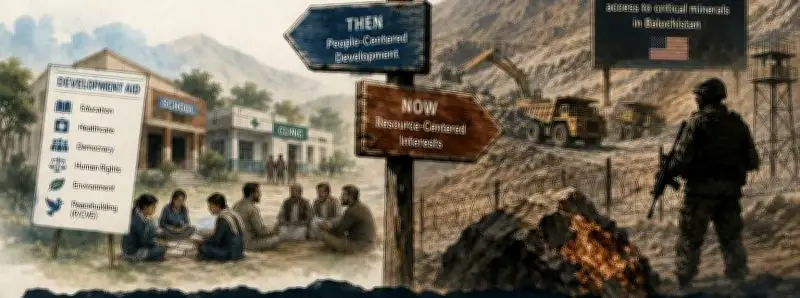
International donor agencies once funded Pakistan's schools, clinics, civic institutions, and peacebuilding initiatives. Most have since left. What remains tells a very different story. For years, international donor agencies, particularly the United States, invested across nearly every dimension of Pakistani civilian life. USAID’s portfolio touched healthcare delivery in rural Sindh, agricultural systems in Punjab, civic education in KP, environmental programming, democratic governance, human rights frameworks, and the painstaking, low-visibility work of preventing and countering violent extremism (P/CVE) in communities where the state had long ceased to be a reassuring presence. The relationship was imperfect and often shaped by American foreign policy priorities rather than Pakistani needs. Yet its breadth meant something: development, in some recognizable form, was the point.
From Development to Extraction: The New Logic of Aid
On 24 May 2026, a bomb killed at least 20 people and injured 70 others on a train in Quetta. That same week, the only active United States government funding call open in Pakistan—other than a few small-scale educational activities by USEFP—was a $5 million State Department grant. Its purpose was stated without ambiguity: to protect American commercial access to critical minerals in Baluchistan and ensure that armed groups do not threaten access to strategic resources. The province is on fire, yet the funding is directed toward the ground beneath it. This is not a coincidence or a bureaucratic oversight; it is the logic of what American aid to Pakistan has become.
The Scale of Withdrawal: $845 Million Suspended
The scale of the withdrawal that preceded this moment is worth stating plainly. In early 2025, the United States suspended more than $845 million in aid projects in Pakistan, pausing or terminating 39 major programs spanning health, education, democracy, human rights, environmental protection, and humanitarian assistance. The breadth of what was lost reflects what had once existed: an ecosystem of civil society organizations, implementing partners, and locally embedded practitioners whose work addressed Pakistani needs through a genuine understanding of local realities because, at least structurally, they were funded to do so.

European Departure Compounds the Crisis
The European departure compounded the problem. According to CONCORD’s April 2026 analysis of OECD data, 17 EU member states reduced their official development assistance in 2025, marking the third consecutive year of cuts. EU institutions reduced their ODA by 13.8 percent, the largest single-year decline in a decade. Globally, 2025 recorded the most severe contraction in foreign aid ever measured. What had once been an architecture of support for civil society work across the developing world has now, in Pakistan, been reduced to what can be justified as directly serving a donor government's commercial or security interests—if engagement occurs at all. When aid begins to protect minerals rather than communities, development gives way to extraction—and the social foundations of stability are left to erode.

Deepening Fragility Amid Funding Cuts
The cruelty of the timing is striking. The conditions that require prevention work—fragility, exclusion, shrinking civic space, and the absence of legitimate channels for grievance—are not diminishing alongside the funding. If anything, they are deepening, as reflected in the rise of violent extremist incidents. For organizations working on preventing and countering violent extremism (P/CVE), democracy, and human rights, the consequences are both immediate and structural. Pakistan’s state, and even its corporate sector, will not fill this gap, and the reasons are complex. The Economic Affairs Division (EAD) spent years requiring organizations to remove P/CVE terminology from grant proposals before No Objection Certificates (NOCs) could be processed. The state remained in institutional denial about a phenomenon around which it would later develop national policy, and many of my friends in the development sector can attest to this reality. The relationship between the security establishment and independent civil society work on prevention has never been comfortable because genuine community-level P/CVE efforts ask difficult questions about the conditions that produce or sustain extremism—questions that state-aligned programs are often not designed to answer honestly.
The Structural Flaw in Funding Models
The funding model that existed also carried a design flaw that the sector is only now fully reckoning with. For two decades, international P/CVE and civil society funding in Pakistan operated largely through project cycles of one to three years, measuring success through trainings delivered and beneficiaries counted. What it almost never provided was flexible, multi-year core funding that would have allowed organisations to build reserves, diversify revenue streams, and develop the institutional resilience necessary to outlast any individual grant. Donors required sustainability plans in every logical framework, but they rarely funded the actual conditions necessary for sustainability. The organisations that remain are not weak because their work lacked value. They are fragile because the funding model was structurally designed never to let them stand fully on their own.
Paralysis and Self-Censorship in Civil Society
This has produced a particular kind of paralysis within Pakistan’s civil society. Practitioners who spent years building platforms for accountability and prevention now find themselves trapped between two shrinking spaces. Internationally, the withdrawal of donor infrastructure has removed the financial—and, in some respects, political—cover that once allowed them to operate with a degree of visibility. Domestically, a state with little appetite for independent civil society, democracy work, or rights-based advocacy has not become more tolerant in the interim. Rather, civic space has continued to shrink, often under the pretext of security. The result is a distinctive form of self-censorship. Before speaking about human rights violations in regions where donor commercial interests are now at stake, practitioners calculate the potential consequences for visas, professional relationships, and access to international or local networks that once sustained their work. Domestically, before speaking publicly about conflict, democracy, enforced disappearances, or state excesses, they weigh the personal and professional costs and act accordingly.
Domestic Philanthropy: A Gap That Cannot Be Filled
Pakistan’s domestic philanthropic culture offers no easy alternative. People give generously to madrassas, orphan sponsorships, hospitals, and humanitarian appeals. The impulse is genuine, but prevention work produces no visible beneficiary and no tangible outcome that can be photographed or publicly celebrated. Preventing a young man or woman in a fragile district from becoming the next recruit leaves no receipt, no ceremony, and no moment of transformation that anyone can easily identify.
What Must Change: A Call for Strategic Investment
Where does this leave us? To the donors: the argument for staying is not charitable; it is strategic. The conditions that produce extremism do not disappear when prevention organisations close or when donor priorities suddenly shift. A funding model that secures extraction corridors while abandoning the social fabric of the communities living above those minerals is not a stable arrangement. If stability is truly the goal, prevention cannot be treated as optional or made contingent solely upon economic interests. And when donors do invest, particularly in P/CVE work or behavioural change initiatives, the model itself must change. Flexible, multi-year core funding is not overhead; it is the investment. Building the financial resilience of P/CVE and civil society organisations—so they can survive the gaps between grant cycles, political transitions, and inevitable shifts in donor priorities—is the only way this work can outlast the individuals currently carrying it forward. Pakistan’s civil society, philanthropic institutions, corporate sector, and diaspora networks must also become part of a broader conversation about what sustaining this work domestically should look like. The people doing prevention work in Pakistan today—without institutional backing, without reliable funding, and in the space between a reluctant state and a retreating donor community—continue because they understand what happens when that work stops. They did not enter this field to serve an extraction economy, and they will not abandon it to serve one. What they need, and what the international community owes them, is not another minerals protection grant. It is sustained, flexible investment in the work that keeps the ground above those minerals from becoming ungovernable.