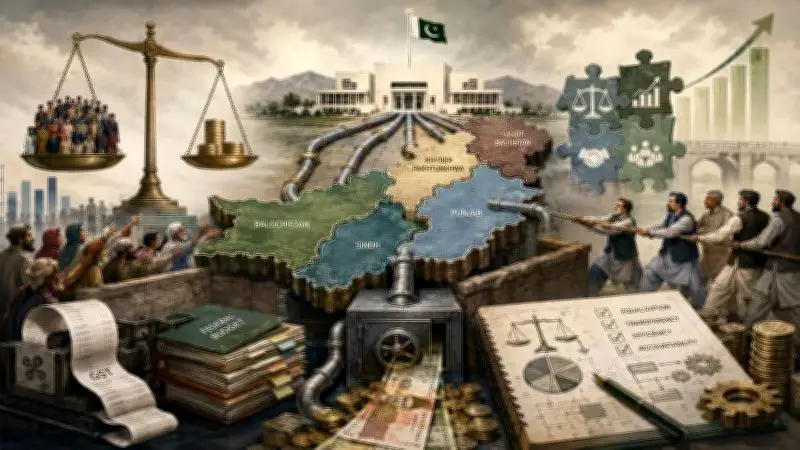
The latest report by the World Bank has reignited a fundamental debate over Pakistan's fiscal federal structure. Its recommendations are familiar yet significant: revisit the vertical and horizontal formulas of the National Finance Commission Award, reduce the weight of population as the dominant allocation criterion, adopt a fiscal equalization framework, and establish a harmonized General Sales Tax regime. At first glance, these proposals appear technical, rational, and perhaps overdue. But in Pakistan's context, the central question is far deeper than any formula can address: is the problem really about how resources are distributed, or is it about how the state itself is structured?
The Core of the Crisis: Institutional Design
Pakistan's fiscal crisis is not merely a question of insufficient revenue. It is, at its core, a crisis of institutional design. Since the Seventh NFC Award, provinces have received 57.5 percent of the federal divisible pool, arguably the largest fiscal devolution in the country's history. The premise was simple: transfer resources downward, strengthen provincial autonomy, improve public services, and ultimately raise living standards. Yet more than a decade later, the results remain underwhelming.
Pakistan's tax-to-GDP ratio still hovers around 9 to 10 percent, among the lowest in the region. Provincial own-source revenues account for barely 6 to 8 percent of total provincial expenditures. Public spending on health remains close to 1.2 percent of GDP, while education spending struggles around 2 percent, both figures significantly below regional averages. In other words, resources moved, but state priorities did not.

Resource Conversion Failure
According to the World Bank, nearly 80 percent of provincial expenditures are absorbed by salaries, pensions, and administrative overheads, leaving little room for meaningful development spending, while district-level expenditure has fallen from under 10 percent to just 4.7 percent. These figures reveal a deeper truth: Pakistan's problem is not resource availability, it is resource conversion. The state spends money, but consistently fails to convert that expenditure into human development, poverty reduction, or better public services.
Fiscal Equalization: Imported Model, Local Barriers
This is where the World Bank's recommendation of fiscal equalization enters the debate. The model has worked effectively in countries such as Canada, Australia, and Germany, where weaker regions receive proportionately higher transfers to maintain equal standards of service delivery. But Pakistan is not Canada, Australia, or Germany, and that is precisely the problem.
The first barrier is constitutional. Following the Eighteenth Amendment to the Constitution of Pakistan, Article 160 effectively locked provincial shares into a one-way structure, whereby no future NFC Award can reduce a province's share below the previous award. Politically, this has created an irreversible fiscal arrangement whose implications are profound: even when the federation faces growing debt servicing obligations, rising defense expenditures, or severe fiscal stress, reducing provincial transfers is constitutionally and politically almost impossible. This rigidity has only amplified federal fiscal vulnerability.
Political Economy and Institutional Overlap
The second barrier is political economy. Pakistan's fiscal federalism suffers from a fundamental contradiction, in which every province demands fiscal autonomy when it means larger transfers, yet resists fiscal autonomy when it requires taxing its own economy. That contradiction lies at the heart of Pakistan's fiscal politics.
The third barrier is institutional overlap. The Eighteenth Amendment devolved key sectors such as health, education, and social welfare to the provinces, yet the federal government continues to operate within these same domains. Federal ministries, provincial departments, and donor-funded vertical programs now coexist in overlapping jurisdictions, producing three governments acting within a single sector and, in the end, no clear accountability. This overlap generates duplication, weakens responsibility, and blurs institutional ownership. It is one of the least discussed, yet most damaging, features of Pakistan's governance structure.

GST Harmonization and Institutional Trust
The World Bank's call for GST harmonization is also correct in principle. Today, goods are taxed federally while services are taxed provincially, a fragmented arrangement that has increased compliance costs, expanded litigation, and weakened tax certainty. But here too, the challenge is not merely technical; it is a matter of institutional trust. Over the past two decades, Pakistan has spent billions reforming the Federal Board of Revenue through digitization, VAT modernization, track-and-trace systems, and audit reforms, yet the outcomes remain largely unchanged: compliance stays low, evasion remains high, and trust remains weak.
This is where Pakistan's donor-dependent reform model repeatedly fails. Too often, reforms arrive as imported policy templates rather than as organic institutional evolution. The pattern is predictable and familiar: an external consultant arrives, a comparative model is presented, a steering committee is chaired by retired bureaucrats, reports are written, funding is disbursed, and projects are closed, while the institutions themselves remain untouched. From urban sanitation systems to tax modernization, from local governance to public finance, this parachute reform model has been repeated for decades.
Lessons from Comparative Devolution
Countries that pursued genuine devolution understood this distinction well. Indonesia linked decentralization with district-level institutional empowerment. Vietnam tied provincial performance to measurable productivity metrics. Bangladesh built district accountability frameworks for social spending. Pakistan, by contrast, devolved functions but did not devolve accountability, and that remains its deepest structural failure. This is also why Provincial Finance Commission awards remain largely ineffective, particularly in Punjab and Sindh, where district-level fiscal empowerment remains weak.
And it is here that the citizen ultimately pays the price, for a citizen's quality of life is not transformed by Islamabad's budget but by the district budget. Water, roads, sewerage, schools, and primary healthcare are delivered by the local state, not by abstract federal transfers, yet in Pakistan the local state remains financially fragile, politically subordinated, and institutionally hollow.
The Real Reform Agenda
This brings the argument to its central conclusion: Pakistan does not need NFC formula reform as urgently as it needs a genuine reform of its state architecture. Before any further debate over percentages and formulas, the country must confront the more fundamental questions of what the federation should do, where the province's responsibility ends, where the district's begins, and, most importantly, who is accountable when public money is spent but outcomes fail to follow. Until these questions are answered with clarity and political will, reports will continue to pile up, reforms will continue to be funded, and public frustration will continue to deepen.
Pakistan is not underfunded. It is over-layered. There are too many governments and too little governance, and that, more than any formula, is the country's real fiscal crisis. Pakistan’s fiscal crisis is no longer about how money is divided, but whether the state knows what it exists to do.