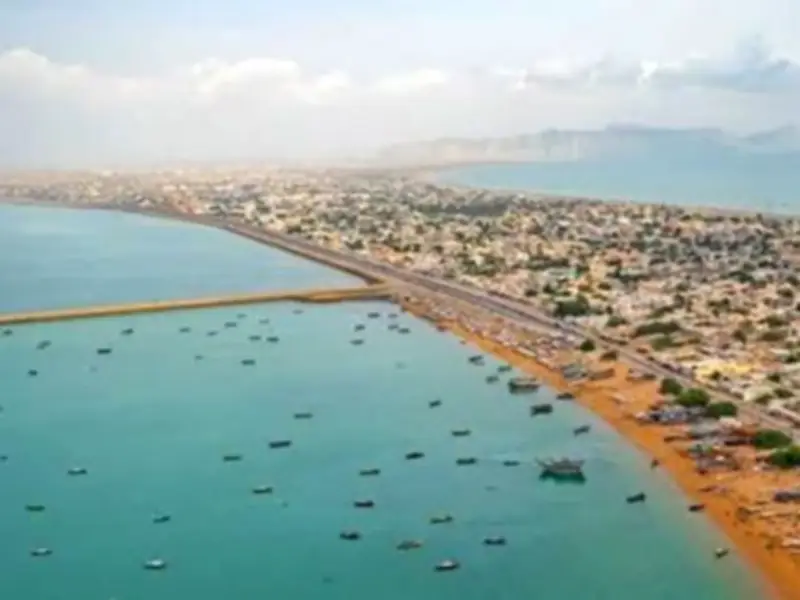
The concept of developing a modern port at Gwadar dates back to 1954 when a survey by the United States Geological Survey (USGS) convinced Pakistan of its strategic importance. However, it took 54 years to realize the dream when the current port received its first commercial cargo on March 15, 2008. Even after that, it remained virtually dormant for 18 years until the Iran war compelled some cargo traffic to divert to it.
Historical Background and Development
Gwadar was integrated into Pakistan in 1958 through its purchase from Oman. Only a small port for local fishing vessels could be established until 1993, which largely proved a failure. In 1999, China offered to develop a modern port, and execution commenced in 2002, taking about five years to complete. The port currently has only three multipurpose berths and one service berth, compared to Karachi's 40 berths and Port Qasim's 18. Gwadar can dock a maximum of three ships at a time, each around 200 meters in length, while Karachi can accommodate about 13 times more.
Capacity and Throughput
Gwadar's designed annual throughput for containerized cargo is 100,000 TEUs (twenty-foot equivalent units), while Jebel Ali in Dubai alone handles 19.4 million TEUs. In 2025, Gwadar handled only 8,300 TEUs. According to the Gwadar Development Authority (GDA) website, Gwadar's GDP is projected to grow to $30 billion by 2050, with per capita GDP reaching $15,000—around eight times Pakistan's current value.

Strategic Location and Energy Corridor
Located in the Arabian Sea opposite Oman, the port sits at the end of the Strait of Hormuz, 120 km downstream of Chabahar port in Iran and 630 km upstream of Karachi Port. Oil exports from seven countries, including Saudi Arabia, the UAE, Kuwait, Qatar, and Iraq—comprising 20% of global oil exports—pass through this route. China, importing about 50% of its oil via this route, tops the list of importers. The Strait of Malacca is another chokepoint; trucking oil to Kashgar in China from Gwadar can bypass it entirely. If implemented, with Saudi Arabia already supplying 14% of China's oil imports, a large Aramco footprint in Gwadar is a real possibility.
Past Performance and Economic Impact
From commissioning in 2008 to 2025, Gwadar Port handled around 7.4 million tons of imports, with an annual maximum of 3,900 tons in FY20-21. Exports were negligible, and there was hardly any identifiable transshipment traffic. Until the Iran war, Gwadar was economically non-existent. Activation as an energy corridor, complemented by the 923-hectare free trade zone, could drive Pakistan's entire economy. Heavy industries like minerals processing, steel, chemicals, pharmaceuticals, refineries, and petrochemicals could make it a major hub. The shipyard project, pending since 2007, could boost support industries such as steel mills, marine paints, and shipping containers.
Recommended Measures for Optimal Utilization
Sustained and optimal utilization requires several measures: 1) A nodal analysis of hydrocarbon logistics from Gwadar to China, considering available options, economic viability, and execution timelines. 2) A lessons-learned exercise from past performance, including capacity mapping of CPEC project forums and adopting governance models like DP World's professional board. 3) Meticulous planning for expanding port capacity to around 100 berths in 20 years, calibrated with realistic economic projections. 4) Identifying and developing human capital, with maximum volume from Balochistan, and integrating local industrialists and entrepreneurs into CPEC projects. 5) Preparing international-standard investment flyers for free trade zone projects, complemented by professional presentations to ambassadors and prefeasibility studies. Quarterly federal cabinet meetings at the site could expedite progress. 6) Aggressive marketing of port benefits, including bunkering potential, through dedicated campaigns and benchmarking studies. 7) Assigning Gwadar special status for education, skilling, health, employment, and amenities to win hearts and counter negativity.
The key to rapid development of Balochistan and Pakistan lies in Gwadar, achievable through merit, professional management, and empathy for the people of Balochistan.