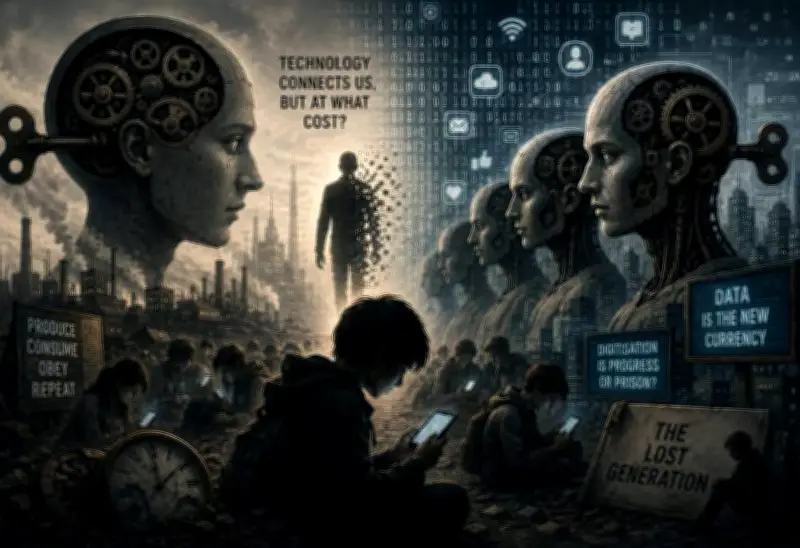
Industrialization Transformed Humanity from Creators to Operators
The Industrial Revolution of the late 18th and 19th centuries is often seen as a turning point in human history. Many historians believe it laid the foundation for modern civilization, transforming weak farming societies into advanced industrial nations. Factories increased production, railways connected continents, scientific innovation accelerated, and economies grew rapidly. Humanity entered an age of machines, industry, and modernity.
However, there is a darker side to this story. While industrialization made life materially better, it also had profound effects on people morally, psychologically, socially, creatively, and spiritually. Machines made life more comfortable but at the cost of making human existence mechanical. Industrial civilization created economies and disciplined workers but also led to isolation, conformity, environmental damage, social fragmentation, and identity crises.
Before Factories: Life Rhythms and Craftsmanship
Before industrialization, people lived according to natural rhythms. Life revolved around nature, seasons, craftsmanship, family traditions, and local communities. Work was often connected with creativity, personal ownership, and skill. A craftsman took pride in creating a product through patience and imagination, as human labor had cultural meaning.

The rise of factories changed this relationship between people and work. Industrial society reorganized life around clocks, schedules, productivity, efficiency, and standardized routines. People adapted to machines rather than machines serving human needs. The factory whistle replaced the rhythm of nature. Time became mechanical. Human existence itself became industrialized.
Weber's Iron Cage and Marx's Alienation
As technology automates labor, humanity risks becoming an algorithm—efficient, connected, yet increasingly detached from itself. The German sociologist Max Weber described this transformation as the 'iron cage' of rationality, where bureaucracy and efficiency imprison human freedom and individuality. Karl Marx also argued that industrial capitalism alienated workers from their labor, creativity, products, and from themselves.
Even modern corporate culture reflects this industrial logic. Employees are evaluated through targets, deadlines, productivity charts, and measurable outputs. The industrial revolution has transformed humanity from a civilization of creators into a civilization of operators.
Education as Commodity and Mechanized Thinking
One overlooked consequence of industrialization was the transformation of education into a commodity or commercial transaction. Before modernity, education focused on philosophy, morality, religion, rhetoric, and intellectual cultivation. But industrial capitalism required disciplined laborers to serve factories, offices, and bureaucracies. As a result, modern standardized schooling systems emerged. Schools resembled factories, with testing measuring conformity and rote memorization, replacing critical thinking and innovation.
This industrial civilization did not merely mechanize labor; it mechanized thinking itself. Repetitive office routines, algorithm-oriented business models, corporate standardization, and bureaucratic structures often suppress originality and independent thought.
From 'Being' to 'Having': Consumer Psychology
Factories producing goods at scale required societies conditioned for mass consumption. Thus emerged advertising, branding, commercial entertainment, celebrity culture, and modern consumer psychology. The German philosopher Erich Fromm argued that modern capitalism has shifted humanity from 'being' toward 'having.' Human identity became increasingly tied to possessions, wealth, brands, and material consumption rather than wisdom, morality, or character.
People began defining themselves through brands, technology, status, and lifestyle choices. Modern civilization commercialized not just products but human aspirations themselves.

Urbanization and the Crisis of Relationships
Urbanization further intensified the crisis of relationships. Capitalist structures and industrialization caused migration from villages into expanding industrial cities. While cities created opportunities, they also weakened traditional social structures. Rural societies once offered family systems, cultural identity, and communal belonging. Industrial cities instead produced anonymity, competition, isolation, and emotional fragmentation.
The sociologist Émile Durkheim described industrial society as producing 'anomie,' a condition of social disconnection and existential crisis. Today, people are more technologically connected than any civilization, yet loneliness has become a global psychological crisis. Industrial civilization expanded cities while shrinking inclusivity.
Environmental Destruction and Colonial Exploitation
Perhaps the greatest indictment of industrial civilization is environmental destruction. Industrial society normalized large-scale coal burning, fossil fuel dependence, deforestation, pollution, resource extraction, and ecological exploitation. Nature was used as raw material for industrial growth.
The Industrial Revolution was also deeply connected with colonialism and global exploitation. Industrial powers required materials, overseas markets, cheap labor, and resource extraction to sustain growth. Local industries collapsed under imports. Entire populations were exploited to sustain capitalism. As Frantz Fanon argued, colonialism was not merely domination but an economic and psychological system designed to preserve industrial power structures. Modernity was built not only upon technological innovation but also upon imperial exploitation and global inequality.
Existential Crises Amid Material Comfort
Modern civilization solved physical problems while intensifying existential ones. Humanity today possesses material comforts unknown to earlier civilizations yet struggles profoundly with fulfillment, peace, and purpose. Modern identity became linked to profession, salary, productivity, social status, and economic performance. Human beings increasingly introduce themselves through occupation rather than character.
Philosopher Hannah Arendt warned that modern industrial systems reduce human beings into laboring entities trapped within endless cycles of production and consumption.
Balancing Progress and Human Dignity
Despite criticism, industrialization undeniably contributed to advances in medicine, transportation, communication, public health systems, and education. However, the contemporary world has become technologically powerful while remaining socially fragmented, psychologically exhausted, morally confused, and environmentally destructive.
Today, humanity stands at another turning point through artificial intelligence, automation, and digital capitalism. The industrial revolution modernized economies, accelerated science, and reshaped civilization materially, but its darker consequences cannot be ignored. True civilization cannot be measured solely through economic growth, industrial productivity, or technological sophistication. Genuine progress must preserve creativity, intellectual independence, emotional well-being, morality, community engagement, and human dignity.