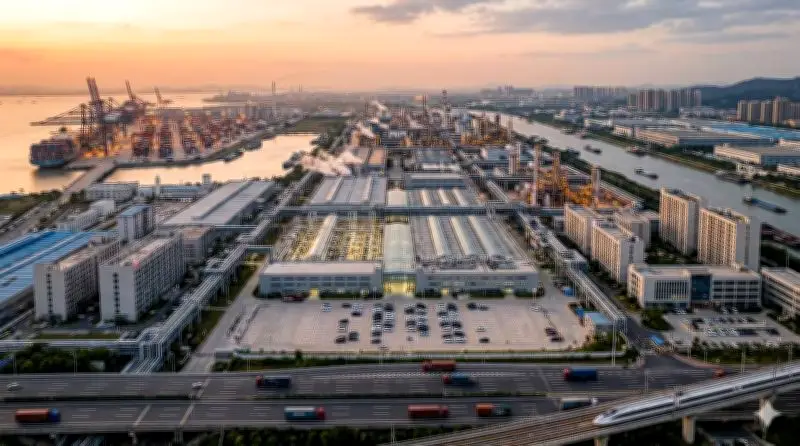
The European Union has finally recognized the scale of its economic dependence on China. As concerns over industrial competitiveness intensify, Brussels is increasingly focused on reducing strategic vulnerabilities created by its deep economic ties with Beijing. Yet, as Europe searches for alternatives, it confronts an uncomfortable reality: no other economy currently offers the same combination of manufacturing scale, industrial depth, infrastructure, and supply-chain integration that China has built over the past four decades.
Europe is not alone in facing this dilemma. The United States, Japan, South Korea, Australia, and India all run significant trade deficits with China. Beijing has established itself as the world's manufacturing center, supplying everything from basic industrial inputs and consumer goods to electric vehicles, batteries, machinery, telecommunications equipment, and increasingly sophisticated technologies.
China's Rise: Not Just Low Wages
This position was not achieved overnight. Following the normalization of relations with the United States in the 1970s, China gradually transformed its economic model. Market reforms, special economic zones, infrastructure expansion, and a deliberate strategy of attracting foreign investment created an environment that encouraged multinational corporations to relocate production to Chinese territory. As globalization accelerated during the 1980s and 1990s, China emerged as the preferred destination for industrial outsourcing.

However, low wages alone do not explain China's rise. Many countries offered cheap labor. What distinguished China was its ability to combine labor abundance with disciplined workforce development, infrastructure investment, export-oriented policies, and an increasingly sophisticated industrial ecosystem. Foreign companies initially came for low-cost production, but many stayed because China developed the suppliers, engineers, logistics networks, and manufacturing expertise required to support large-scale industry.
The results are striking. Hundreds of thousands of foreign-invested enterprises operate within China, and despite growing geopolitical tensions, many international companies continue to expand their presence there. Corporate behavior often reveals realities that political rhetoric cannot conceal.
India: The World's Back Office
India presents a markedly different story. Rather than becoming the world's factory, India emerged as the world's back office. The country successfully cultivated a vast pool of engineers, software developers, and business-service professionals. Today, India occupies a dominant position in global information technology and business-process outsourcing services. Virtually every major multinational corporation relies on Indian talent somewhere within its global operations.
Yet the contrast between the two development models remains significant: China became a destination for factories, and India became a destination for services. This distinction does not imply that India failed to develop manufacturing. The country has built globally competitive industries in pharmaceuticals, steel, chemicals, automotive components, and increasingly electronics assembly. Nevertheless, these achievements have not yet produced the broad, integrated industrial ecosystem that China constructed across multiple sectors simultaneously.
The difference is not merely one of output. It is one of economic architecture. India produced world-class talent and exported services. China built an interconnected industrial capacity. As a result, while India became indispensable to the global digital economy, China became indispensable to the global production economy.
Policy Divergence and Its Consequences
This contrast is embedded in the policies these two countries pursued. India's development model successfully created a highly skilled professional class that integrated into the global economy through technology and business services. This achievement transformed the country into a global center for software development and outsourcing. Yet the benefits of that success were distributed unevenly. Large sections of the population continued to face limited access to quality education, industrial employment, and economic mobility.

China pursued a different path. Its development model sought to integrate broad sections of the population into a national industrial system as factory workers, technicians, engineers, and skilled manufacturing professionals. While India generated globally competitive professionals, China combined workforce development with large-scale industrial expansion, creating a deeper manufacturing ecosystem and a broader base of industrial employment.
The consequences are visible today. Technology companies such as Tata Consultancy Services, Infosys, and Wipro helped transform India into a global software powerhouse. Chinese firms, meanwhile, evolved from contract manufacturers into globally competitive producers of advanced industrial goods.
Historical Lessons and Structural Inequality
History also offers important lessons. During the eighteenth century, the Indian subcontinent accounted for a significant share of global economic output. Yet colonial domination emerged through a combination of political fragmentation, military advantages enjoyed by European powers, and unequal economic structures of India that were based on two classes – the richest and the poorest, with no other class in between. This created a fertile ground for trading corporations such as the East India Company to capture influence.
The legacy of inequality still carries remnants of its past. Across much of South Asia, large sections of the population continue to face limited access to quality education, healthcare, infrastructure, and economic opportunity. While prosperous urban centers have expanded, millions remain excluded from the conditions necessary to participate fully in a modern industrial economy.
This challenge extends beyond questions of social justice. Broad-based prosperity creates consumers, skilled workers, entrepreneurs, and innovators. Societies that fail to develop strong middle classes often struggle to sustain industrial transformation on a national scale.
Case Study: Tata Motors vs. BYD
The contrast between India's Tata Motors and China's BYD illustrates the broader issue. Tata Motors represents one of India's most respected industrial enterprises and has achieved global recognition through acquisitions such as Jaguar Land Rover. Yet BYD demonstrates what can happen when industrial policy, domestic scale, technological integration, and supply-chain development operate in concert. Within a relatively short period, the Chinese company emerged as one of the world's leading electric vehicle manufacturers and a formidable global competitor.
China's transformation has also altered the nature of global trade itself. For decades, foreign firms relied on China primarily as an assembly platform. Over time, however, Chinese companies moved steadily up the value chain, developing their own technologies, brands, and industrial capabilities. Increasingly, China no longer manufactures products designed elsewhere; it designs, engineers, and exports products of its own.
This evolution has intensified competitive pressures worldwide. Chinese producers frequently combine acceptable quality with lower costs, allowing them to penetrate markets across both developed and developing economies. Consumers benefit from lower prices, but domestic industries often struggle to compete.
EU Dependence and Global Implications
The European Union's imports from China reveal the scale of this dependence. Electrical machinery, telecommunications equipment, industrial machinery, and related products constitute a large share of European imports. China has also established an overwhelming presence in several sectors critical to the global energy transition, including solar panels, battery manufacturing, and many components used in renewable-energy supply chains.
When multinational corporations seek alternatives, they encounter significant limitations elsewhere. Vietnam has become an increasingly attractive manufacturing destination, particularly in electronics and consumer goods. Taiwan remains indispensable in advanced semiconductor production. Yet neither possesses China's combination of scale and industrial breadth.
South Asia presents a different challenge. India excels in services, Bangladesh has developed a substantial textile sector, Pakistan maintains strengths in agriculture and selected industries, and Sri Lanka has built important apparel exports. However, the region as a whole has yet to create a diversified manufacturing ecosystem capable of rivalling East Asia's industrial centers.
Lessons for the Future
China's success ultimately reflects more than population size or low labor costs. It reflects the cumulative effect of long-term planning, infrastructure investment, industrial policy, workforce development, and institutional capacity. For Europe, the implications are increasingly difficult to ignore. The continent faces mounting pressure to preserve its industrial competitiveness while reducing strategic vulnerabilities. At the same time, Chinese manufacturers continue expanding into sectors once considered secure strongholds of Western industry.
South Asia confronts a different but equally important question. Can it move beyond fragmented successes and build the broad industrial foundations necessary to compete in a world increasingly shaped by manufacturing capability and technological production? The answer will depend less on ideological debates and more on practical outcomes. Citizens ultimately judge economic systems by their ability to create opportunity, raise living standards, and provide long-term prosperity.
China's rise demonstrates that national power is built not through political labels alone but through the capacity to mobilize resources, develop productive industries, and deliver tangible economic results. The speed with which China has reshaped global industrial hierarchies should serve as a warning as well as an inspiration. While much of the world debates how to respond to China's economic influence, the more important question may be whether other nations possess the vision, discipline, and institutional capacity required to build comparable foundations of their own.