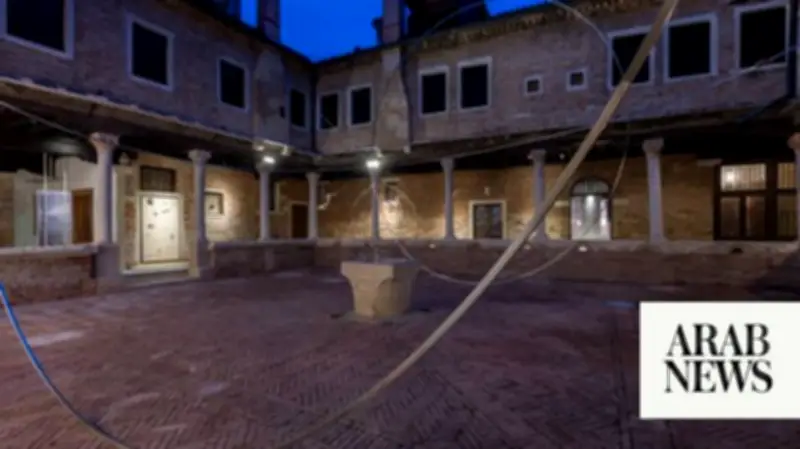
The Saudi-backed exhibition "A Necessary Fiction: Maps, Art, and Models of Our World" is being staged alongside the 61st Venice Biennale. The show is curated by Sara Almutlaq and Aurora Fonda, with associate curators Zaira Carrer and Amina Diab, and exhibition designers Ibrahim Kombarji and Bianca Pedron. The Saudi Ministry of Culture has a long-term lease on the 13th-century Abbazia di San Gregorio, and this exhibition, running until November, is its first long-term curated show there.
Exploring the Concept of Maps
The exhibition explores, according to a press release, "our enduring need to create models of the world." This includes not just maps and globes, but also pre-cartographic methods. Amina Diab explained to Arab News: "We have the pre-cartographic, which looks at everything that came before the map; how people used oral traditions, poetry, and tools to orient themselves in the world, like the astrolabe, for example."
Participating institutions include the King Abdulaziz Public Library, the Saudi National Museum, the King Abdulaziz Foundation for Research and Archive, the Biblioteca Civica Bertoliana of Vicenza, and the Cremona State Library. In the first room, visitors find the Idrisi map, created in the 12th century by Islamic cartographer Muhammad Al-Idrisi for the King of Sicily, considered at the time "the most accurate map of the world."

The Subjectivity of Accuracy
Diab noted that accuracy in cartography is a thorny subject. "I want to reflect on the title of the exhibition. Maps are always thought of as these tools of truth, or accurate tools of documentation and orienting yourself in the world. But actually, they're full of the imaginary, they're full of fiction, they're full of abstraction. All maps are abstractions of reality. You really see how theology, ideology, culture… all were embedded in that. Hence, 'A Necessary Fiction.' Maps are full of projections of so many layers of things. And 'fiction' is not necessarily a 'negative' word in this context. People were trying to orient themselves in the world, but some places were unknown, and these unknown places were completely fictional and full of myth."
She added: "Many of the maps are very arbitrary; they're full of projections, abstractions. If you look at old Islamic maps, the south was at the top — they're inverted. Why? Because it really depends on who's creating the map." In medieval Islamic maps, Makkah was always at the center; in European counterparts, Jerusalem was. "One of the most surprising things that you find in both Islamic and European traditions is these mythical imaginary creatures inhabiting unknown lands," she explained. "When territories were still not charted, it was believed that unknown lands were full of jinns or mythical creatures."
Contemporary Artworks and Commissions
The exhibition features 78 works, with 29 contemporary artists contributing, including seven new commissions. One notable commission is "Each Time a Star Goes Astray" by Saudi artist Nasser Al-Salem, created between Riyadh and Venice with Murano glassmakers. Diab described it as "a nice conversation between two places." The installation is based on a Bedouin poem, as Bedouins used stars to orient themselves in the desert. Al-Salem took stone and put verses of the poem onto a spherical installation, embedded with Murano glass forming the stars.
Other Saudi artists include Ahmed Mater, Manal AlDowayan, Sarah Abu Abdallah, Abdulmohsen Albinali, Marwah Almugait, Basmah Felemban, and Abdullah Miniawy. Another highlight is Kuwaiti artist Monira Al-Qadiri's "Children of Smokeless Fire," a series of seven figures on the building's façade, inspired by mythical creatures from cosmography. Diab said: "If you're coming from the water, you're greeted by these creatures. It's a real showstopper. People on the local water bus are always asking what they are."

Venice as a Context
The building and Venice itself were important factors in the curation. Diab explained: "Venice is historically a place of travelers, of navigators, a trading port with all the ships passing through, so this idea of maps and finding your way is deeply relevant. We came in as curators and said 'OK, how will we create a dialogue between the historic and the contemporary?' Maps can be a very nerdy topic, right? So we always had this idea of, 'How are maps still relevant to us today?' There are so many contemporary artists interested in cartography and in map-making. The more we researched, and the more we spoke to artists, the more we realized that the map — as a model, as an abstraction — is very much used by artists to try and understand the world today."