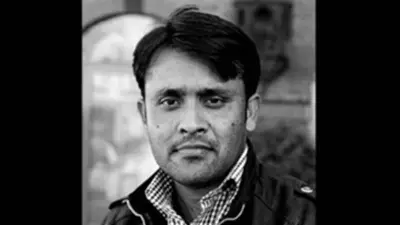
Saudi artist Ramy Alqthami recalls that when he was just nine years old, he took a can of spray paint to a concrete post that was used as a marker of land ownership. Recently, that same post stood in the center of the halls of the Diriyah Contemporary Art Biennale.
Picasso's Influence
Picasso once said, “Art is a lie that makes us realize the truth.” This saying has inspired Alqthami, whose installation at the biennale, “Al-Bitra,” includes the concrete post he painted at age nine. The show catalogue states that the work frames “the fraught relationship between material, symbol, and memory.”
Borders as Illusions
Alqthami told Arab News: “Borders are imaginary lines drawn by man in pursuit of security and peace. Yet what is truly unsettling is for a human to be left without refuge — suspended between illusions.” Born in Jeddah, his ancestors belong to a tribe in Taif where the chieftain distributed pieces of land through a lottery system for equality. “At nine years old, I went to these places for the first time to see the available lands, and I spraypainted ‘515’ on a post to cement that number so it would not be washed away by rain or floods,” he explained.

From Preservation to Possession
He later removed and kept the piece. This is not a story of preservation, but one of possession. Borders are a central factor in global conflict, yet Alqthami believes they are merely illusions. The work itself resists physical interpretation; it invites viewers to read it as a layered record in which time, memory, belonging, and social resonance are condensed into a single material form.
“The important thing in contemporary art is how you increase your effectiveness and influence — participating and having a genuine concern that’s not contrived or manufactured,” he said. “This piece I worked on means a great deal to me emotionally because it symbolizes my place, my identity, and me as a human being. And then I started thinking about the concept of fragmentation.”
Installation Details
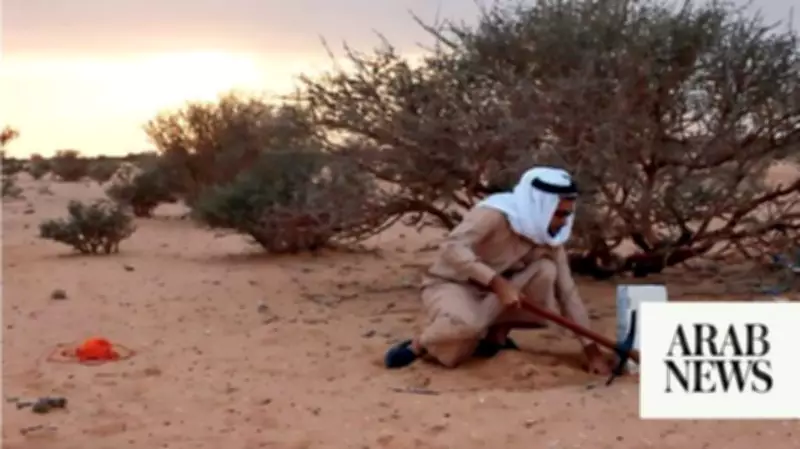
The installation features the original post as a sculptural element, while photographs behind it show the artist at the post’s original location in the process of shifting and removing the marking stone. The piece was first displayed in 2012 in an exhibition curated by Ashraf Fayadh. In 2013, “Al-Bitra” was showcased in Edge of Arabia’s exhibition “Rhizoma” at the Venice Biennale, and it has now returned to the spotlight in the Diriyah Contemporary Art Biennale’s third edition in Riyadh.
Biennale Theme
This year’s biennale explores the intersections of geographies, histories, and cultures that have connected the Arab region to the world while centering the motif of procession. “I felt that the theme ‘In Interludes and Transitions’ paralleled my work in many ways. Bedouins are essentially nomads, but they also belong to a geographical location they call home,” Alqthami said. “Their nature in the Arabian Peninsula long ago also called for invasions of other spaces.”