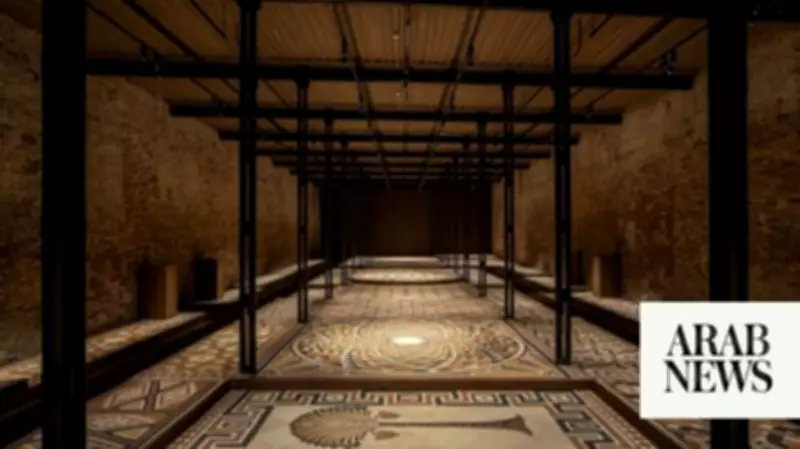
The National Pavilion of Saudi Arabia at the 61st International Art Exhibition of La Biennale di Venezia invites visitors to experience deep emotion. Saudi-Palestinian artist Dana Awartani's installation, titled "May your tears never dry, you who weep over stones," has quickly become a crowd favorite since the biennale opened on May 9. Curated by Art Jameel's director Antonia Carver and Saudi-Iraqi assistant curator Hafsa Alkhudairi, the work occupies the entire floor of the pavilion.
A Celebration of Diversity
Awartani expressed honor at representing her community on a global platform. "I think this is the first time an artist from Jeddah, from Hijaz, has shown in Venice, and I'm glad I get to represent that side of Saudi," she said. "People have this idea of Saudi Arabia being very homogeneous. We're actually so diverse culturally."
Cultural Heritage Under Threat
The installation engages with cultural heritage under threat, borrowing its title from classical Arabic poetry. It invites viewers to walk an imagined archaeological site composed of intricately crafted mosaics referencing 23 places, including sites in Syria, Lebanon, and Palestine. These locations hold immense cultural and material importance, recognized by UNESCO, the World Monuments Fund, and ALIPH Foundation. The shared motifs and traditions highlight common cultures spanning three millennia.

"Mosaics arose in Mesopotamia and were adopted across cultures over centuries, including in Venice," Awartani noted. "Material and cultural evidence demonstrate that our histories are much more interconnected than many appreciate."
A Saudi Collaboration
The work is a truly Saudi collaboration. Working with 32 artisans at a studio in the mountains outside Riyadh, Awartani sourced four differently-hued clays from across the Kingdom. The installation contains more than 29,000 handmade clay bricks, baked under the Saudi sun, requiring over 30,000 labor hours.
"The most important thing is that we were able to represent this cultural destruction that's happening right now, in real time," Awartani said. "The work is a composite of many sites that are and have been under attack, and which hold significant shared histories that surpass contemporary borders. It is a response to the present—to what is still ongoing."
Global Resonance
Carver noted that the project's urgency has only grown over time. "When we began this project, it was of global urgency. Over the past years that we've been working on it, its relevance and timeliness have only become more and more acute." She added that recent pro-Palestinian protests at the biennale showed that the sentiment and themes are shared and appreciated by the global art world.
"This work is really exploring the threat of loss of cultural heritage, and what that loss means," Carver said. "There's a true element of reflection and mourning in it."
Emotional Impact
Alkhudairi described the emotion she wants visitors to feel: "Pure, immense sadness and heartbreak over these sites that are being erased. Stories, histories, people, our loves, our daily lives, our experiences—that is all going away." However, she also expressed hope: "We want people to come out of this really hopeful—hopeful for a future, for a way to preserve something for our children."
Visitors often react with a gasp upon entering the space, according to Carver, due to a deliberate decision to create a moment of reveal over a field of optical effect. Guests tend to lower their voices and take a moment to reflect. "We've had many different adjectives offered to us by audiences—of the space being meditative, a space of reflection, a moment of pause," she said.
Awartani emphasized that the threatened cultural sites are not merely stones but vessels that carry stories and identities across time. "I hope this exhibition highlights the urgency of preserving and protecting cultural heritage as a shared inheritance."