Decolonial Keywords: South Asian Thought Challenges Colonial Knowledge Systems
In the simplest possible sense, keywords serve as shortcuts for large amounts of valuable information. They are words of great conceptual significance, referring to things fundamental to a subject. The term "decolonial" specifically refers to the condition of being or having been extracted or removed from the colonial condition. Decolonising words represents an ongoing attempt by formerly colonised peoples to eliminate or remove the distorting effects of colonialism in their ways of knowing. Decolonial keywords, therefore, are conceptually loaded terms that challenge colonially influenced systems of knowledge.
A Groundbreaking Editorial Effort
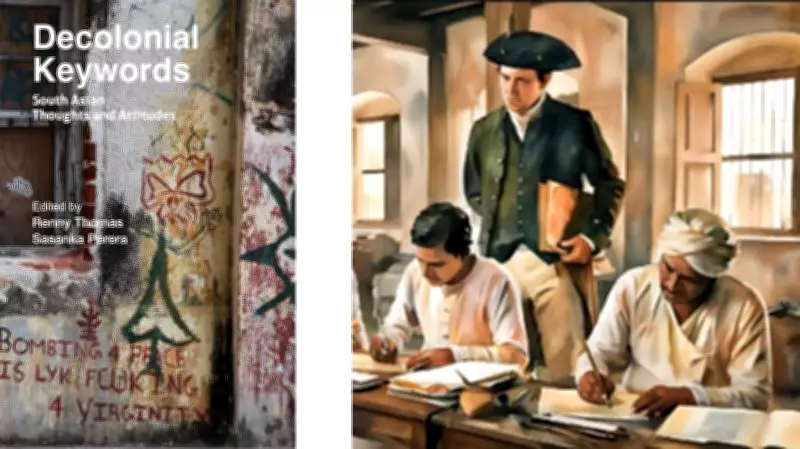
Decolonial Keywords: South Asian Thoughts and Attitudes, edited by Sasanka Perera and Renny Thomas, undertakes the ambitious task of enlisting and explaining important decolonial keywords grounded in South Asian histories, experiences, and intellectual traditions. The editors dedicate this book to 'those who think differently.' Given the depth and durability of colonial influence on the region's knowledge systems, the work of decolonising concepts is a demanding and critical endeavor.
Perera and Thomas have curated a collection of thirty essays, each with a word count exceeding 4,000. Every essay explains one keyword, either originating within South Asia or acquiring particular significance within its context. These essays are organised into six thematic sections, ranging from cultural variations, resistance and people, to spaces, poetics and identity.

Editorial Stance and Political Context
In the introduction, the editors make their positions and biases known. While retaining the disciplinary rationality of sociology and history, they challenge the inadequacies of these disciplines when applied uncritically to South Asia and the post-colonial world in general. The project is not about producing a distinct South Asian sociology but about reworking sociology and history through a better-grounded conceptual vocabulary.
This critical stance is not merely abstract. In a striking moment in the acknowledgements, Perera thanks his former institution, South Asia University (SAU), for freeing him of his duties, which ironically afforded him more time to complete the volume. As one of the founding faculty members at the Sociology Department of SAU, Perera was forced into resignation after a PhD research proposal he entertained was deemed objectionable by the university administration. This episode, briefly alluded to in the book, underscores that political pressures continue to influence and censor knowledge production even today.
Beyond Universalism and Particularism
Rather than excavating vernacular terms in isolation, the book foregrounds South Asian debates as theoretically at par with, rather than subordinate to, Western formulations. By challenging the dogmatic binaries of universalism and particularism, liberal globalisation and state-enforced indigenism, the editors claim that the book is an attempt at 'decolonising the decolonial itself' (page 5). They repeatedly caution against the uncritical embrace of nativism in the name of decolonisation.
The ambition of the volume is twofold. First, it demonstrates how supposedly universal concepts developed in Europe or North America often fail to capture the specificities of South Asian social and political life. Second, it challenges the tendency to confine South Asian concepts to the domain of area studies, denying them the status of theory. The possibility that such concepts might possess greater explanatory power than their Western counterparts is rarely entertained. This book does exactly that and tries to mainstream these keywords within the broader social sciences.

Conceptualising South Asia as a Cultural Landscape
What makes Decolonial Keywords distinctly decolonial is that it goes beyond the limited imaginaries of nation-states, which themselves are products of the colonial encounter. It conceptualises South Asia as a cultural landscape with shared histories, ideas, traditions, and practices. Even the differences are understood as overlapping and interconnected. This approach resists colonial generalisations as well as narrow nationalisms that have tried to appropriate decolonial thought in recent times, especially in the region.
However, this is not a book that is just about South Asia. Through its keywords, the authors seek to widen the social scientific vocabulary of the world and prompt a re-examination of the use of concepts devised in Europe to explain South Asian lives, people, societies, and politics.
Rich Examples from the Essays
Given the scale of the project, it is difficult for a review to do justice to all thirty keywords that the book has taken up. Any cursory discussions of a South Asian concept-word in English risk undermining the very purpose of the book. A few examples may, however, highlight the richness of the effort.
- In her essay on Rasa, Magna Mohapatra turns to the term as an alternative to concepts such as 'essence' or 'affect.' She notes that Rasa has largely been relegated to the study of Indian aesthetics and classical dramaturgy rather than being engaged as a philosophical concept of affective consciousness in its own right (pp 22–23).
- Other essays recover concepts beaten out of shape by colonial and postcolonial transformations. Tutti captures the Indianisation of Western and Christian musical traditions as they are absorbed in local cultures.
- Mundhum, an oral storytelling tradition in Nepal, becomes a lens for exposing the neo-colonial logic underlying development projects (p 41).
- Poromboke, long used pejoratively by British colonisers and post-colonial elite alike, is reclaimed by indigenous activists who use it for activism to defend the commons (p 63).
Strategies for Elevating Vernacular Concepts
While Perera's essay on Aragalaya seeks to elevate a Sinhala term into a globally legible concept of political struggle, Ravi Kumar's contribution on violence follows a different strategy. Rather than excavating a vernacular term, Kumar foregrounds Indian debates on violence as theoretically at par with, rather than subordinate to, Western formulations.
Several essays grapple with the limits of existing social-scientific categories. The anthropological binary of the self or the other, for instance, proves inadequate for understanding the experience of partition of the subcontinent, where identities were fractured in ways that defy neat distinctions. The Bengali keyword Ora offers a more contextually grounded way of approaching the subject (p 113).
Similarly, the Western concept of the "refugee," which presumes an outsider to the nation, fails to capture the specificity of Partition, where citizens and refugees were produced simultaneously, forming complementary diodes of citizen-refugees across both sides of the newly drawn border. Hence, terms like Vastuhara, or Sharanarthi, may thicken the reader's perception of what partition meant and how people were disposed and displaced here (p 172).
Blurring Rigid Categories
Other entries further blur rigid categories. Adab uniquely meanders across religious and secular realms (p 187), while Adivasiyat highlights a political identity claimed from below rather than conferred by the state (p 275).
Limitations and Suggestions
For all its rigour and originality, the book is not without its limitations. Most essays are written in dense academic prose, making the volume difficult to access for non-specialist readers. Moreover, while the book confronts caste and linguistic chauvinism directly, religion-based discrimination, which is quite central to contemporary appropriations of decolonial discourse, receives comparatively less sustained attention.
If this reviewer could suggest one addition to the list of keywords discussed in the book, the word Sangh, which comes up during the discussion on Bahishkrit Bharat or the caste-based dispossession in India, would have been a valuable fit. The word itself is currently most easily associated with the Hindu nationalist Sangh Parivar, despite being an organisational concept that was and still is invoked in bringing together the dispossessed or depressed castes or classes of the country.