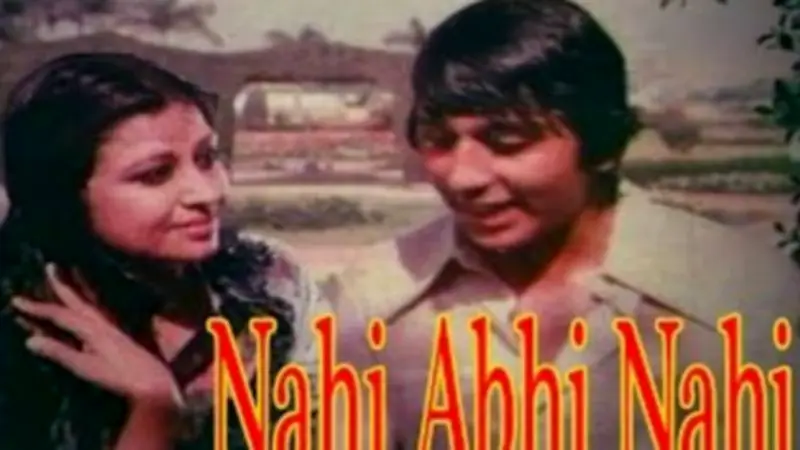
Our elders are right. Flowers that bloom before their time also die prematurely. I shall eat this fruit but… no, not just yet. There is a line near the end of Nahin Abhi Nahin — Pakistan’s 1980 romantic drama directed by Nazar-ul-Islam — that I have carried for decades. A teenage boy, chastened and genuinely altered, turns down a girl’s offer with those words. And then, as far as Pakistani cinema and media culture are concerned, that voice went quiet.
The Legacy of a Film
The film starred the legendary Shabnam alongside Faisal Rehman, who was 14 or 15 when it was made. By his own account, he thought he was auditioning for a minor child’s role, not the lead. The director cast an actual teenager to tell teenagers: not yet. The film ran to a golden jubilee and won a Nigar Award. Both this and Summer of ’42 (1971) knew what they were doing with material this combustible. That awareness is what is missing now.
What the Screen Is Selling Now
Open any streaming platform. Scroll any reel. Watch any drama channel. The logic is straightforward: emotion sells, and nothing sells faster than the idea that first love — young love, preferably very young love — is the truest kind. No malicious intent is required for this to cause harm. You only need reach, repetition, and no one saying otherwise.

The text running across this interview tells us that the man beside his wife recalls picking her up in his lap when she was a small child — and that is when he fell in love with her. When she passed her Matric exams, he sent a proposal. They married. The caption calls these dilchasp baatein — interesting stories. Charming (or sickening?). The studio lights are warm. Nobody in the room says anything.
From Collapse To Comeback: The Rise Of ABHI Bank
The older woman in Nahin Abhi Nahin does not shame the boy for his feelings. She redirects him, with decency: not yet. Grow up first. This is not an isolated clip. It is a genre. Pakistani entertainment is full of couples recounting stories in which the man’s affection began when the girl was a child, framed as love, fondness, saccha pyaar, etc., etc., rather than being examined for what it is. No one fact-checks the age gaps. No one asks whether the story being warmly celebrated would look different if described plainly.
But the content is only part of it. Look at who the industry puts in front of the camera and what it expects of them. Aina Asif — born in 2008 — stated on a private channel’s Ramadan transmission that she was still 17, roughly nine months away from her national identity card. Her breakthrough came with Mayi Ri in 2023 — a drama about a child bride in which she, a minor, played the lead. Nobody seemed to notice the irony or, if they did, they said nothing. The drama was neither straightforwardly harmful nor straightforwardly redemptive. It ends with divorce and the girl choosing education, treated in some quarters as a happy resolution. I wonder if divorce and single motherhood in Pakistan are clean endings? Reality check, please — the stigma follows (still in 2026). The economics are punishing. And the child born of that marriage does not disappear from the story just because the credits roll.
The Development Sector: Where Did the Work Go?
Between approximately 1998 and 2008, there was a meaningful body of work on adolescent sexual and reproductive health in Pakistan. International technical agencies, bilateral donors, non-governmental organisations, both local and international organisations — there were programmes, research, pilot interventions, trained community health workers, and some policy traction. I was part of that work. Others were too — committed practitioners who understood that you cannot address “child marriage” without addressing adolescent sexuality, and that you cannot address adolescent sexuality without talking honestly about it.

From Conflict To Confidence: Pakistan’s Rise Since Marka-E-Haq
And then, almost without announcement, it evaporated. Not because it failed. Not because the evidence collapsed — but because donor priorities shifted. Funding windows closed. The next log-frame called for different indicators. The institutional memory of what had been learned was not systematised, not handed over, not built into any national system. It dissolved. Between one project cycle and the next, nobody picked it up.
The development sector in Pakistan — and I say this as someone who has worked within it and alongside it — has a flattery problem. It tells donors what they want to hear. It produces reports calibrated to funder glossaries rather than ground realities, and the distance between a well-produced project document and what actually happens in a village or a slum is enormous. We need to ask, candidly: who in Pakistan is running a sustained campaign to dismantle myths and harmful cultural practices around adolescent sexuality? Who is consistently and publicly voicing for adolescent sexual and reproductive health and rights — not when a project requires it, but as a matter of principle? Who currently owns that agenda in a non-project-dependent way? Who is training health service providers of all cadres? Who is reviewing the school and medical college curriculum? Who is following up on the girls who drop out at puberty? If the answer is “whoever has a grant this year,” then we have a crisis of institutional continuity, not just a crisis of political will.
The Voice That Left the Room
The older woman in Nahin Abhi Nahin does not shame the boy for his feelings. She redirects him, with decency: not yet. Grow up first. That voice is gone from our drama serials, from the couple of interviews where age gaps are reframed as destiny, from the phones and platforms we have handed adolescents without a single honest story about what any of it costs.
Stories are not neutral. They tell us what love is supposed to look like, who gets to feel it first, and who pays. When the dominant stories reaching Pakistani adolescents are ones in which a girl’s most valuable years are her earliest — in which a man’s attention towards a child is coded as romantic devotion, in which a minor actress is praised for appearing older than she is — this is not entertainment that happens alongside real life. It shapes what real life looks like for the girl watching it at thirteen on her phone.
Pakistan Fixation Blinds Indian Media To Iran War
In 1980, a mainstream Pakistani film looked directly at a teenager and said: I see what you are feeling. It is real, and you are not ready for it yet. We have not managed to say that clearly enough since — not in our drama serials, not in our podcasts and vlogs, not in the content we produce and celebrate and the conversations we choose not to have. Nahin Abhi Nahin. Not yet. Not now. We said it once. Forty-five years ago. We have had plenty of chances since.