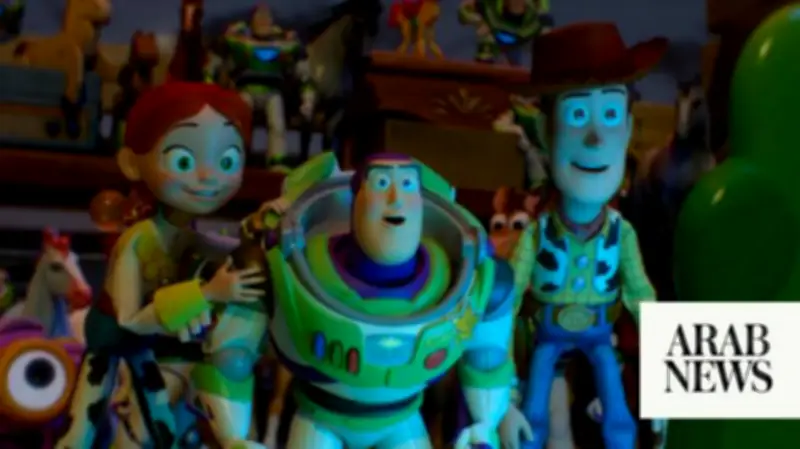
Nearly three decades after audiences first met Woody and Buzz Lightyear, Pixar is heading back to the toy box with Toy Story 5. But for director Andrew Stanton and producer Lindsey Collins, the latest installment is not simply an exercise in nostalgia; it is about reflecting the realities of modern childhood.
While the beloved franchise reunites familiar characters, the film will also grapple with kids' shrinking attention spans and constant screentime. Speaking to Arab News, Stanton said Toy Story 4 was never intended as the definitive ending of one of cinema's finest franchises, animated or otherwise.
"I never looked at it as finishing the whole series; that was just Woody's story," Stanton said. "I look at the films like the lives of the children. So there are the Andy years, and they are finished, and now we are deep in the Bonnie years."

In Toy Story 5, the new territory is a deeply contemporary setting: a child whose imagination and emotional life are competing with tablets, phones, and endless streams of content. Collins feels that tension was impossible to ignore.
"I think it is the reality of the world we are living in," she said. "That is what these films are always trying to do: capture the moment and what toys are dealing with, and what we are dealing with in the moment that we are in."
Stanton admits the creative team initially flirted with the idea of making technology, in the shape of Lilypad, a frog-shaped tablet, an outright antagonist. "That was the first instinct," he said. "But then you realize: if it really was a villain, parents would not be buying it, kids would not be using it."
Instead, the film leans into the ambiguity of something that is both irresistible and disruptive. "It is a seductive element, and we have not figured out the balance of use of it," said Stanton. "It is all-consuming of your attention when you get it, and that was something we felt we could speak to the truth of, but it is not a binary thing. How do you navigate and deal with this thing that is not going away?"
He compares it to another disruptive screen that once invaded the living room. "It is like television in the 1950s," he said. "As much as that may have caused some disruption and damage to certain dynamics in the family, it never went away. So we just tried to lean into the mess of that."
In saying farewell to the stoic Sheriff Woody, who had been in charge of the toy crew for years, Toy Story 4 closed the book on one kind of leadership. Toy Story 5 shifts the spotlight onto cowgirl Jessie, who is now in charge of the gang in Bonnie's room.
"Ever since Toy Story 2, I think there has been a strong desire to give Jessie her moment and her film, and this felt like the right time," says Collins. "The minute we heard that Andrew's idea was to write a story with Jessie as the lead, I think everybody at Pixar was super-excited at the thought. Anybody who has seen Toy Story 2, this movie feels like such a companion piece to that. It feels like this great gift for Jessie. She is leading Bonnie's room, and she is kind of like Woody in some ways, but she handles some things so differently. She is kind of unhinged, in the best way."
Much of the action in the new film takes place outside in nature. Five films in, the franchise now faces an inevitable question: how do you speak both to today's children, many of whom meet Woody and Jessie for the first time via streaming, and to adults who grew up with Andy? Stanton insists the answer is to stop thinking about demographics altogether.
"I have never divided the audience between children and adults, and I think that is actually one of our strengths," he says. "We have just thought about what is universal; what still speaks to us and resonates with us as an adult about our childhood. I think as long as you get into the truth of childhood and the struggles that go on during it, that speaks to everybody."
On the visual and technical side, Collins describes Toy Story 5 as a balance between restraint and evolution. Pixar's tools are more powerful than ever, but the aim is to keep the Toy Story world recognizable.

"We are actually pretty good at it by now," she said. "Technologically, obviously, our tools are always improving, and so the goal, in some ways, with Toy Story, is almost to hold ourselves back a little and make sure that we are always grounding these films in a look and a feel that is familiar. We are never throwing the audience outside of what feels familiar visually, but we are always pushing ourselves to try some new things."
She cited the fact that, in Toy Story 5, a lot more of the action is outside, in nature, as an example of how improved technology has given the studio greater freedom, adding: "Also in our fantasy playtime, we are taking some real stylistic chances, going inside Bonnie's imagination in a way that feels totally different to what we have done in the past. We try to do both: we try to ground it in the familiar, but also really push some boundaries."