For decades, the constitutional architecture of Azad Jammu and Kashmir (AJK) has rested on a delicate balance between democratic representation, historical continuity, and the broader national commitment to the Kashmir cause. Yet in recent months, a misleading narrative has gained traction around the twelve reserved seats allocated to Jammu and Kashmir refugees residing in Pakistan. What began as a movement framed around public rights and governance concerns has increasingly transformed into a campaign targeting institutions, constitutional arrangements, and democratic processes themselves. The debate surrounding these seats is not merely a technical legislative matter; it is a test of whether constitutional questions will be resolved through elected forums or through pressure exerted on the streets. At a time when emotions are running high, facts deserve greater attention than slogans, and history deserves more respect than political expediency.
Historical and Constitutional Basis
The claim that the twelve refugee seats are an unnecessary burden or an outdated constitutional anomaly does not withstand serious scrutiny. Critics often overlook the simple reality that these seats represent hundreds of thousands of refugees whose roots lie in Jammu and Kashmir and whose political status remains linked to the unresolved dispute recognized under Pakistan's constitutional framework. The argument that such seats did not exist before 1974 is equally misleading because the present legislative structure itself did not exist in its current form before that period. More importantly, these representatives impose only a negligible financial cost on the public exchequer, accounting for a tiny fraction of the overall budget. The allegation that they manipulate governments or determine political outcomes is similarly exaggerated. Successive administrations have secured broad parliamentary support that extends well beyond the votes of refugee representatives. Historically, many of the most prominent figures associated with the Kashmiri political struggle emerged through these very constituencies, demonstrating that refugee representation has never been an artificial addition but rather an integral component of the political identity of AJK.
Transformation of the Movement
The real issue, therefore, is not cost, influence, or legitimacy. It is whether a significant segment of the Kashmiri population can be politically erased through a campaign built on selective interpretations of history. Equally concerning is the transformation of a movement that initially presented itself as a platform for public grievances into one increasingly associated with violence, confrontation, and institutional disruption. A substantial majority of the demands raised by the Joint Awami Action Committee were reportedly accepted, implemented, or placed on a formal mechanism for resolution through dialogue between government representatives and committee leadership. Cases against protesters were withdrawn, compensation was provided to affected individuals, administrative reforms were introduced, and implementation committees were established to monitor progress.

Democracy Under Threat
In democratic societies, such developments ordinarily create space for continued engagement and negotiated solutions. Instead, the political atmosphere became increasingly polarized, culminating in calls for agitation at a time when the electoral process had already been initiated by the Election Commission. When constitutional disputes are transferred from legislative chambers to street pressure, democracy itself becomes the casualty. Every citizen possesses the right to protest peacefully, but no group possesses the authority to suspend democratic processes, obstruct elections, or deprive others of their constitutional right to choose representatives through the ballot box. Genuine public movements strengthen institutions; they do not seek to replace them.

Violence and Its Consequences
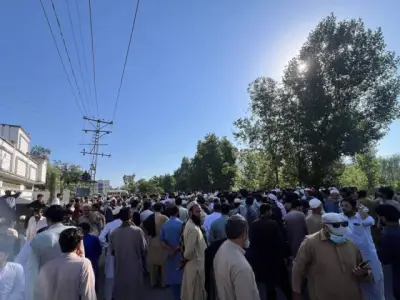
The situation became even more alarming when protests descended into violence. The tragic events witnessed in Rawalakot, including attacks on public facilities, clashes resulting in loss of life, injuries to civilians and security personnel, and reports regarding the recovery of weapons from organizational premises, marked a dangerous departure from peaceful activism. Regardless of political affiliation, no democratic society can normalize assaults on hospitals, attacks on law enforcement personnel, hostage-like situations, or attempts to challenge state authority through force. Such actions undermine not only public order but also the very grievances that protesters claim to represent. The consequences extend far beyond immediate security concerns. Businesses suffer, tourism declines, daily wage earners lose income, and ordinary families bear the cost of instability.
External Exploitation
Significantly, as violence escalated, Indian media outlets and television anchors quickly amplified the unrest, portraying the turmoil as evidence of internal collapse and exploiting the situation for their own narratives on Kashmir. This should serve as a reminder that internal disorder rarely remains an internal matter. Every episode of instability in Kashmir is closely monitored by external actors eager to shape perceptions in ways that undermine Pakistan's diplomatic position and weaken the broader Kashmiri cause. Violence does not strengthen political arguments; it weakens them by shifting attention away from legitimate concerns and toward lawlessness.
The Way Forward
There must therefore be absolute clarity about the path forward. The future of Kashmir, the status of refugee representation, and every constitutional question related to AJK must be decided through lawful institutions, democratic debate, and the aspirations of the Kashmiri people themselves. There is no place for intimidation, armed confrontation, or mob pressure in determining constitutional outcomes. Across the world, the use of violence to challenge state authority is considered unacceptable regardless of the cause being advanced, and the same principle applies here. Governments have a responsibility to maintain law and order, while citizens and political groups have a responsibility to pursue change through peaceful and constitutional means. The ballot box, not the barricade, remains the legitimate instrument of political transformation.