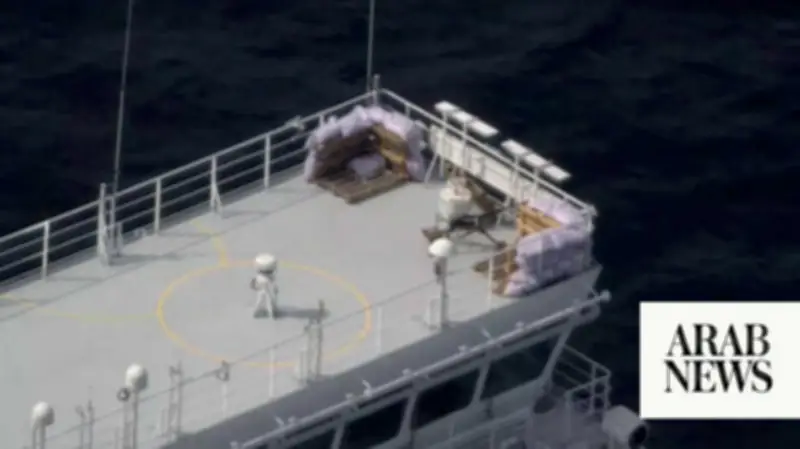
Estonia has released surveillance images showing machine guns and sandbags mounted on a Russian-flagged liquefied natural gas (LNG) carrier in the Baltic Sea this spring, indicating a more confrontational approach by Moscow to protect its civilian fleet. The images, provided by Estonia's Police and Border Guard, depict fortified machine gun positions on the bridge roof of the Marshal Vasilevskiy, a civilian vessel whose home port is Kaliningrad.
Armed Guards on Civilian Vessels in the Baltic
While armed guards are common on ships transiting piracy hotspots, their presence on civilian vessels in the Baltic is unprecedented. Yoruk Isik, a geopolitical analyst who runs the Bosphorus Observer consultancy, described the development as a “crazy new step.” “This is a hostile move by Russia to send a message to EU and NATO nations that it will actively oppose any attempt to detain or inspect its ships,” Isik told Reuters. “There is no justification for self-defense posture like a machine gun in the Baltic... This clearly shows that the high seas are becoming increasingly lawless.”
Details of the Marshal Vasilevskiy
The Marshal Vasilevskiy, owned by Gazprom unit Gazprom Flot LLC, has transported LNG to Kaliningrad from a port near St. Petersburg four times since the start of 2025, most recently in May, according to LSEG ship tracking data. The route runs along Estonia’s coastline. The images “were taken this spring on the Baltic Sea... within Estonia’s area of responsibility,” a spokesperson for the Estonian Police and Border Guard service said on Monday. Gazprom did not reply to Reuters' request for comment.

Russian Justification and Broader Context
Nikolai Patrushev, Russian President Vladimir Putin’s aide on maritime affairs, said in an interview published on June 15: “We cannot allow the blockade of our key maritime routes. The Baltic and Black Seas handle the majority of our maritime trade. It is crucial to ensure the timely dispersal and combat readiness of the (Russian) fleet, its ability to counter the full spectrum of threats.”
Since the start of the war in Ukraine, Western sanctions have targeted Russia's energy exports. Nine suspected shadow fleet oil tankers—vessels linked to Russia with opaque ownership and sailing under flags of convenience to skirt sanctions—have been seized across Europe since the start of the year, most recently by France on June 26. The Marshal Vasilevskiy was sanctioned by the United Kingdom in October 2024, by Canada in February 2025, and by Australia in December 2025. Gazprom Flot was sanctioned by the EU in April.
Baltic Security Concerns
A Baltic security official noted that the vessel was unlikely to be seized, as it does not fall into the shadow fleet category and sails under the Russian flag. “It’s hard to say what the Russians are thinking,” the official said. “Since the Baltic Sea became a NATO lake, Russians have been stressed about anything that is going on over there—so maybe they are just overthinking and overreacting.”
In April, Estonian Navy Commander Ivo Vark told Reuters that Russia is increasing its military presence in the international waters between Estonia and Finland—the access route to the ports around St. Petersburg, where a significant share of Russia’s energy exports is loaded. Vark also said Estonia had stopped attempting to detain Russia-linked vessels that do not pose an immediate danger because “the risk of military escalation is too high.” The Estonian Navy did not respond to a request for comment this week.
Strategic Importance of the Marshal Vasilevskiy
The Marshal Vasilevskiy, which can regasify LNG directly into a natural gas pipeline, was inaugurated by Putin in January 2019 as a backup supply route for the militarised Kaliningrad exclave, in case pipeline gas deliveries through NATO member Lithuania are disrupted. This development underscores the escalating tensions in the Baltic region, as NATO and Russia continue to vie for control over critical maritime routes.