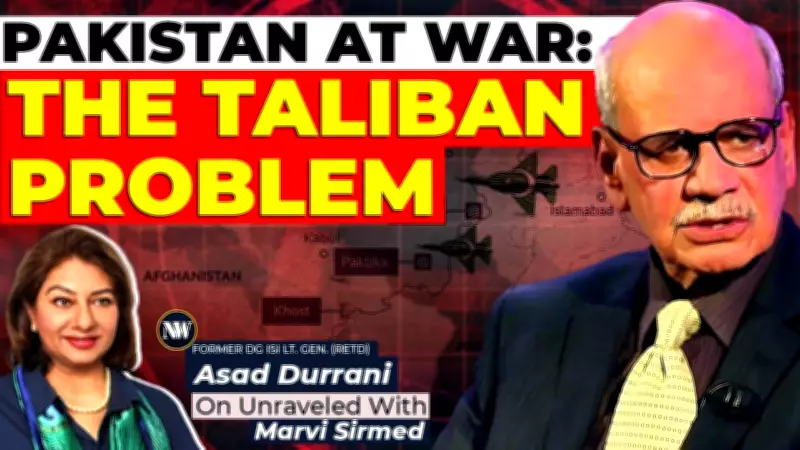
Ex-DG ISI Asad Durrani Analyzes Pakistan-Afghanistan 'Open War' Crisis
Pakistan and Afghanistan are currently embroiled in a perilous escalation of cross-border hostilities, a situation that Pakistan's defense minister has starkly labeled as "open war." In a detailed analysis, former Director General of the Inter-Services Intelligence (ISI), Lieutenant General (Retired) Asad Durrani, provides critical insights into the origins and dynamics of this conflict. He describes the trajectory as "completely nonsensical" yet predictable once the initial actions set events in motion.
Policy Triggers and Decision-Making Failures
General Durrani identifies several key policy triggers that have fueled the crisis. He points to the contentious issue of refugee expulsions, which has exacerbated tensions between the two neighboring nations. Additionally, he highlights unrealistic demands surrounding militancy, particularly concerning groups like the Tehrik-i-Taliban Pakistan (TTP), as a significant factor. Durrani emphasizes that decision-making failures have played a crucial role, often overriding established institutional mechanisms designed to manage such disputes. This breakdown in process has contributed to the rapid deterioration of bilateral ties.
Militancy as a Political Problem
A central argument in Durrani's analysis is that border militancy is fundamentally a political problem rather than a purely military one. He contends that military solutions alone are insufficient to address the root causes of cross-border violence. Instead, he advocates for a political approach that involves dialogue, negotiation, and addressing underlying grievances. This perspective challenges conventional strategies that prioritize military operations, suggesting that a shift in focus is necessary for lasting stability.

The Path to Course Correction
General Durrani discusses potential avenues for "course correction" to de-escalate the situation. He stresses the importance of revisiting policy decisions, particularly those related to refugees and counter-terrorism demands. Engaging in diplomatic channels to rebuild trust and cooperation is also highlighted as essential. Durrani warns that without such corrective measures, the spiral of hostilities could lead to further instability in the region, affecting both countries and beyond.
The analysis underscores the complexity of Pakistan-Afghanistan relations, marked by historical tensions and recent airstrikes. As cross-border incidents continue, Durrani's insights offer a sobering reminder of the need for strategic recalibration to prevent a full-blown conflict. His call for a political resolution over military escalation resonates as a critical message for policymakers seeking to navigate this volatile landscape.