India's Indus Waters Treaty Suspension: A Geopolitical and Environmental Crisis
A few weeks ago, I was invited by a group of senior diplomats to provide my assessment of India's suspension of the 1960 Indus Waters Treaty. The setting was serious, and the tone was strategic, yet the central question they posed was startlingly narrow: What could Pakistan offer India to persuade it to reinstate the treaty? The discussion did not begin with hydrology, climate science, or treaty law. Instead, it pivoted almost immediately to concessions.
One proposal was particularly alarming—granting India complete freedom to construct dams on the western rivers without objection. This approach reduced a complex, science-based water-sharing framework, which has governed one of the world's most fragile basins for over six decades, to transactional bargaining. It revealed more than anxiety; it exposed a diplomatic failure to grasp the technical and geopolitical stakes involved.
The Enduring Legacy of the Indus Waters Treaty
The Indus Waters Treaty has long been regarded as one of the most durable water agreements in modern history. Signed in 1960, it survived wars, military crises, and decades of hostility between two nuclear-armed neighbours. Its endurance was not accidental. The treaty rests on detailed engineering criteria, technical annexures, and a carefully calibrated allocation regime grounded in basin hydrology. It was designed to remove politics from rivers, ensuring stability and cooperation.

Suspending such a framework is not symbolic. It alters the strategic architecture of a river system that sustains hundreds of millions of people. Yet, rigorous technical discourse is often absent from Pakistan's policy debates. Climate change, glacial melt, sediment transport, seismic instability, and river engineering require interdisciplinary expertise. Engineering itself plays a dual role in the climate era: it contributes to emissions through infrastructure expansion, yet it also provides tools for mitigation and adaptation.
Without credible scientific oversight, water policy becomes reactive and vulnerable to manipulation. Pakistan's climate funding landscape illustrates this weakness. Foreign-funded NGOs operate with minimal performance audits, and no independent authority consistently evaluates the environmental outcomes of funded projects. In contrast, India and Bangladesh have supreme audit institutions that review public expenditures, including environmental and development programmes. In Pakistan, scrutiny is limited, and this vacuum has significant consequences.
Water Weaponisation and the Indus Crisis
In 2012, a Pakistani NGO and a diplomat began advocating for the revision of the Indus Waters Treaty under the banner of climate modernisation. Updating international agreements to reflect changing conditions is not inherently misguided, but reform must be grounded in basin-wide science and geopolitical foresight. Instead, the narrative became fragmented and politically exploitable.
Over time, India leveraged that internal debate to argue that even Pakistan's own voices questioned the treaty's adequacy. What began as an academic discussion evolved into a strategic liability—a blunder born of insufficient institutional caution. On 23 April 2025, India formally placed the Indus Waters Treaty "in abeyance," citing climate-driven changes in the basin. The claim was that the treaty's original framework did not address contemporary hydrological variability.
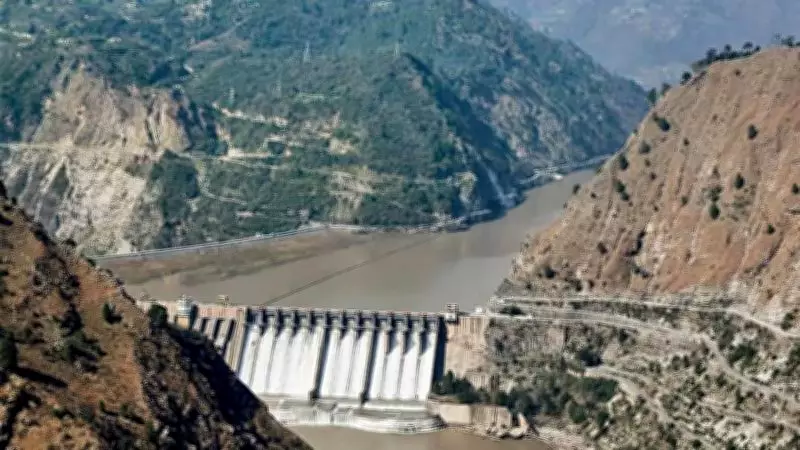
Yet, at the same time, India accelerated work on the 1,856-megawatt Sawalkote Hydroelectric Project in the Ramban district of Jammu and Kashmir. The scale of that project is immense. It will clear more than 24,000 kanals of dense conifer forest across riverine and designated forest land, in addition to deforestation required for roads and support infrastructure. Approximately 6,000 residents face displacement as villages fall within the reservoir zone.

Environmental and Seismic Risks
The environmental implications are serious. The dam will alter natural flow regimes, river temperature, and water chemistry, directly affecting aquatic ecosystems. Sediment transport—essential for downstream channel stability and agricultural fertility—will decline. The Chenab Valley is seismically sensitive terrain. Large reservoirs in such regions increase slope instability and landslide risk, particularly when combined with tunnelling and underground excavation.
These risks are not hypothetical. In August and September 2025, catastrophic floods swept through Uttarakhand, Himachal Pradesh, Punjab, and Jammu and Kashmir. Communities were submerged, and infrastructure collapsed. In response, the Supreme Court of India issued strong observations warning that unchecked development could cause the Himalayan states to "vanish." It underscored that revenue generation cannot come at the cost of environmental survival.
The Court's caution makes the expansion of major hydropower infrastructure in fragile mountain systems appear contradictory. The Himalayan arc is inherently disaster-prone. Climate change is accelerating glacial melt and increasing the frequency of extreme rainfall events and glacial lake outburst floods. Large reservoirs in such conditions do not automatically reduce vulnerability; if poorly managed, they can amplify it.
Economic and Strategic Considerations
Yet, the economics of hydropower have shifted in important ways. The Sawalkote project is estimated to cost $3.8 billion and generate electricity at roughly $0.088 per kilowatt-hour—higher than India's current average solar tariff of about $0.028 and wind at approximately $0.039. On the surface, that comparison seems decisive, but energy markets are not governed by tariffs alone.
Hydropower provides grid stability, storage capacity, and peaking power—functions intermittent renewables cannot fully replicate without large-scale battery systems, which carry their own costs and environmental burdens. In mountainous regions with seasonal water flows, storage-based hydropower can smooth volatility and enhance energy security over decades. When evaluated over a long asset life, with strategic value assigned to reliability and water storage, such projects can become financially viable despite higher upfront tariffs.
In that sense, hydropower in the Himalayas is no longer an economic relic; it is a strategic asset embedded in a broader energy transition. Kashmir also possesses vast renewable potential—approximately 111,000 megawatts of solar and around 5,300 megawatts of wind. Solarisation initiatives across thousands of government buildings are already contributing to measurable installed capacity. Distributed renewables reduce deforestation and minimise tunnelling, making them well-suited to dispersed settlements.
Geopolitical Risks and Nuclear Implications
What elevates the concern from environmental debate to geopolitical risk is storage control. In May 2025, India reportedly demonstrated operational control over the gates of the Kishanganga and Baglihar dams before Prime Minister Narendra Modi. Storage figures are telling: Sawalkote is designed for 430,000 acre-feet; Baglihar holds approximately 2,522 million acre-feet; Kishanganga maintains 6,100 acre-feet of live storage.
Storage confers timing power—the ability to regulate when and how much water flows downstream. In a basin shared by rival nuclear-armed states, that leverage carries strategic weight. Public rhetoric suggesting Pakistan should be "taught a lesson" amplifies anxieties that water could become an instrument of coercion. International water law rests on principles of equitable use, prevention of significant harm, and good-faith cooperation. When dams are perceived as geopolitical tools rather than developmental infrastructure, mistrust deepens.
It is important to acknowledge that not all voices in India endorse confrontational water policy. Indian analysts and environmental experts have cautioned against equating infrastructure expansion with strategic dominance. India enjoys nearly double the per capita water availability of Pakistan and controls larger river basins. Framing water as a weapon despite relative abundance suggests excess rather than necessity.
A Global Threat and Call to Action
The world is transfixed by existing battlefields, yet a far more catastrophic conflagration is smouldering in the Himalayas. This is no longer a regional friction; it is a systemic threat to global survival. If the Indus Waters Treaty is not reinstated in its original, technical integrity, the weaponisation of water between two nuclear-armed neighbours will become the detonator for World War III.
The pattern is a chilling roadmap to escalation: the unilateral suspension of a 65-year-old peace framework under the guise of "climate change," while simultaneously accelerating high-risk, strategically positioned dams. By asserting operational control over downstream flows, water is being transformed from a shared lifeblood into a tool of surgical coercion.
South Asia is a pressure cooker of two billion people, scarce resources, and extreme climate volatility. When river control is securitised by nuclear powers, the fallout cannot be contained. A single miscalculation—a man-made drought or a tactical flood—could trigger a conventional clash that spirals into a nuclear exchange, poisoning the global atmosphere and collapsing international stability.
The erosion of this treaty marks a dark shift in human history: the absorption of climate stress into existential geopolitical rivalry. Rivers ignore borders, but once they are weaponised, the damage is irreversible. The international community must wake up: if the original spirit of the Indus Waters Treaty is not restored now, the "Great Thirst" of the subcontinent will inevitably ignite a global fire that dwarfs every current conflict on Earth.