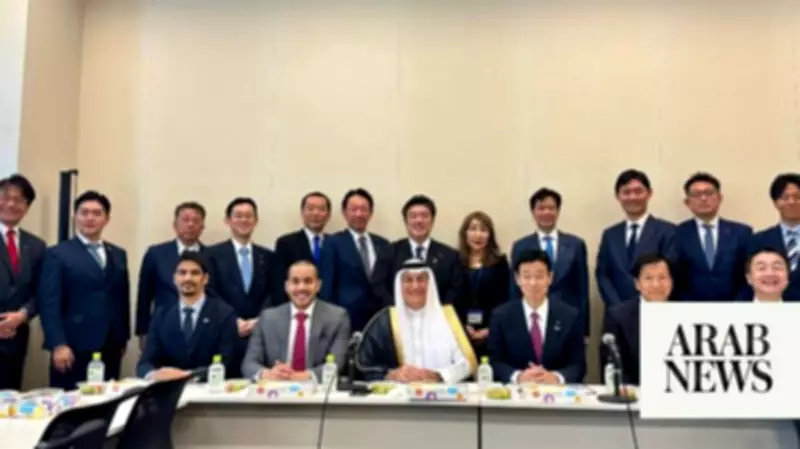
The Japan-Saudi Parliamentary Friendship League convened a pivotal general meeting in Tokyo on Tuesday, drawing key figures from both nations to discuss enhancing bilateral relations. Participants included Saudi Ambassador to Japan Ghazi Faisal Binzagr; Nishimura Yasutoshi, former minister of economy, trade and industry; 21 other Japanese parliamentarians; and senior officials from the Saudi Embassy.
Ambassador Binzagr Highlights Cultural and Economic Ties
Ambassador Binzagr described the Parliamentary Friendship League as a vital bridge that nurtures mutual understanding, sparks dialogue, and drives collaboration between Japan and Saudi Arabia. He praised the league's dedication to strengthening ties, especially as the countries last year celebrated 70 years of diplomatic relations built on trust, respect, and a shared vision.
“As we honor this remarkable legacy, we renew our commitment to deepen and expand our connection,” Binzagr said. “What began as simple exchanges has blossomed into lasting partnerships rooted in enduring trust. This journey has unfolded with intention, especially since the launch of the Saudi-Japanese Vision 2030 in 2017. Since then, our collaboration has grown beyond energy to industry, investment, technology, innovation, and culture.”

The ambassador cited the success of Expo 2025 Osaka as evidence that strong economic ties depend on robust cultural connections. He emphasized that in the current global context, economic strength and security are interdependent, with energy security central to both. Rather than seeking alternatives, he advocated for shared resilience through an integrated system.
“The partnership between Japan and Saudi Arabia is not a reaction to a crisis but a model for turning challenges into lasting stability,” Binzagr added. “The collaboration is strengthened by shared human capital, including Saudi professionals educated and employed in Japan, and Japanese experts proficient in Arabic with deep regional understanding. These individuals enhance mutual understanding, effective implementation, and future cooperation.”
Binzagr also highlighted progress toward establishing a Strategic Partnership Council and stressed that continued support is essential to advance bilateral relations, emphasizing that partnership is a necessity, not an option.
Nishimura Yasutoshi Acknowledges Energy Cooperation
Nishimura thanked the ambassador for Saudi Arabia’s reliable oil supplies during the current crisis in the Middle East and expressed a desire to strengthen bilateral ties. He also expressed sympathy for the Kingdom’s losses during the ongoing conflict with Iran and praised Saudi Arabia for its role in facilitating talks between Iran and the US.
“Saudi Arabia has continued supplying our country from Yanbu Port through east-west pipelines and will keep doing so,” Nishimura said. “Saudi Arabia has always been an important energy partner for Japan, now and in the future. I want to thank you again for your help and efforts in keeping the supply steady during these difficult times.”
He added that the partnership extends far beyond oil, encompassing hydrogen, ammonia, and advanced materials. He reiterated Japan’s commitment to fostering corporate alliances through the Japan-Saudi Vision and Saudi Vision 2030 initiatives.
Nishimura also noted the remarkable popularity of the Saudi Pavilion at last year’s Osaka-Kansai Expo and expressed optimism about enhancing ties in emerging fields such as esports, gaming, anime, space, artificial intelligence, and other advanced industries. He mentioned a recent telephone conversation between Prime Minister Sanae Takaichi and Crown Prince Mohammed Bin Salman, during which both leaders pledged to collaborate more closely in these innovative sectors.
Japanese Foreign Ministry Official Highlights Opportunities
Keiichi Iwamoto, director of the Japanese Foreign Ministry’s Middle East Division, noted the vital role of the Kingdom, discussed Japan’s reliance on Gulf states—particularly Saudi Arabia—for energy, and highlighted fresh opportunities for collaboration beyond the energy sector.