In the busy streets of Karachi, children are increasingly becoming the most vulnerable victims of a city where roads and transport systems are designed for vehicles rather than people. A comprehensive study on child road traffic injuries reveals a disturbing pattern: what often appears as isolated accidents is, in fact, the result of deep-rooted systemic failures in urban planning, transport governance, and road safety enforcement. The findings suggest that child road traffic injuries in Karachi are not random events, but predictable outcomes of an unsafe urban environment where infrastructure, behaviour, and institutional gaps intersect to create continuous risk.
Global Context and Local Realities
Road traffic injuries remain one of the leading causes of death and disability worldwide, particularly in low- and middle-income countries where rapid urban growth has outpaced safety planning. Karachi, Pakistan’s largest city and economic hub, reflects this global challenge in an intensified form. With rising population density, increasing reliance on motorcycles, and weak enforcement of traffic laws, the city’s road network has become increasingly hazardous. Within this environment, children face disproportionate risks due to their limited ability to assess danger, dependence on adults for mobility, and frequent exposure to unsafe commuting conditions. Whether walking to school, riding as passengers, or playing near roads, children are constantly interacting with traffic systems that are not designed with their safety in mind.
Four High-Risk Groups
The study identifies four major groups of children most affected by road traffic incidents in Karachi: child pedestrians, motorcycle passengers, school van users, and children playing in streets and service roads.

Child Pedestrians
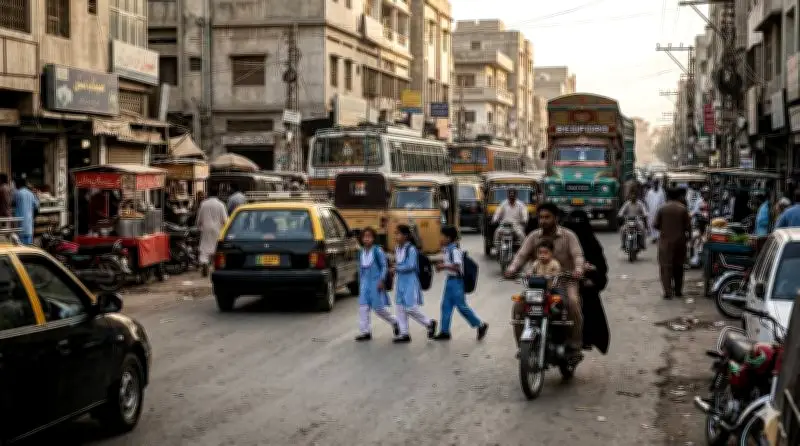
Child pedestrians remain highly vulnerable due to the lack of safe crossings, pavements, and traffic-calming infrastructure. Many children are forced to navigate busy roads in residential and commercial areas without supervision, increasing their exposure to speeding and unpredictable traffic.
Motorcycle Passengers
Motorcycles, which are among the most common modes of transport in Karachi, present another major risk. Children are frequently transported without helmets, proper seating arrangements, or safety precautions. In many cases, multiple children are carried on a single motorcycle, significantly increasing the severity of injuries during collisions.
School Van Users
School vans, widely used for transporting children across the city, represent a critical but often overlooked risk category. Overcrowding, weak regulation, and unsafe drop-off practices frequently force children to disembark in unsafe locations, requiring them to cross busy roads alone.
Children Playing in Streets
In addition, children playing cricket or football in streets and service lanes remain highly exposed to traffic hazards. In densely populated neighbourhoods, roads often double as play areas due to the absence of safe recreational spaces.
Behavioural and Infrastructural Factors
The study highlights a combination of behavioural, infrastructural, and institutional factors that collectively drive child road traffic injuries. At the behavioural level, reckless driving, speeding, dangerous overtaking, and non-compliance with traffic rules are consistently reported. Teenagers riding motorcycles without licences or proper training further add to the risk environment, particularly when interacting with child pedestrians. School transport practices also present serious concerns. Overcrowded vans operated by private drivers often exceed safe capacity limits, with children forced to stand near doors or footboards. In many reported cases, children are dropped at unsafe locations, leaving them to cross multiple lanes of traffic alone. Heavy vehicles such as dumpers, trailers, and water tankers are frequently involved in severe and fatal accidents involving children, especially in high-traffic corridors.

Infrastructural Deficiencies
At the infrastructural level, Karachi’s road system is largely designed for vehicular flow rather than pedestrian safety. The absence of pavements, designated school zones, safe crossings, and traffic-calming measures creates dangerous conditions for children. Weak enforcement around schools, where traffic wardens, crossing guards, and speed control systems are largely absent, further intensifies risks.
Socioeconomic and Environmental Factors
Socioeconomic conditions also play a significant role. Children from low-income families are more likely to rely on motorcycles or informal transport and often live in densely populated areas where safe play spaces are unavailable. As a result, streets become informal playgrounds, increasing exposure to traffic dangers. Environmental factors such as poor street lighting, encroachments, illegal parking near schools, broken pavements, and lack of road signage further worsen visibility and safety conditions.
Systemic Governance Failures
Beyond immediate risk factors, the study highlights deeper systemic failures within Karachi’s urban governance and transport systems. One of the most significant gaps is fragmented institutional responsibility. Road safety management is distributed across multiple agencies, often with limited coordination, leading to inconsistent enforcement and weak accountability. Another major concern is the absence of child-specific road safety planning. Existing policies tend to treat road users as a uniform group, failing to account for the unique vulnerabilities of children in traffic environments.
Inadequate Emergency Response
Emergency response systems also remain inadequate. Delays in pre-hospital care, limited trauma preparedness, and unequal access to emergency services significantly worsen outcomes for injured children. In many cases, survival and recovery depend more on response time than on the nature of the accident itself.
Data Gaps
A particularly critical gap identified in the study is the lack of reliable, integrated data on child road traffic injuries. Information is scattered across hospitals, police records, and emergency services, with no unified system for tracking incidents. Minor injuries and near-misses are often unreported, making it difficult to accurately assess the scale of the problem or design targeted interventions.
Call for Systemic Change
The findings strongly suggest that child road traffic injuries in Karachi are not simply the result of individual negligence but are deeply embedded in structural failures of urban planning and governance. The dominance of vehicle-centric planning, weak regulatory enforcement, unsafe transport systems, and fragmented institutional coordination collectively create an environment where children remain highly exposed to preventable harm. Experts involved in the study emphasise that current responses, which largely focus on awareness campaigns and behavioural change, are insufficient. While important, these measures cannot compensate for unsafe infrastructure and weak institutional systems. The study calls for a fundamental shift towards integrated, system-level interventions that place child safety at the centre of urban planning and transport policy.
Key Priorities
Key priorities include the development of child-focused road safety policies, stricter enforcement of traffic laws, regulation of school transport systems, and the creation of safe pedestrian infrastructure. Investment in safe recreational spaces is also essential to reduce the need for children to play in the streets. Improving coordination between institutions and developing integrated road traffic injury data systems are also critical for evidence-based policymaking and targeted interventions. Ultimately, child road safety in Karachi must be treated not only as a public health concern but as a core issue of urban governance, requiring sustained political commitment and multi-sectoral action.