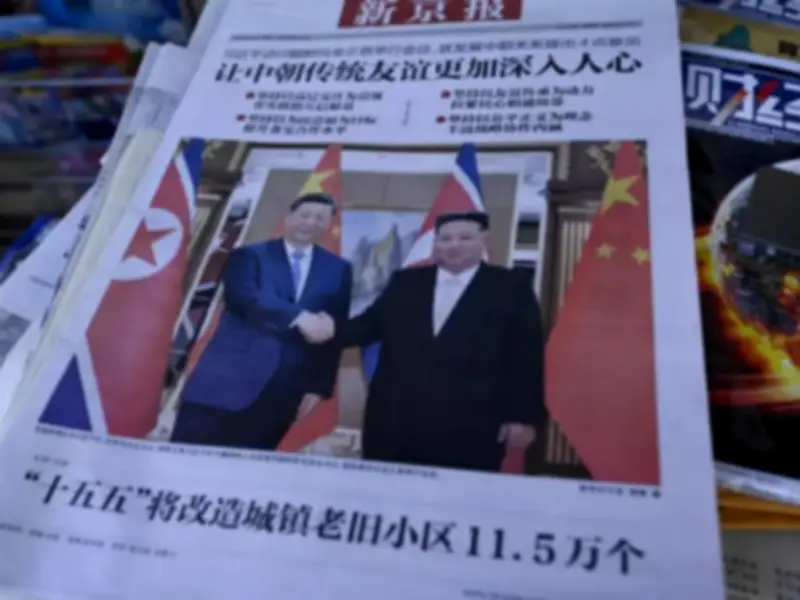
The leaders of North Korea and China have adopted a 'far-reaching blueprint' for bilateral ties during Chinese President Xi Jinping's recent visit to Pyongyang, according to the state-run Korean Central News Agency (KCNA) on Wednesday. Xi made a rare visit to diplomatically isolated North Korea on Monday, following a series of meetings with world leaders in Beijing, including US President Donald Trump and Russian leader Vladimir Putin. The trip also occurred amid unusually warm relations between North Korea and Russia, with Pyongyang reportedly sending soldiers and munitions to assist Moscow's invasion of Ukraine.
Key Outcomes of the Xi-Kim Summit
Kim and Xi 'expressed satisfaction and deep emotion over the fact that they provided a far-reaching blueprint for the development of the relations,' KCNA reported. During the two-day trip, 'the countries further deepened the revolutionary friendship and close comradely relationship and affirmed their steadfast will to develop the traditional DPRK-China friendly ties into a model of the most powerful and strategic relations,' it added.
Xi and Kim toured the Central Cadres Training School of the Workers' Party, where they discussed the training of party officials and planted a commemorative tree. They also visited the Friendship Tower memorial, which honors Chinese soldiers who fought in the Korean War. Xi was afforded a lavish welcome on the trip, accompanied by his wife and other senior officials.

In a letter thanking Kim, Xi said the leaders had 'made an in-depth exchange of views on the issues of mutual interest and achieved a series of important common understanding,' according to KCNA. The talks 'showed the firm determination of both sides to add lustre to the traditional friendship, promote development and prosperity together and defend peace and stability in the region and the rest of the world,' Xi reportedly wrote.
Strengthening Military and Diplomatic Ties
On Tuesday, China's state-run Xinhua news agency reported Xi as saying he had reached 'an important consensus with Kim on developing China-DPRK relations in the new era,' using North Korea's official acronym. Xi pushed to strengthen diplomatic, law enforcement, and military ties, according to Beijing's state media. By sharing information in the military sector, China appears to want to 'directly assess technological changes within the North Korean military and the status of Russian technology transfer,' said Hong Min, an analyst at the Korea Institute for National Unification. China may also hope to 'collect intelligence for the purpose of monitoring trends in pro-Russian and pro-Chinese human networks within the North Korean military,' he added.
Nuclear Silence Raises Questions
Xi's trip came after last month's talks with Trump, during which the White House said the leaders 'confirmed their shared goal to denuclearise North Korea.' However, official media reports from both China and North Korea made no mention of denuclearisation in their coverage of the Xi-Kim summit. Analysts suggested that Beijing was tacitly accepting Pyongyang's status as a nuclear-armed state.
Kim has repeatedly vowed never to give up his nuclear arsenal, and his powerful sister said before Xi's visit that the programme was Pyongyang's 'line of no retreat.' Despite being historically highly reliant on political and economic support from China, Kim has drawn North Korea closer to Russia in recent years. He has boosted an alliance with Putin by sending troops to fight alongside Russian forces against Ukraine.
Still, Beijing remains an economic anchor for North Korea, whose economy has been hobbled for years by international sanctions over its nuclear programme. China accounted for $2.6 billion of North Korea's foreign trade — nearly 98 percent of the total — in 2024, according to South Korea's Ministry of Economy and Finance.