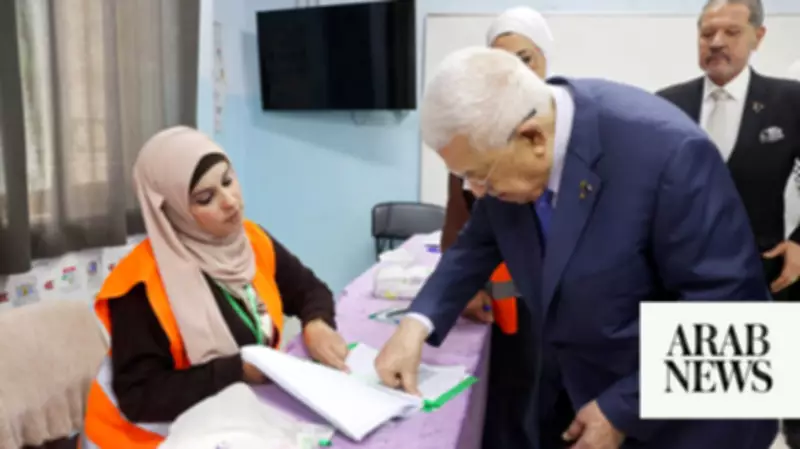
Palestinians in the West Bank and central Gaza went to the polls on Saturday for municipal elections, marking the first vote since the war in Gaza erupted. Turnout was low, and the political field remained limited.
Voter Registration and Turnout
Nearly 1.5 million people were registered to vote in the Israeli-occupied West Bank, alongside 70,000 individuals in Gaza's Deir El-Balah area, according to the Ramallah-based Central Elections Commission. In the early hours, a steady trickle of voters arrived at polling stations in Al-Bireh in the West Bank and Deir Al-Balah. By late morning, turnout stood at a mere 15 percent, rising to 24.53 percent by 1 p.m., as reported by the election commission.
Presidential Remarks
Palestinian President Mahmoud Abbas expressed satisfaction with the democratic process despite challenges. "We are very pleased to exercise democracy despite the many challenges we face, both locally and internationally," Abbas told journalists after casting his vote in Al-Bireh, as reported by the Palestinian news agency Wafa. He emphasized that elections would eventually be held across the Gaza Strip, stating, "Gaza is an inseparable part of the state of Palestine. Therefore, we have worked by all means to ensure that elections take place in Deir Al-Balah to affirm the unity of the two parts of the country together."

Voter Perspectives
Voter Khalid Eid, 55, expressed hope for change in council composition. "We can't change the situation, but we hope to replace people ... people who might be better and help develop the community," he said. However, some questioned the timing of the elections. Ziad Hassan, a businessman from Dura Al-Qaraa village, remarked, "We did not want elections at this time — not with war in Gaza and settler attacks ongoing in the West Bank. The decision was imposed on us, and so we are compelled to elect an administrative body for the village council."
Security Concerns
Israeli settler attacks have surged in recent months, becoming a major concern. Abed Jabaieh, 68, former mayor of Ramun village, stated, "The main thing is security from settlers. That's why we need new faces, young people willing to fight for our rights."
Political Landscape
Most electoral lists are aligned with Abbas's secular-nationalist Fatah movement or consist of independents. Hamas, Fatah's rival and the ruling power in Gaza, is absent from the race. In many municipalities, Fatah-backed lists face off against independents supported by smaller factions such as the Marxist-Leninist Popular Front for the Liberation of Palestine. Municipal councils oversee water, sanitation, and local infrastructure but do not enact legislation. With presidential or legislative elections frozen since 2006, councils have become one of the last remaining democratic mechanisms under the Palestinian Authority (PA).
PA Challenges and International Reaction
The PA faces widespread criticism over corruption, stagnation, and declining legitimacy. Western and regional donors have increasingly tied financial and diplomatic support for the PA to visible reform, particularly in local governance. The European Union called the vote an "important step toward broader democratization and strengthened local governance ... in line with the ongoing reforms process."
Context of War
Two years of war have left swaths of Gaza destroyed and more than 72,000 people dead, according to the territory's Health Ministry, whose figures are considered reliable by the UN. Public infrastructure, sanitation services, and the health sector are all struggling to function. Under Hamas control since 2007, Gaza is seeing its first vote since the 2006 legislative elections that the Islamist movement won. The PA is holding elections only in Deir Al-Balah to test its "success or failure, since there are no post-war opinion polls," said Jamal Al-Fadi, a political scientist at Cairo's Al-Azhar University. It was chosen as one of the few areas where the population has not been massively displaced.

Symbolism and Hope
After voting, Mohammed Al-Hasayna, 24, said although the elections were largely symbolic, they served as a sign of people's "will to live." "We are an educated people with strong determination, and we deserve to have our own state," he said. "We want the world to help us overcome the catastrophe of war. Enough wars — it is time to work toward rebuilding Gaza."