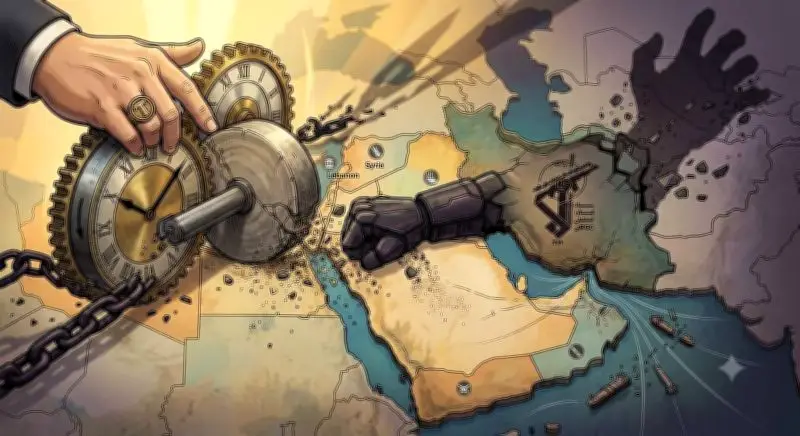
The latest American strikes against Iran following the IRGC’s attacks on commercial shipping in the Strait of Hormuz have once again raised fears that the Middle East is sliding towards another major war. President Trump’s declaration that the Islamabad MoU is “over” appears to reinforce that perception. Yet the latest escalation is better understood as part of a longer strategic contest that is steadily reducing the IRGC’s regional leverage rather than signaling the collapse of diplomacy. That process did not begin with the latest crisis in Hormuz. It has unfolded throughout the chain of events that began with Hamas’s attack on Israel on 7 October 2023. Since then, wars, proxy conflicts, diplomacy and shifting regional alignments have steadily changed the balance of power. Judged over that entire period rather than through the headlines of any single week, one trend stands out: the IRGC is steadily losing the sources of influence that enabled it to shape events across the Middle East.
Hormuz: The Latest Flashpoint in a Broader Contest
The Strait of Hormuz is the latest example. Tehran insists that the post-war framework allows it to regulate shipping through its waters. The United States and its regional partners reject that interpretation, arguing that freedom of navigation cannot be subject to coercion. The attacks on commercial vessels linked to Saudi Arabia and Qatar therefore marked an important turning point. Unlike previous incidents, Washington responded not simply by retaliating but by expanding strikes against the naval, missile and drone capabilities that allow the IRGC to threaten one of the world’s busiest maritime routes. Hormuz, however, is only one part of a much larger story.
IRGC’s Regional Leverage Under Pressure
When the current conflict began, the IRGC possessed several important sources of regional leverage. One by one, they have come under increasing pressure. Hamas has been severely weakened. Hezbollah now faces growing constraints under the evolving Lebanon framework. Syria has moved in a very different direction since the fall of Bashar al-Assad. Washington’s decision to remove Syria from its list of state sponsors of terrorism is significant because it supports the country’s reintegration into the region and further reduces Tehran’s ability to use Syria as the strategic corridor it once depended upon.

Gulf Diplomacy and Deterrence
A similar pattern has emerged across the Gulf. During the early months of the conflict, Iran demonstrated that it could threaten several Gulf states simultaneously. Over time, diplomacy and deterrence narrowed those options. Pakistan strengthened its security cooperation with Saudi Arabia. Qatar evolved from being a target into a key diplomatic channel. Oman consistently supported dialogue while rejecting any attempt to legitimize coercion in Hormuz. These developments made attacks on the Gulf increasingly costly, both politically and militarily. The latest attacks on Saudi and Qatari ships are therefore more likely to strengthen regional resolve than weaken it.
Trump’s Long Game vs. Israel’s Approach
These developments point to a broader shift in American strategy. Israel viewed the conflict primarily as an opportunity to pursue regime change in Iran. Trump appears to have reached a different conclusion. Such an objective would have required a costly ground campaign and broad regional support that simply did not exist. Instead, Washington has increasingly focused on reducing the sources of leverage through which the IRGC has projected influence across the Middle East for decades. The struggle is no longer simply about Iran's nuclear programme or another exchange of missiles. It is about whether the Middle East can move beyond a regional order built on coercion, proxy warfare and the disruption of international commerce.

Why the IRGC Continues to Escalate
Whether that strategy ultimately succeeds remains uncertain. The risk of further escalation is real, and diplomacy remains fragile. But the latest military exchanges should not obscure the broader trend. From Hormuz to the Gulf and from Syria to Lebanon, the strategic space in which the IRGC has traditionally operated is steadily narrowing. That, more than the latest exchange of missiles, is the real story unfolding in the Middle East today. The question, then, is why the IRGC continues to escalate despite these setbacks. The answer lies in the changing balance of power. The IRGC has long relied on three principal sources of leverage: its ability to threaten the Strait of Hormuz, its network of regional allies and proxies, and its capacity to impose costs on the Gulf states whenever tensions with the United States or Israel escalated. Each of these is now under greater pressure than at any point since the current conflict began.
Hormuz: A Narrowing Space for Maneuver
Hormuz remains its most important remaining card, which explains why it has become the centre of the latest confrontation. But even here the space for manoeuvre is narrowing. American naval deployments, expanded protection of commercial shipping, repeated strikes on IRGC naval assets and growing international support for freedom of navigation are steadily increasing the cost of disrupting maritime trade. Every attack on commercial shipping now invites a stronger military response and further weakens the very capability the IRGC seeks to preserve. The same trend is visible in the Gulf. Earlier in the conflict, Iranian attacks extended across much of the Gulf region. Today, the political environment is very different. Saudi Arabia, Qatar, Oman and Pakistan have consistently invested in diplomacy while simultaneously strengthening deterrence. The Gulf states refused to become parties to a wider regional war, frustrating Israeli hopes of building a broader anti-Iran military coalition. Yet that restraint should not be mistaken for acceptance of IRGC behavior. Recent attacks on commercial shipping have steadily eroded whatever political tolerance remained for using Hormuz as a bargaining tool.
Strategic Reversal in the Levant
The Levant presents perhaps the most significant strategic reversal. Hezbollah remains the IRGC’s most important regional partner, but its freedom of action is increasingly constrained. The Lebanon framework, continued pressure from Israel and Syria’s changing political orientation have together created conditions very different from those that existed before 7 October. Washington’s decision to remove Syria from its list of state sponsors of terrorism, together with growing Turkish and Arab engagement with Damascus, points towards a regional strategy aimed at integrating Syria rather than allowing it to remain a platform for Iranian influence. This is where Trump’s approach differs fundamentally from Israel’s. Israel largely viewed military victory and regime change as the pathway to regional security. Trump appears to have reached a different conclusion. Rather than seeking to overthrow the Iranian state, he has increasingly worked with regional partners to reduce the strategic value of the IRGC itself. The objective is not simply to punish Iran but to make the instruments through which the IRGC has projected influence—Hormuz, regional militias and coercive pressure on neighboring states—progressively less effective.
Pakistan’s Role in Regional Diplomacy
Pakistan’s role deserves recognition in this wider picture. Working closely with Qatar and maintaining communication with Saudi Arabia, Türkiye and Iran, Islamabad consistently supported diplomacy while reinforcing deterrence where necessary. Its contribution was not to resolve the conflict but to help prevent repeated crises from developing into a wider regional war. That remains an important, if often overlooked, part of the current diplomatic landscape.
The Larger Challenge: Gaza and Palestinian Statehood
None of this should obscure the region’s larger challenge. Israel’s conduct in Gaza and the West Bank, together with the continued absence of a credible political process leading to Palestinian statehood under the Arab Peace Initiative, remains the greatest long-term obstacle to a just and lasting peace. That explains why the Gulf states never embraced Israel’s broader regional agenda despite sharing concerns about Iran’s regional activities. They continue to see regional stability—not perpetual confrontation—as essential to their own security and economic transformation.
Conclusion: The Long Game
The latest escalation, therefore, should not be read simply as another chapter in the confrontation between Washington and Tehran. It is part of a larger contest over the future of the Middle East. The more the IRGC’s traditional sources of leverage are reduced, the more it is likely to test the limits through calculated escalation. Yet every such escalation also strengthens the regional and international determination to deny it that leverage. That is Trump’s long game. It is slower than the military solution Israel preferred, more dependent on regional diplomacy than many expected, and far from guaranteed to succeed. But judged by the cumulative direction of events since 7 October rather than the headlines of any single day, the evidence increasingly points in one direction. The struggle is no longer simply about Iran’s nuclear programme or another exchange of missiles. It is about whether the Middle East can move beyond a regional order in which coercion, proxy warfare and the threat of disrupting international commerce have long been accepted as instruments of influence. On that larger question, the IRGC is finding itself with fewer options than before. According to Ishtiaq Ahmad, Professor Emeritus of International Relations at Quaid-e-Azam University, Islamabad, the trend is clear: the IRGC is steadily losing its sources of influence.