Human societies are built not merely upon facts, but upon stories. Making up stories is an ancient human art. Making millions believe them as truth is an even greater craft. Nations, religions and states are held together not only by facts but also by myths and stories that people choose to believe. History is rarely a simple record of events. It is shaped by memories, interpretations and competing narratives about the past.
Few modern conflicts illustrate this better than the struggle between Israelis and Palestinians. For many Jews, the creation of Israel in 1948 was the return of an ancient people to their ancestral homeland after nearly two thousand years of exile. For Palestinians, it was the arrival of European settlers who displaced a native population with the support of powerful imperial states. Both sides draw upon history. Both seek legitimacy from the past. Yet neither story can be fully understood without looking at the long and complex journey of the Jewish people.
Origins of the Jewish People
That journey began in ancient Judea and stretched across continents. It passed through centuries of migration, persecution and survival before leading to the rise of Zionism and the creation of the State of Israel. One of the central questions in this debate is whether the Jews who founded Israel in the twentieth century were the direct descendants of the ancient inhabitants of Judea, or whether centuries of migration, intermarriage and conversion had transformed them into a very different people.

The Romans brought Judea under their control in 63 BC. The relationship that followed was turbulent and often violent. Contrary to popular belief, the Romans did not expel all Jews from Palestine in a single act. Jewish communities remained in the region for centuries. But repeated wars, economic hardship and political repression encouraged many to leave.
Jewish Diaspora and Persecution
Jewish migration into Europe and other parts of the Roman Empire happened gradually. In many places, Jewish communities already existed long before the destruction of Jerusalem. Over time, the Jewish world spread far beyond Judea and became a vast diaspora stretching across Europe, North Africa and the Middle East. Though separated by great distances, these communities remained connected by religion, tradition and a shared memory of their ancestral homeland. At the same time, they were shaped by the societies in which they lived.
By the modern era, Jews had developed into several distinct communities. The Ashkenazi Jews of Europe, the Sephardi Jews of North Africa and Spain, and the Mizrahi Jews of the Middle East shared a common religious heritage but very different historical experiences. Jewish communities made important contributions to trade, learning, science and culture. Yet throughout much of Europe, they remained vulnerable to discrimination and persecution.
For centuries, many Christians blamed Jews for the death of Jesus. They were portrayed as enemies of Christianity and agents of evil. In many countries, they were barred from owning land, holding public office or joining professional guilds. Excluded from many occupations, many Jews turned to trade, commerce and money-lending. During times of crisis, they were often used as convenient scapegoats. They were falsely accused of poisoning wells during the Black Death and of using the blood of Christian children in religious rituals. In many cities, they were confined to segregated neighbourhoods known as ghettos.
The Enlightenment brought some improvement. Jews gained greater rights, and many rose to prominent positions in business, science, politics and the arts. Yet old prejudices never completely disappeared. By the nineteenth century, many European Jews had hoped that political emancipation and equal citizenship would finally allow them to become accepted members of the societies in which they lived. But rising nationalism and racial antisemitism shattered those hopes.

Modern Antisemitism and Zionism
By the late nineteenth century, a new form of antisemitism had emerged. Jews were accused of using their wealth, education and influence to dominate society. Conspiracy theories flourished across Europe. Violent pogroms in Eastern Europe and events such as the Dreyfus Affair in France convinced many Jews that assimilation alone could not guarantee their safety. The Nazis took this hatred to its most extreme form. Jews were blamed for Germany's political instability, economic problems and social tensions. They were no longer viewed simply as followers of a religion but as members of an inferior race. The result was the Holocaust, one of the greatest crimes in human history. Millions of Jews were murdered in a systematic campaign of extermination.
For many Jews, the connection to Palestine was not based solely on history. It was also rooted in religion. Jewish tradition holds that God promised the land of Canaan to the descendants of Abraham, Isaac and Jacob. For nearly two thousand years, prayers, rituals and sacred texts preserved the thought of Jerusalem and the hope of return. Although many of the founders of modern Zionism were secular rather than religious, they drew upon this deep historical and spiritual attachment to the land. Palestine was not simply a place on a map. It was the homeland remembered in Jewish history and faith.
Palestinians, however, viewed the matter differently. They argued that a religious promise made thousands of years ago could not override the rights of people who had lived continuously on the land for centuries. To them, Palestine was not an ancient memory but a living homeland. It was in this climate that Zionism emerged. Led by Theodor Herzl and other Jewish thinkers, Zionism argued that Jews were not merely a religious community but a nation. Like other nations, they needed a homeland of their own. For many Zionists, Palestine—the land of ancient Judea and the homeland preserved in Jewish faith—was the natural destination.
The Birth of Israel and the Palestinian Nakba
Beginning in the late nineteenth century, Jewish immigrants from Europe started settling there and building new communities. The collapse of the Ottoman Empire after the First World War gave new momentum to the movement. Britain, through the Balfour Declaration, expressed support for the establishment of a Jewish national home in Palestine. Jewish immigration increased during the British Mandate. At the same time, tensions with the Arab population grew. Both communities believed they had legitimate claims to the same land.
The Holocaust further strengthened international support for a Jewish state. Unable to reconcile Arab and Jewish demands, Britain referred the issue to the newly formed United Nations. In November 1947, the UN adopted the United Nations Partition Plan for Palestine. The plan proposed: a Jewish state, an Arab state and international administration of Jerusalem. Although Jews were about one-third of the population and owned less than 10 per cent of the land, the proposed Jewish state would receive roughly 55 per cent of the territory. Jewish leaders accepted the plan. Arab leaders and the Palestinian Arab leadership rejected it, arguing that it unfairly allocated land and violated the principle of majority rule.
Immediately after the UN vote, fighting broke out between Jewish and Arab communities in Palestine. During this period, Jewish forces gradually gained the military advantage. Many Palestinian Arabs fled combat zones, while others were expelled from their homes. The causes of this exodus remain one of the most disputed issues in the conflict. In 1948, one day before Britain ended its mandate, Israel declared its independence.
The creation of Israel cannot be separated from the wider transformation of the Middle East after the First World War. European powers dismantled the Ottoman Empire and redrew the map of the region. New states and borders emerged, often with little regard for the wishes of the people who lived there. Palestine became one of the most enduring legacies of that imperial settlement.
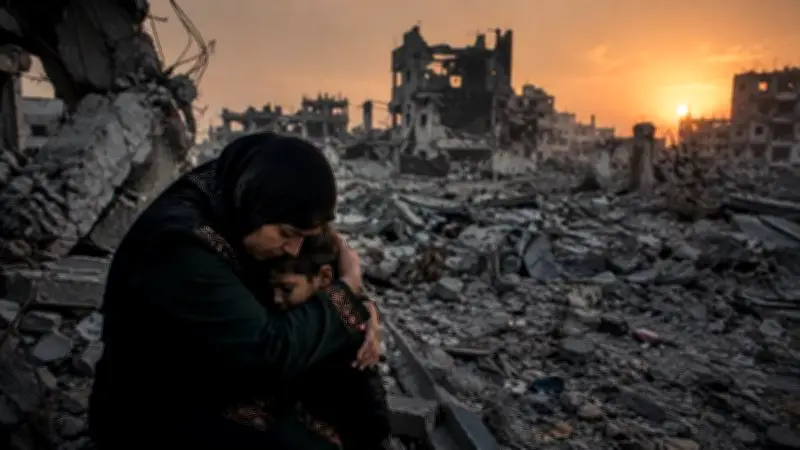
For Jews, Israel represented security after centuries of exile, persecution and the horrors of the Holocaust. It was the fulfilment of a long-held aspiration for national self-determination. For Palestinians, the same event marked the Nakba—the catastrophe. Hundreds of thousands fled or were expelled during the 1948 war. Families lost their homes, villages disappeared, and people found themselves scattered across refugee camps and neighbouring countries. One person's redemption became another person's tragedy.
Legacy of Imperialism
The roots of this conflict lie not only in the competing claims of Jews and Palestinians but also in the unresolved problems of European history. Antisemitism was largely a European phenomenon, yet many of its political consequences were ultimately felt in Palestine. The continent that had persecuted Jews for centuries played a decisive role in creating a solution whose costs were borne by another people. At a time when the Europeans were themselves forced to leave their colonies in the face of national liberation movements, they brought a new colonial enterprise into existence, which remains the last settler colony in the world today.
History seemed to come full circle. A people who had themselves experienced centuries of exile and dispersal established a state that resulted in the displacement of a large part of Palestine's indigenous Arab population. As the decades passed, the Palestinian presence on the land became increasingly fragmented. Many found themselves confined to the Gaza Strip, the West Bank or refugee camps across the Arab world.
Ongoing Conflict
What began as a dispute over territory evolved into one of the world's longest-running conflicts. Wars, occupations, settlements and recurring cycles of violence deepened the divisions between the two peoples and destabilised much of the surrounding region. More than seventy-five years later, the conflict remains unresolved. It is also a reminder that historical injustices do not cancel one another out. The suffering of one people cannot erase the suffering of another.
The Jewish story speaks of exile, persecution and return. The Palestinian story speaks of dispossession, displacement and resistance. Both are rooted in genuine historical experience. Between these competing narratives lies one of the great tragedies of the modern age: two peoples, each carrying the weight of history, claiming the same land and believing that justice is on their side.
Perhaps that is the deepest lesson of this conflict. History rarely offers simple answers. More often, it leaves behind unfinished grievances and truths that coexist uneasily with one another. And nowhere is that reality more visible than in the land between the Jordan River and the Mediterranean Sea.