Trilateral Meeting in Tripoli Highlights Growing Border Insecurity
Security officials from Libya, Tunisia, and Algeria convened in Tripoli on June 16 for the second session of a joint working group aimed at securing their shared frontier. The meeting, hosted by Libya's Ministry of Interior under the Tripoli-based government, focused on strengthening operational coordination against arms and drug trafficking, militant networks, and irregular migration. This reflects a broader strategic shift from ad hoc bilateral cooperation to a coordinated regional effort to secure one of North Africa's most volatile frontiers.
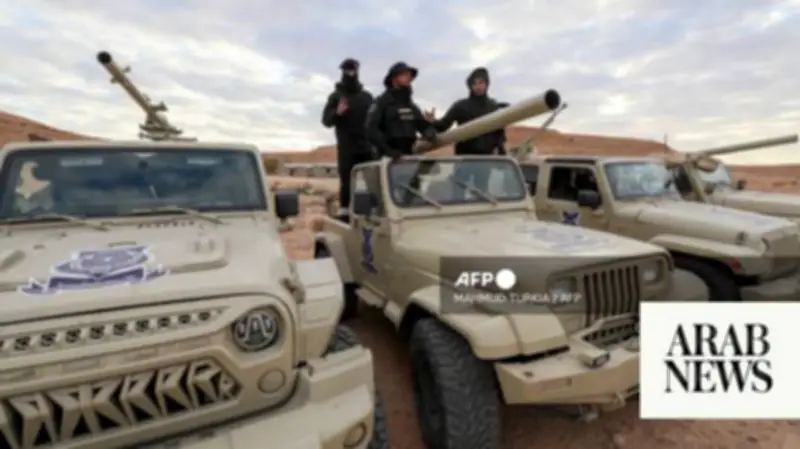
Along a stretch of desert where smugglers' convoys often move as freely as state patrols, the borders separating Libya, Tunisia, and Algeria have become the front line of a rapidly changing regional security crisis. Arms traffickers, extremist groups, and migrant smuggling networks now operate across an increasingly interconnected landscape stretching from the Sahel to Sudan, blurring what were once distinct security challenges into a single transnational threat.
Three Interlocking Developments Driving Urgency
Virginie Collombier, president of the Italy-based nonprofit Mediterranean Platform, told Arab News that three interlocking developments explain why border cooperation has become much more urgent. The first and most significant is the expansion and geographic spread of militant groups linked to Al-Qaeda and Daesh across Mali, Burkina Faso, and Niger, where violence has reached record levels. The Sahel accounted for 51 percent of global terrorism deaths in 2024, according to the Global Terrorism Index.

“This has heightened concerns that militants, weapons and illicit finance may increasingly move north through long-established Saharan trafficking routes into southern Libya and, from there, toward Algeria and Tunisia,” Collombier said. The second development is the spillover of Sudan's civil war into the remote Libya-Sudan-Egypt border triangle, particularly around Jabal Uwainat, a mountain massif that has become a key corridor for arms trafficking, human smuggling, and militant logistics. This has further weakened border governance and created new opportunities for criminal networks.
Migration as a Symptom of Broader Instability
“Migration — especially from Sudan — is part of this broader security picture rather than a separate issue,” Collombier said, adding that the focal point of concern “is no longer simply managing migration across the Mediterranean, but preventing Libya from becoming a convergence point for instability.” Since the fall of Libyan dictator Muammar Qaddafi in 2011, the country has transformed from a destination for African economic migrants into a lawless transit corridor for hundreds of thousands attempting to reach Europe. Researchers estimate more than a million migrants have crossed from Libya's shores since the uprising, based on an aggregation of yearly UN and EU data.
Following a 2014-17 peak, when Libya became the dominant departure point for the Central Mediterranean route, the EU sought to intervene through a strategy of “externalization” — paying, training, and equipping North African states to stop migrants before they reach European shores. While recent data suggests such interventions have reduced the number of migrants reaching European shores, Collombier said the picture is more nuanced. “EU externalization has been a major driver of tighter border controls in Libya and Tunisia. In the short term, it has delivered results. The problem is that these gains have proved difficult to sustain. Rather than reducing migration, externalization has largely reshaped it.”
Shifting Migration Routes and Economic Impacts
Total irregular sea arrivals to Italy fell sharply between 2023 and 2024, dropping by roughly 58 percent as departures from Tunisia collapsed by 60 percent following its own crackdown. However, arrivals from Libya climbed 40 percent year on year, a newer corridor from eastern Libya to Crete surged 285 percent to nearly 19,857 people, and Algeria saw arrivals from its shores rise 43 percent. Preliminary data from Frontex shows Libya remains the main departure point to Europe, even as overall arrivals dropped some 40 percent in the first four months of 2026 compared with the same period in 2025.

“The key point is that Libya, Tunisia and Algeria increasingly function as a single migration space,” Collombier said. These policies have reshaped the political economy of migration, making migration control itself a source of revenue, influence, and political leverage for local actors. Libyan officials estimate the country hosts around 3 million irregular migrants, whose remittances drain an estimated $7 billion annually from the economy, according to the Central Bank of Libya. It also hosts some 559,000 Sudanese refugees who have fled the war since April 2023.
Criminal Economies and Terrorism Concerns
Over the years, the power vacuum left by the 2011 uprisings in Tunisia and Libya enabled militias and transnational networks to profit from human trafficking, extortion, and rights abuses — revenue streams that also help fund arms trafficking and terrorism. Historical estimates by Chatham House put the value of Libya's trafficking and smuggling economy in the hundreds of millions of dollars, occasionally nearing $1 billion depending on prevailing political conditions. “The deeper concern is the consolidation of trans-Saharan criminal economies,” Collombier said, noting these networks are highly adaptive and thrive wherever state authority is fragmented.
“Terrorism should be understood in that same context. The immediate concern is not necessarily large-scale militant infiltration into North Africa. Rather, it is that expanding criminal networks and increasingly ungoverned border areas provide infrastructure that armed groups can exploit. In that sense, migration is the most visible symptom.”
National Fortification and Trilateral Push
Under international pressure, Tunis, Algiers, and Tripoli have moved to strengthen their borders, investing heavily in unilateral fortification. Tunisia has built a trench and berm system along much of its Libyan border and received a $95 million package from the US to upgrade its border security systems with surveillance, detection, and response equipment. Algeria has deployed special counter-insurgency units, radar-based surveillance, aerial patrols, and built concrete walls and electric fences. The current trilateral push aims to layer political summits and working groups on top of these national fortifications.
But Collombier believes this approach remains too narrow, prioritizing containment over deeper governance reforms — legal migration pathways, asylum systems, protection standards — that are needed to address migration's structural roots. “Border security and migrant protection are not inherently incompatible. The problem is that current policies have prioritized containment over governance. A sustainable strategy needs to recognize that migration is a structural feature of the region, not a temporary crisis that can simply be deterred.”
Political Challenge and Long-Term Solutions
In a region where border security policies collide with deep socioeconomic marginalization — in frontier towns where smuggling is a de facto livelihood — the question of whether tighter coordination can deliver lasting stability remains central. Migration, Collombier said, should be understood less as an isolated security threat and more as an indicator of broader regional governance failures. “Ultimately, this is also a political challenge. As long as migration is treated primarily as a domestic political issue in Europe and as a bargaining tool in relations with transit countries, governments will continue to prioritize short-term containment over long-term solutions. A more sustainable approach requires partnerships that balance security objectives with shared responsibility for protection and mobility.”