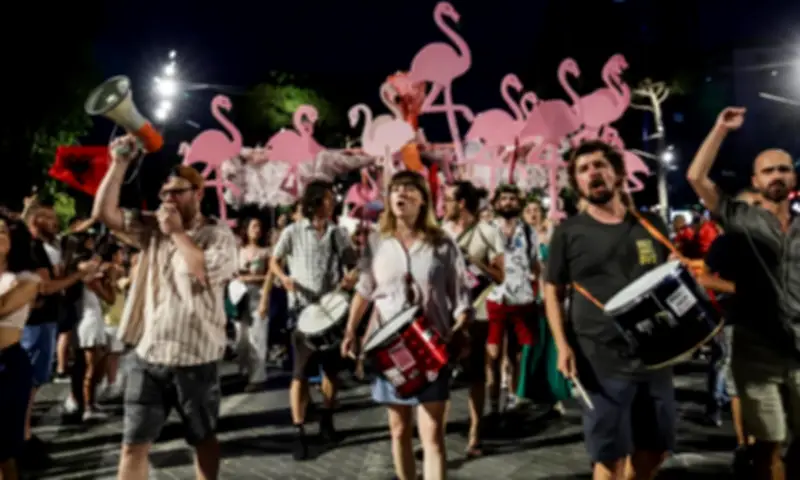
Albania is experiencing its largest civic protests since the fall of communism in the early 1990s, sparked by a luxury real estate development backed by Jared Kushner, President Donald Trump’s son-in-law and Middle East envoy. The movement, called “The Flamingo Revolution,” began in late May 2026 after Ivanka Trump and Kushner announced plans to build resorts on Sazan Island and the Vjosa-Narta Protected Landscape on Albania’s southwestern coast. The proposed development includes up to 10,000 tourist accommodations, threatening endangered Mediterranean monk seals, flamingos, nesting sea turtles, and hundreds of migratory bird species.
What Triggered the Protests?
In 2024, Albania passed controversial amendments to laws on protected areas, which critics say opened the door for Kushner’s project. Construction began earlier in 2026, met with fierce resistance from locals and activists. “You could visibly see they were beginning construction, there were excavators, there were diggers, there were fences being built up,” said Jakob Weizman, a Politico journalist covering the Western Balkans. “When I went there myself, you could see that there was a road already built and you could see the foundation from the fences. So that was really what kicked off everything.”
The Protected Landscape Under Threat
The Vjosa-Narta Protected Landscape is a vital habitat for endangered species and a cherished area for Albanians. “It’s a special place that Albanians in that area hold dear to their heart,” Weizman noted. “It’s a place where people go fishing. It’s a place where people go to the beach with their families. It’s an untouched area where you can really feel the beauty of Albania, and for that to be ruined by excavators and diggers and fences.” The area also serves as a migratory path for birds and a popular turtle nesting site.

Ivanka Trump’s Controversial Story
Ivanka Trump described on a podcast how she found Sazan Island while swimming from a friend’s boat and hiked to the top, captivated by its beauty. Locals dismissed the account as “completely false,” given the island’s rugged terrain, danger of explosive mines from its communist-era military use, and snake infestations. “When I told the locals about this story, they were like, ‘It’s completely false,’” Weizman said. “There’s no way she was able to do that.” The podcast went viral, fueling anger that Albania was being treated as a personal luxury haven.
Protest Scale and Civic Awakening
Protests grew from 10,000 to 20,000 participants, becoming a daily routine. “Albania is a small country. It’s 2.4 million. And now, it’s going up to 100,000, maybe 200,000 [protesters],” Weizman reported. “There are people driving from the UK, from Belgium, from Germany to join the protests and people driving from all across the country.” The movement reflects an awakening of civic consciousness against the tourism boom and foreign investments perceived as benefiting elites while ignoring citizens’ needs.
Corruption and Distrust
Many Albanians view the Kushner project as the latest symptom of systemic corruption. “There is so much suspicion and there are so many allegations of corruption,” Weizman said. “The country’s track record in the last 20, 30 years is not good and does not convince people that there’s going to be trickle-down economics.” Prime Minister Edi Rama champions the development as a boon for the economy, but Albanians remain skeptical. “The mass immigration from Albania is insane. You talk to anyone in Albania, their only dream is to leave,” Weizman added. “The scale of corruption that’s going on in the country is forcing people to lack trust in the government.”
Historical Context
Albania endured a monarchy, Nazi occupation, and 50 years of brutal communist rule before the fall of communism. “Their hopes had surfaced once more after the fall of communism. It was a very poor country. It was isolated from the entire world,” Weizman recalled. “So the land is so important to the Albanians, and when someone like Kushner comes along, it just wakes up the entire country and says, ‘No, this is ours, and you’re not going to touch it.’”

Economic Debate
Some Albanians support tourism as a path to economic growth. “To be fair, there are people I have spoken to who think that tourism is good for the country,” Weizman acknowledged. “I’m not going to say that all the people in Albania think that this is a bad thing.” However, distrust in the government’s ability to deliver benefits prevents widespread support for such projects.