A senior Pakistani diplomat at the United Nations on Monday strongly rejected allegations from India and Afghanistan that Pakistan recently conducted military strikes against Afghanistan, causing "huge" civilian casualties. He asserted that the strikes were solely directed at terrorist and military support infrastructure used by the Taliban regime to carry out cross-border attacks.
Pakistan's Response at UN Security Council
Exercising his right of reply during a UN Security Council discussion on Afghanistan, Pakistani Ambassador Asim Iftikhar Ahmad stated that Pakistan's actions, including those conducted in March, targeted drone storage and technical support infrastructure, as well as ammunition storage sites. He emphasized that the strikes were precise, deliberate, and professional, and no hospital, drug rehabilitation center, or civilian facility was targeted.
Indian and Afghan Statements
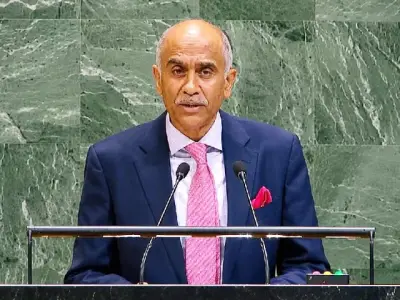
India's statement was delivered by Ambassador Parvathaneni Harish, while Naseer Ahmad Faiq, an appointee of the previous Afghan government, spoke for Afghanistan. The Pakistani envoy noted that Faiq does not represent anyone but himself, as the UN has not yet recognized the Taliban government. The Indian envoy highlighted India's humanitarian and capacity-building assistance in Afghanistan and pointed out that the Pakistani strikes were carried out during the holy month of Ramazan.

Accusations Against India
Ambassador Asim Ahmad countered that India's key aim, under the disguise of development and humanitarian assistance, is to destabilize Pakistan through terrorist groups, including Tehrik-e Taliban Pakistan (TTP) and the Balochistan Liberation Army (BLA), which act as proxies of India to perpetrate terrorism inside Pakistan. He stated that India's "newfound love for the Taliban" comes on the heels of Pakistan's successful counterterrorism operations against terrorist hideouts and camps operating inside Afghanistan with India's active support.
International Community's Expectations
The Pakistani envoy noted that key expectations of the international community from the Taliban regime, now in its fifth year, include inclusive governance, human rights, women's and girls' rights, and counterterrorism, ensuring Afghan soil is not used for terrorism against any country. He pointed out that concerns were raised over the non-implementation of these pledges, and demands were made for the Taliban to comply.
India's Violations
Ambassador Asim Ahmad described India's calls for compliance with international law as "laughable," calling India a "serial violator of international law." He cited India's illegal occupation of Jammu and Kashmir for decades, where it has engaged in gross and systematic human rights violations, including persecution of minorities such as Muslims, Christians, and Sikhs. He also accused India of being a state sponsor of terrorism, aiding and financing terrorism elsewhere, and engaging in extraterritorial assassinations, as known in North America.
Breach of Treaties
India, he said, is in serious breach of Security Council resolutions on Jammu and Kashmir and violated the Indus Waters Treaty by declaring it in abeyance without reason, justification, and in complete breach of the treaty's provisions and international law.