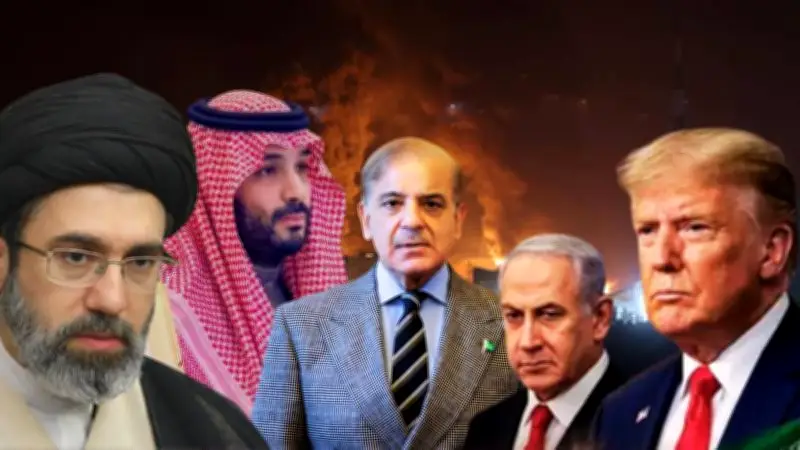
In the brittle, anxious summer of 2026, the world watches as the Middle East teeters on a precipice. The recent conflict between the United States and Iran, punctuated by Israel's involvement, has shattered the fragile calm, threatening to ignite a regional firestorm with global consequences. For Pakistan, this is not a distant spectacle. As warplanes streak across the sky, Islamabad finds itself navigating a treacherous diplomatic strait, balancing its deep economic ties with the Gulf monarchies, its fraught but crucial relationship with a nuclear-armed Iran, and its ever-present need to manage a complex partnership with the United States.
The Crisis as a Lesson in Modern Statecraft
The crisis offers a stark, contemporary lesson: in the twenty-first century, a nation's security and prosperity are not solely determined by the strength of its military, but increasingly by the agility and foresight of its diplomacy. For a developing nation of over 240 million people, Pakistan's survival and future growth depend on a fundamental strategic pivot. The traditional model of statecraft, where foreign policy was a separate domain handled by a select few in grand chancelleries, has been rendered obsolete. In its place, a new doctrine has emerged: economic diplomacy. This is not merely a tool of foreign policy but a central, strategic instrument of national development.
For Pakistan, located at the crossroads of South Asia, Central Asia, the Middle East, and the Indian Ocean, active diplomacy is not a luxury—it is the essential engine for attracting investment, expanding trade, securing energy resources, and navigating a perilously divided world. The global order is fragmenting. The unipolar moment of the 1990s has given way to a multipolar world defined by great-power competition, particularly between the United States and China. In this environment, developing countries can no longer afford diplomatic passivity or isolation. The era of simply choosing a side is over; survival now belongs to those who can build a "multi-aligned" foreign policy, engaging with all major powers while skilfully avoiding entanglement in their rivalries.

The Geoeconomic Shift: From Security to Prosperity
This is the essence of the geoeconomic shift. Pakistan's recent National Security Policy articulates a historic departure, explicitly transitioning from a traditional security-oriented mindset to one focused on citizen-centric security and economic prosperity. The doctrine of cooperative engagement is not about weaponising the economy for geopolitical ends, but about creating a web of deep economic interdependence that makes Pakistan too valuable to fail and too stable to destabilise. As one former national security adviser has observed, Pakistan's security and prosperity depend less on military posturing and more on creating conditions where friends and rivals alike suffer more from Pakistani instability than from its stability.
Pakistan no longer leans on Washington for economic survival but simultaneously engages with multiple partners to secure its interests. This is the singular lesson Pakistan can learn from the success stories of other developing nations. Singapore transformed its geographic limitations into a global trade and financial hub through savvy diplomacy and open economic policies. The United Arab Emirates has used its strategic location and investment-friendly environment to become a global connector, all while maintaining a remarkably stable and influential foreign policy. Vietnam and Indonesia have successfully navigated the US–China competition by pursuing strategies of hedging, maximising their economic opportunities with both superpowers. These nations have proven that, for developing countries, diplomacy is a force multiplier for development. It is the art of turning a nation's potential into tangible prosperity.

Pakistan's Strategic Location: Asset and Challenge
Pakistan's strategic location is both its greatest asset and its most persistent challenge. Situated at the confluence of three major regions—the Asia-Pacific, the Middle East, and Central Asia—it has the potential to serve as a critical connector. The China–Pakistan Economic Corridor, the flagship project of China's Belt and Road Initiative, is the most visible manifestation of this potential. Valued at approximately sixty-two billion dollars, this corridor is not just a collection of infrastructure projects; it is a strategic anchor for Pakistan's economic recovery.
Yet the potential of Pakistan's geography is constrained by its turbulent politics. The national agenda, which aims for an export-led growth model to reach one hundred billion dollars in exports by the end of the decade, represents a necessary vision for the future. However, this vision is predicated on an ambitious economic diplomacy strategy that goes beyond just one partner. While the corridor provides the vital infrastructure backbone, Pakistan must also strengthen its ties with the Gulf states, not just as sources of remittances—which exceed forty billion dollars annually—but as partners for long-term investment and development.
Multilateral Platforms and Regional Connectivity
Pakistan has skilfully leveraged multilateral diplomatic platforms, aligning its national interests with the common aspirations of the region. Within the framework of the Shanghai Cooperation Organisation, Pakistan has strengthened economic and trade connectivity with Central Asian countries, opening up new channels for the export of its agricultural and mineral products. The recent signing of a railway corridor agreement connecting Pakistan, Uzbekistan, and Afghanistan represents a strategic milestone in regional connectivity, offering a vital route for trade and economic collaboration among the three nations. This expansion of cross-regional economic cooperation demonstrates strategic wisdom in transforming geography into opportunity.
The key to unlocking this potential lies in diplomatic credibility. For decades, Pakistan's economic model relied on selling its strategic relevance to secure aid. This model was fragile, as the inflows would dry up the moment Pakistan lost its geopolitical importance to its patrons. The shift now must be towards genuine, mutually beneficial development partnerships. Pakistan must become a hub of interdependence, where the cost of its instability for the international community is too great to allow it to fail.
Pakistan-US Relations: From Patronage to Partnership
Pakistan and the United States are witnessing a quiet but profound transformation in their bilateral relationship. What was once a dynamic dominated by aid, mistrust, and episodic crises has evolved into a more balanced, pragmatic partnership rooted in autonomy, selective cooperation, and mutual respect. This post-patronage phase reflects a deliberate move away from dependency towards self-reliant engagement with Washington, anchored in shared interests rather than conditionality.
Pakistan no longer leans on Washington for economic survival but simultaneously engages with multiple partners to secure its interests. Economically, exports to the United States crossed six billion dollars in recent years, while domestic reforms and rising Gulf investments reflect Islamabad's focus on stabilisation from within. Across the Atlantic, American policy towards Pakistan has matured as well. Cooperation has increasingly focused on climate resilience, clean energy, trade facilitation, and institutionalised dialogue. The resumption of military education and training programmes signals a quiet revival of professional military-to-military exchanges, while trade and investment frameworks continue to provide structured channels for commercial engagement.
Pakistan is now seeking to translate its growing diplomatic influence into tangible economic and strategic gains. This marks a conscious shift from aid dependency to selective, institutionalised cooperation. For Washington, this adjustment has required recognising Pakistan as a self-reliant partner, capable of independent decision-making. The relationship has evolved from transactional patronage to selective cooperation: trade, climate, education, and security partnerships proceed without the baggage of historical dependency. In short, both sides have embraced diplomatic adulthood—engagement without coercion, cooperation without dependency, and respect without subordination.
The West Asian Crisis: A Test of Multi-Vector Diplomacy
The current West Asian crisis provides a powerful, real-world demonstration of why active, nuanced diplomacy is indispensable. The traditional view might hold that Pakistan is trapped between an alliance with Saudi Arabia, a close partnership with China, and a complicated history with the United States, while also sharing a long border with rival Iran. However, this moment of crisis is also a moment of opportunity. Rather than rushing to take sides, Pakistan has adopted a posture of strategic balance. It has condemned the strikes while simultaneously condemning retaliatory actions. By doing so, Islamabad is attempting to keep multiple doors open. This is not a sign of weakness, but of strategic wisdom in a region where rigid alignment can be a liability. This multi-vector diplomacy allows Pakistan to maximise its options: it maintains its economic and strategic ties with the Gulf, avoids confrontation with its neighbour Iran, and preserves the potential for constructive engagement with Washington.
The Pakistani government has been pursuing a hands-on diplomatic strategy towards Tehran, with Pakistan's most senior military commander and the Prime Minister both visiting Iran in the months preceding the recent conflict. The army chief, in particular, has left a positive impression, with American officials reportedly praising his professional approach. This direct access and personal rapport proved critical when the crisis erupted. The Pakistani leadership had much to lose if the conflict spiralled into an all-out regional war. Pakistan shares a border with Iran and relies heavily on Gulf trade routes, so prolonged instability could trigger refugee flows, economic disruption, and security challenges along its western frontier.
Pakistan's Mediation Role: From Messenger to Mediator
Once the strikes began, the government embarked on an intensive diplomatic effort involving shuttle diplomacy, direct contacts with Washington and Tehran, and coordination with regional capitals. In early April, Pakistan announced the initial understanding between the two warring parties and then hosted delegations for a marathon negotiation session. The memorandum credited to Pakistan is widely viewed as a catalyst for improved regional stability and enhanced cooperation. Pakistan could only act as a mediator due to strong support from key partners. Beijing has ties to Tehran and needs stability in the Gulf to ensure energy imports and regional trade routes remain open. Chinese officials publicly backed Islamabad's diplomatic initiative and encouraged efforts to prevent escalation. Countries such as Qatar and Saudi Arabia also have strong incentives to avoid a prolonged conflict that threatens energy markets and maritime traffic through the Strait of Hormuz. Qatar, in particular, has now positioned itself as a second mediator.
Diplomatic sources describe Pakistan's role as extending beyond mere mediation. Pakistani officials helped identify areas of compromise, coordinated draft proposals, and worked to keep channels open during several moments when negotiations appeared close to collapse. Analysts agree that Pakistan was not simply a messenger, pointing to the army chief and his direct involvement in the talks. Three-way discussions were taking place, which goes far beyond the role of a country merely passing messages between two sides. That is direct mediation.
Tangible Benefits: Trade, Energy, and Security
By positioning itself as a potential mediator and a voice of restraint, Pakistan is not merely surviving the crisis; it is crafting its relevance in its aftermath. It is demonstrating that it can communicate across hardened geopolitical divides, a role that can translate into enhanced international prestige, greater importance in regional security discussions, and, ultimately, greater investor confidence if it is viewed as a stabilising force in a volatile region. The diplomatic breakthrough has already begun to yield tangible economic benefits. Pakistan is now seeking to translate its growing diplomatic influence into tangible economic and strategic gains.
The initiative has opened a new chapter in Pakistan-Iran relations, with both countries rapidly expanding bilateral engagement across trade, energy, infrastructure, and security sectors. The Iranian president's visit to Pakistan marked a significant step forward, with the two sides set to sign agreements covering trade, infrastructure development, and energy cooperation. Among the most ambitious goals emerging from the renewed engagement is a plan to increase bilateral trade to ten billion dollars in the coming years, with discussions on a potential Free Trade Agreement gaining momentum. The improved regional climate has also revived interest in major energy projects that had long remained stalled. Discussions surrounding the Iran–Pakistan gas pipeline have regained prominence, while both countries are examining opportunities for expanding cross-border electricity transmission.
Security cooperation has emerged as another important pillar of the evolving relationship. With regional peace efforts reducing tensions across the wider Middle East, Islamabad and Tehran are moving towards more structured coordination on border management, counterterrorism operations, and measures aimed at preventing cross-border criminal activities. Officials believe enhanced security cooperation could contribute significantly to stability in border regions while facilitating greater trade and investment flows.
Domestic Impact: Stability and Prices
Pakistan's leadership argues that the country's role as a facilitator of dialogue and peace has strengthened its international standing and improved its attractiveness as an investment destination. One adviser to the finance minister noted that a country which promotes stability both domestically and internationally becomes a more credible destination for investment. He argued that a growth-oriented economic strategy, combined with Pakistan's image as a force for peace, could help attract investment into infrastructure, technology, human capital, and emerging growth sectors. This is not mere rhetoric. Just this week, petrol prices were reduced significantly, providing notable relief in an economy where fuel costs ripple through almost every sector. While no single diplomatic breakthrough can be credited for this alone, easing regional tensions does help stabilise oil markets, which, in turn, filter down into domestic prices. Markets reward predictability above all else. Trade routes become more secure, shipping costs stabilise, and supply chains regain some breathing space.
For Pakistan's diplomatic position, this is arguably one of its most significant recent roles. After years of political turbulence and diplomatic uncertainty, Pakistan has remained relevant—not as a spectator but as a facilitator of dialogue between two adversaries—while persisting in its efforts to secure a peaceful solution. The defence minister recently stated that Pakistan's regional diplomatic initiatives are producing positive outcomes, helping transform the country's image into one associated with peace, stability, and constructive dialogue on the global stage. Today, the international community views Pakistan as a country contributing to peace, reconciliation, and regional stability.
Challenges Ahead: Political Stability and Policy Continuity
Despite these promising moves, Pakistan's path is fraught with challenges. The country has suffered from a history of political instability and policy discontinuity that has undermined its diplomatic gains. The central policy prescription would be to create a portfolio of flagship projects where Western and Chinese interests coexist in Pakistan, build multi-aligned diplomacy, and focus on cooperative engagement so external actors have strong incentives to protect Pakistan's stability. Pakistan's current strategy reflects necessity. China offers infrastructure and security; the United States offers trade, aid, and strategic plausibility. Yet neither relationship is risk-free. Realistically, Islamabad must craft a multi-aligned foreign policy—deepening Chinese ties where needed, cultivating American economic engagement, and diversifying relationships with Middle Eastern and global partners. At the same time, domestic priorities such as debt management, political stability, and inclusive development must not be sidelined.
The test ahead is whether Pakistan can uphold its sovereignty—not by choosing sides, but by maintaining strategic autonomy, pursuing balanced partnerships, and positioning itself as a regional hub of stability. The balancing act is not just foreign policy; it is survival. With deep geopolitical rivalries reshaping South Asia, Pakistan must not let great-power dynamics dictate its destiny. Pakistan's past shortcomings are not a reflection of its geopolitical potential, but of its inability to translate that potential into a coherent national strategy. The challenge ahead is to build a political consensus that transcends parties and personalities, ensuring policy continuity so that a multi-aligned, geoeconomic diplomacy can take root. It must resolve the issues surrounding its major infrastructure projects to attract not just Chinese but also Western investment into co-located projects that create a vested interest for all in its stability. It must carefully manage its ties with Afghanistan and India to unlock the full potential of regional connectivity.
Conclusion: Diplomacy as the Only Strategy
In the final analysis, the turbulent events of today serve as a powerful reminder. In a world increasingly defined by competition, uncertainty, and multipolar rivalry, the ability to navigate the global system is the single most important determinant of a nation's future. For developing countries like Pakistan, the choice is stark: embrace active, sophisticated diplomacy as a development strategy, or risk marginalisation. Pakistan's greatest strategic asset is not merely its nuclear arsenal, its population, or its location. Its true potential lies in its ability to transform diplomatic engagement into economic opportunity, regional influence, and long-term national development. The tumultuous realignments of the current era are not just a threat to be managed, but an opportunity to be seized. In the crucible of this crisis, the art of the possible has never been more vital, nor its rewards more consequential. Pakistan's active diplomacy has already demonstrated its power—peace is not merely a political virtue but the foundation upon which prosperity is built. For Pakistan, active diplomacy is not just a win-win strategy; it is the only strategy that can secure its place in the twenty-first century.