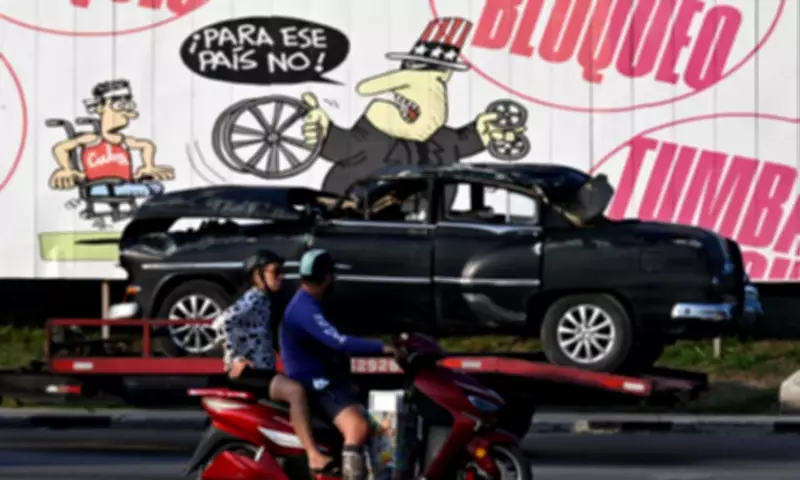
President Donald Trump has repeatedly suggested that Cuba will be the next target of his administration's regime change efforts, following military actions in Venezuela and Iran. In recent remarks, he stated, "We may stop by Cuba after we're finished with this," fueling speculation about US intentions toward the island nation.
Escalation of Pressure on Cuba
The Trump administration intensified its "maximum pressure" campaign against Cuba in January, shortly after the capture of Venezuelan President Nicolas Maduro, a key Cuban ally. Severe restrictions on oil imports were imposed, exacerbating the island's existing struggles with nationwide blackouts. The Pentagon is now preparing a range of military options for potential action, alarming Senate Democrats who have sponsored legislation to block any military intervention.
Diplomatic Efforts Amid Threats
Despite the saber-rattling, diplomatic channels remain open. A US State Department delegation visited Havana earlier this month, marking the first time a US government aircraft landed in Cuba since the Obama-era rapprochement. The delegation presented a list of demands, including economic reforms, release of political prisoners, compensation for seized properties, and allowing Starlink internet connectivity.

Historical Context and Trump's Ambitions
Since Fidel Castro took power in 1959, every US president has grappled with the Cuban question. Trump appears confident in his ability to resolve it, stating, "All my life I've been hearing about the United States and Cuba: When will the United States do it? I do believe I'll have the honor of taking Cuba." However, the meaning of "taking Cuba" remains ambiguous.
Regime Change or Something Less?
The administration's concept of "regime change" seems flexible. In Venezuela, the US left Maduro's former Vice President Delcy Rodriguez in power under implied threat of further military action. In Iran, after the killing of Supreme Leader Ayatollah Ali Khamenei, Trump praised the new government as "less radical." For Cuba, the outcome may fall short of complete regime removal.
Economic Pressure and Its Limits
The US embargo, in place since the early 1960s, has been tightened under Trump. After Maduro's ouster, oil supplies from Venezuela were cut off, and Trump threatened tariffs against any country supplying oil to Cuba, leading Mexico to halt shipments. This near-blockade has worsened Cuba's economic crisis, with rising food prices, accumulating trash, and a collapsing healthcare system. However, the Cuban regime has survived past crises, such as the "special period" after the Soviet Union's collapse. Experts doubt that economic pressure alone will topple the government.
Chris Sabatini, senior fellow for Latin America at Chatham House, noted, "What's not different is the Cuban regime's almost genetic need to survive and defend itself, and its resistance to anything that could weaken its power." The regime has historically prioritized its survival over the well-being of its people.
Can the Cuban Leadership Be Replaced?
Trump may hope for a Venezuela-like scenario where a pliant leader replaces an anti-American one. However, current President Miguel Diaz-Canel, Cuba's first non-Castro president, leads a unified and ideological government. Michael Bustamante, a professor at the University of Miami, explained, "There's no one who has a consistent track record of having stood for economic liberalization." The State Department has reportedly negotiated with Raul Castro's grandson, also named Raul, but he is seen as a go-between rather than a potential leader. Any deal leaving a Castro family member in power would violate the Helms-Burton Act.
Cuban Public Opinion on US Intervention
Some Cubans support Trump's pressure, hoping for change. Graffiti reading "Viva Trump" and "Make Cuba Great Again" has appeared in Havana. Journalist Boris Gonzalez Arenas said, "People perceive that pressure from the US president could change the government." He believes credible military threat is necessary for negotiations to produce real change. He would support intervention only to restore sovereignty, not to install a pro-American regime.

The Role of Marco Rubio
Secretary of State Marco Rubio, whose parents were Cuban, is a driving force behind the Cuba policy. A longtime critic of Obama's normalization efforts, Rubio has been the face of the administration's assertive Latin America posture. Ricardo Herrero of the Cuba Study Group noted, "The only person in office today who would care enough to make Cuba a priority is Marco Rubio." Rubio has left open the possibility of lifting the embargo if "new people are in charge" and major economic reforms occur, but he has also suggested that complete toppling of the communist government may not be necessary immediately.
This stance could be difficult for regime opponents and Cuban American exiles to accept. However, Bustamante remarked, "In Marco we trust is sort of the vibe." Any deal would require Cuban government compromises, and as the Iran crisis continues, it remains uncertain how much priority Trump will give to another regime change project.