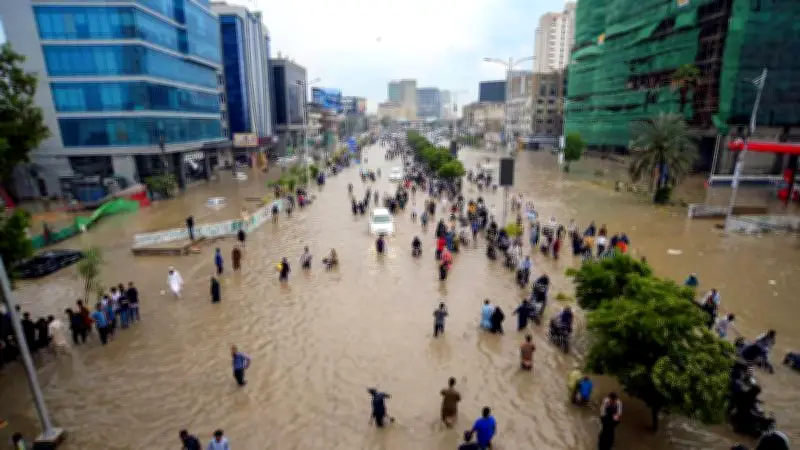
Every monsoon season, we are surprised. We shouldn't be. It has become a grim ritual. The rains arrive, the rivers swell, the embankments give way, and the images flood our screens: submerged villages in Sindh, stranded families on rooftops in Punjab, relief trucks navigating roads that have become rivers. Politicians visit, donors pledge, agencies respond. And then, gradually, the waters recede, along with our attention. In 2022, a third of Pakistan was underwater. In 2025, the cycle repeated. Different districts, same chaos. Same fractured response. Same questions left unanswered.
The Illusion of Inevitability
We tend to explain these disasters as the result of record rainfall, of climate change, or of bad luck. And while none of that is wrong, it is dangerously incomplete. Monsoon rains are inevitable. Rivers will rise. Droughts will come. These are not surprises; they are the rhythm of the subcontinent. But disasters are not inevitable. They happen when human systems fail to anticipate, absorb, and respond. When drainage is blocked. When settlements expand into flood-prone areas. When warnings do not translate into action. When recovery consumes resources that could have prevented the damage in the first place.
The floods themselves are not the real story. The real story is why the same country, with the same agencies, the same budgets, and the same warnings, ends up in the same place year after year. That is not bad luck. That is a pattern. And patterns have causes.

The Uncomfortable Truth
Here is the uncomfortable truth: the people managing Pakistan's water are, for the most part, doing their jobs. Engineers repair what they can. Disaster authorities respond when called. Meteorologists issue forecasts. Farmers make rational decisions about their crops. Local communities cope as best they know how. The problem is not the people. It is the structure they are operating within, a structure that quite predictably produces floods, depletes groundwater, chokes our cities with water, and then channels money into emergency relief rather than prevention. Over and over again.
Consider what happens after every major flood. Emergency funds are released, new embankments are built or raised, and promises are made about better preparedness next time. This feels like progress. It looks like action. But very little changes in the systems that caused the failure in the first place: the chronic underfunding of maintenance, the fragmented responsibilities across dozens of agencies, the communities left to fend for themselves without clear warnings or evacuation plans. We fix the symptom, not the disease. And so the disease returns.
Stories Behind the Statistics
To understand why Pakistan stays stuck, it helps to think in stories rather than statistics.
The Maintenance Story
Pakistan's irrigation and flood infrastructure is vast and ageing. Canals, embankments, barrages, drainage channels: most of it was built decades ago and requires constant upkeep. But maintenance is unglamorous. It is invisible when it works, and the minister who funds it gets no ribbon-cutting ceremony. New construction, on the other hand, is visible, photographable, and politically rewarding. So year after year, maintenance is quietly underfunded. The infrastructure quietly deteriorates. Then a heavy monsoon arrives, not necessarily an exceptional one, and an embankment that was already weakened gives way. We call it a natural disaster. It was not.

The Land Story
Across Pakistan, in cities, on the edges of towns, and deep in rural areas, people are settling and farming in places where water needs to go. Floodplains that once absorbed river overflow are now fields and villages. Natural drainage channels that carried stormwater away from settlements have been built over, narrowed, or simply encroached upon piece by piece. This is not recklessness. It is the pressure of population growth, land scarcity, and the absence of affordable alternatives. Land-use planning exists on paper. Regulations exist. Officials periodically call for stricter enforcement. But the gap between what the rules say and what happens on the ground remains vast, and encroachment continues, incrementally, quietly, and largely beyond the reach of any single agency. When the rains come, the water follows the laws of physics, not the laws of zoning. It fills the floodplain that was always meant to hold it and finds the drainage channel that is no longer there. So embankments are raised, new drains are dug, and protective works are built, making the land behind them look safer, attracting more settlement, and setting up the next cycle. We are not solving the problem; we are moving it forward in time while steadily making it larger.
The Groundwater Story
For millions of farmers, groundwater has become a lifeline. When canal supplies are uncertain, and in Pakistan they often are, a tube well provides reliability and control. You decide when to water your crops. You are not at the mercy of a rotational system managed by an agency three tiers above you. From the perspective of an individual household, this makes complete sense. But across the system, the consequences accumulate. Water tables decline. Pumping costs rise. Farmers respond not by using less water, but by drilling deeper and planting more water-intensive crops to justify the investment. What begins as a solution to uncertainty gradually becomes a dependency that is harder to escape. No single farmer is at fault; each is making a reasonable decision with the options available. Yet collectively, these rational choices place increasing pressure on aquifers that took centuries to fill, and on the communities, often the poorest, who depend on them most.
The Relief vs. Resilience Story
When disasters strike, governments respond, and they should. But relief is expensive, visible, and politically necessary. Prevention is cheap, invisible, and easy to cut. So budgets year after year flow towards emergency response and away from floodplain management, community preparedness, early warning dissemination, and the kind of local-level work that would actually reduce losses. Communities that could be learning to protect themselves remain dependent on a response system that is always overwhelmed. The cycle continues.
The Limits of Nature Story
Every system has a carrying capacity, a point beyond which it can no longer absorb what we throw at it. Pakistan's water system is approaching, and in places has already crossed, that threshold. We allocate vast quantities of water to irrigation but invest far too little in drainage. The result is waterlogging and salinity: water that soaks into the soil without a way out, drawing up salts that slowly poison the land. Pakistan has some of the most productive agricultural land in the world, and some of it is quietly dying in this way, not dramatically, not all at once, but steadily. Pesticides and fertilisers compound the problem, accumulating in soils and waterways while the drainage systems that would flush them out are neglected or absent. Meanwhile, our rivers and canals receive the untreated sewage of tens of millions of people. Rivers are natural filters, up to a point. Below a certain load, a river can clean itself. Beyond it, that capacity is overwhelmed, and what flows downstream is no longer water in any meaningful sense. In many stretches of Pakistan's river system, that point has been passed. What links these problems is the same pattern we see everywhere else: we exploit the productive capacity of the system while neglecting its maintenance. We take it out, but do not put it back. We assume nature will absorb the excess, and for a long time, it does. Until it doesn't.
Rational Choices, Irrational Outcomes
What makes these patterns so difficult to change is that they are not driven by incompetence or neglect. On the contrary, every actor in the system is responding rationally to the pressures they face. Governments prioritise visible action because that is what politics demands. Institutions manage crises with the resources and mandates they have. Farmers protect their livelihoods under conditions of uncertainty. Urban residents seek affordable land and opportunity. Communities adapt as best they can to risks that keep returning. Individually, each of these choices makes sense. Together, they create outcomes that are increasingly difficult to sustain: rising flood losses, declining water reliability, growing inequality, and mounting pressure on infrastructure and ecosystems that were never designed for this scale of stress. The problem is not the people. It is how the system is structured, the incentives it rewards, the investments it prioritises, and the burdens it allows to fall on those least able to bear them. Until that structure changes, the individuals within it will keep making the same rational choices, and the system will keep producing the same results.
The Social Fabric of Resilience
One of the most striking realities of Pakistan's flood seasons is this: the same rainfall event can be catastrophic in one district and merely disruptive in another. The difference is rarely just geography. It is the strength of social networks, the quality of local leadership, the presence of people who know what to do and when to do it, and the existence of community drainage committees or informal flood monitors. In places where communities are organised, informed, and trusted by local authorities, people evacuate in time, temporary barriers get raised, and losses are lower. In places where that social fabric is weak, often the poorest and most marginalised communities, the same flood kills more people and destroys more livelihoods. Yet this form of resilience, local knowledge, social cohesion, and informal coping, is rarely the focus of policy. It cannot be photographed at a ribbon-cutting. It does not appear in project budgets. Instead, the system remains oriented towards responding to crises after they occur, rather than strengthening the communities that bear the greatest risk. The result is a cycle in which each disaster quietly reinforces the conditions for the next. Technical solutions are necessary but not sufficient. A flood embankment protects the community behind it only if people know it is there, know its limits, and know what to do when it fails.
The 2025 monsoon brought something additional into sharp focus: the information gap. While global satellite data could tell analysts something about what was happening, local measurement data, river flow readings, rainfall gauges, and ground-truth observations were scattered, incomplete, or simply not publicly available. Warnings were issued, but communities reported not knowing what to do with them. In some areas, years of false alarms had eroded trust to the point where people no longer acted on official forecasts. This is not a small thing. An early warning system that people do not believe, or cannot act on, is not an early warning system. It is a bureaucratic formality.
What Would Actually Work?
The honest answer is that there is no single fix, and anyone who offers one is not taking the problem seriously. But the direction of change is clear enough, and it starts with recognising something that Pakistan's governance structure makes particularly difficult: water does not respect provincial boundaries, agency mandates, or administrative tiers, but the institutions managing it are organised precisely along those lines.
At the federal level, the Indus Waters system is managed through the Indus River System Authority, but interprovincial water allocation remains a source of persistent tension, particularly between Punjab and Sindh. Sindh has long argued that its share of river water is compromised upstream, leaving farmers in the lower delta with unreliable supplies and driving the very groundwater dependency described above. Any serious reform of water governance has to address this allocation question honestly, not just technically but politically, because the grievances are real and the trust deficit is deep.
Provincial irrigation departments control much of the physical infrastructure, but their maintenance budgets are chronically squeezed and their mandates rarely extend to the drainage side of the equation. In Punjab, where the canal system is most extensive, deferred maintenance has accumulated over decades. In Sindh, the problem is compounded by the flat topography that makes drainage structurally difficult and politically easy to ignore. In Balochistan and Khyber Pakhtunkhwa, the challenges are different again: glacial melt, flash flooding, and water scarcity demand approaches that canal-era institutions were simply not designed to provide.
Local governments, which in principle are closest to the communities bearing the greatest risk, remain underfunded and politically marginal in most provinces. Yet they are the tier most capable of enforcing land-use rules, maintaining local drains, disseminating early warnings in local languages, and building the community-level preparedness that determines whether a flood becomes a manageable disruption or a catastrophe. Strengthening local government capacity is not glamorous. It does not attract international headlines or large donor projects. But it may be the single most important structural change available.
A Call for Rebalancing
What these points point to is a rebalancing rather than a revolution. Maintenance budgets need protection from the annual political cycle that redirects them towards more visible spending. Floodplain encroachment requires enforcement mechanisms with actual teeth, applied consistently across provinces rather than selectively. Groundwater use needs to become a managed, shared resource, with provincial governments taking seriously their responsibility to regulate abstraction before aquifers in the most stressed areas pass the point of recovery. And the relief-to-prevention ratio in public budgets needs to shift, gradually but deliberately, so that communities are equipped to reduce their own risk rather than simply waiting to be rescued.
None of this requires Pakistan to wait for a better climate, more resources, or a perfect government. It requires the institutions that already exist, at every level of the federal structure, to coordinate more honestly, invest more consistently, and treat communities as participants in their own protection rather than passive recipients of aid.
Pakistan's water challenges are often described as complex, and they are. But they are not unpredictable. The patterns are visible. The feedback loops are well established. The outcomes, floods, shortages, and degradation, are increasingly familiar. This should not lead to pessimism. It should lead to clarity. Because once we understand that these outcomes are produced by the system itself, we can begin to ask a different question: not how to respond better to the next disaster, but how to change the conditions that make disasters so predictable in the first place. Until then, the next flood will not be a surprise. It will be a repetition.