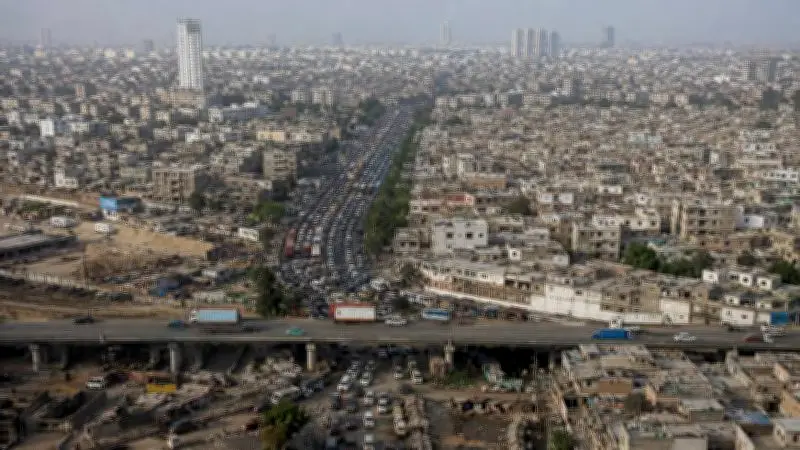
Until a few decades ago, Karachi was celebrated as Pakistan's 'jewel in the crown.' Today, this megacity of 40 million people is grappling with multiple man-made disasters, including a severe water crisis, crumbling infrastructure, rampant crime, and sprawling illegal settlements. Residents face countless issues such as power shortages, inadequate waste disposal, and a failing education system.
Karachi served as Pakistan's federal capital from August 1947 until 1960, when President General Ayub Khan's military regime relocated the capital to Rawalpindi and later to Islamabad. Beyond being the capital, Karachi was the industrial, commercial, and business hub of the new nation, reflecting multicultural characteristics as people from diverse regions settled there for employment opportunities despite ethnic and linguistic differences. As West Pakistan's only port city, Karachi also emerged as the country's international gateway.
The erosion and decline of Karachi did not begin with the capital's relocation. Instead, its story of neglect and successive disasters started with the first Pakistan People's Party (PPP) government in December 1971. The urban-rural divide, quota system, language riots, and discrimination against Urdu-speaking residents in employment and education deepened the city's sense of deprivation. Particularly over the last 18 years, the PPP-led Sindh government has exacerbated Karachi's water, infrastructure, electricity, and waste disposal issues. Illegal settlements, facilitated by those in power, and rising crime have further worsened Karachi's predicament.

However, it would be unfair to blame only the PPP for Karachi's endless problems. The MQM, other political parties, and military regimes also bear responsibility for what the megacity has become. Karachi contributes 60% of federal and 80% of provincial revenue but receives step-motherly treatment from both Islamabad and the Sindh government. Trillions of rupees in grants from Islamabad to the Sindh government since 2008 have failed to complete projects like the K-4 bulk water supply, the Red Line bus project, infrastructure modernization, and waste disposal initiatives, indicating rampant corruption, inefficiency, and nepotism.
The story of Karachi's multiple disasters extends beyond failed mega projects funded by the federal government and international agencies like the Asian Development Bank. Recent protests at the University of Karachi, Pakistan's largest center of learning, illustrate this. Around 50,000 students have suffered due to a 100-day protest by teachers, officers, and employees over unpaid house rent, evening class remuneration, and dues for retired teachers. Like many state-owned universities, the University of Karachi faces a huge financial crisis, with debts exceeding 1.5 billion rupees. Neither the PPP nor the MQM has raised its voice in support of the protesters. The apathy of the PPP government and the MQM, a coalition partner in the federal government holding the education ministry, highlights the lack of interest among those in power.
There is no shortage of resources in Karachi, but political will and determination are missing. The failure of the Sindh Assembly, National Assembly, and Senate to address Karachi's issues has led to man-made disasters. Only Jamaat-e-Islami has consistently raised its voice against injustices, organizing protests for water supply and infrastructure improvements.
What is the solution to Karachi's multiple man-made disasters? How has the city of lights experienced such erosion and decline? Observers note that neither the Sindh nor federal government possesses commitment to help Karachi's 40 million residents. The situation can be analyzed from three perspectives. First, Karachi faces 'mafias' patronized by powerful people. For instance, citizens pay over 30 billion rupees annually to the tanker mafia for water. The gap between water supply and demand exceeds 50%; daily demand is 900 million gallons, but only 450 million gallons are supplied. The K-4 bulk water project, intended to provide 350 million gallons daily, has been stalled for two decades, with costs escalating from 15 billion rupees in 2005 to 150 billion rupees in 2026. Alongside the tanker mafia, land, electricity, and construction mafias have profited from incomplete projects like the Red Line road.

Second, there is a lack of ownership of Karachi. Neither provincial nor federal governments claim responsibility. The city government faces a legitimacy crisis, with opposition refusing to recognize the PPP-led administration due to alleged electoral manipulation. Karachi, which generates 60% of federal and 80% of provincial revenue, is in dire straits because those responsible are only interested in making money and maintaining comfort zones.
Third, the only viable solution is to declare Karachi a separate entity from the provincial government, run by elected representatives with expertise, planning, vision, and integrity to transform it into a city-state. Issues regarding this transformation can be resolved, but delays will plunge the city into perpetual crisis. A city-state of Karachi would have provincial status with adequate resources to manage its affairs independently. It is time for decision-makers to declare Karachi a city-state with autonomous characteristics, free from provincial and federal control. Otherwise, Karachi will continue to face multiple man-made disasters, detrimental to Pakistan's interests. Karachi's multiple man-made disasters over the last five decades will further augment and completely ruin Pakistan's 'jewel in the crown.'