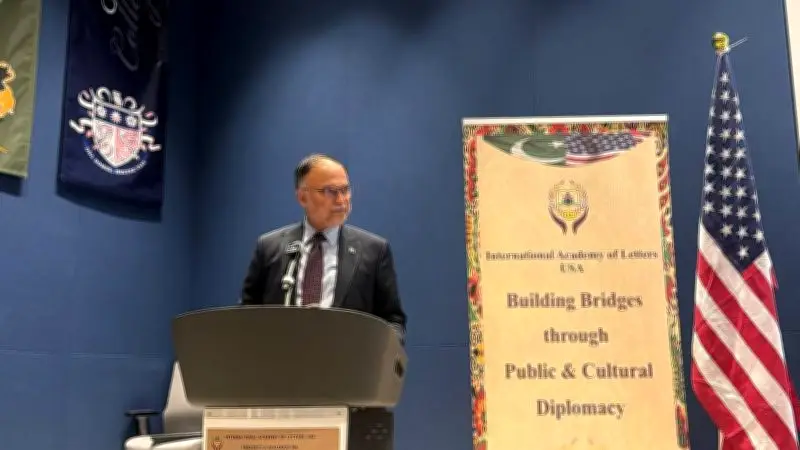
Federal Minister for Planning, Development and Special Initiatives Prof. Ahsan Iqbal stated on Saturday that Pakistan has entered a new phase of opportunity after achieving three major milestones: economic recovery, national resilience, and diplomatic renewal. He made these remarks while addressing students, faculty members, researchers, and members of the Pakistani community at Rice University.
Operation Bunyan-um-Marsoos and National Unity
The minister highlighted that the successful execution of Operation Bunyan-um-Marsoos demonstrated Pakistan’s strategic clarity, national unity, and institutional coordination. This operation strengthened confidence in the country’s stability, which he described as a prerequisite for investment and sustainable economic growth. He further noted that the operation exposed India’s aggression before the international community while reflecting Pakistan’s responsible and measured approach towards regional peace and security.
Diplomatic Achievements and Global Standing
Ahsan Iqbal emphasized Pakistan’s diplomatic achievements, stating that the country has re-emerged as a credible and responsible global actor by prioritizing dialogue over confrontation and cooperation over conflict. Through balanced engagement with major powers and constructive regional diplomacy, Pakistan has strengthened its international standing and expanded opportunities for economic cooperation, he added.

The minister said the recent achievements have created a rare strategic opportunity for Pakistan, but stressed that lasting progress will depend on sustained reforms and long-term national transformation. Referring to the development experiences of Singapore, South Korea, China, Malaysia, Vietnam, and the Gulf states, he noted that political stability, policy continuity, investment in human capital, innovation, strong institutions, meritocracy, and productivity remain the key drivers of sustainable economic progress.
URAAN Pakistan: A National Transformation Agenda
Describing URAAN Pakistan as a national transformation agenda rather than merely an economic programme, the minister said it aims to shift Pakistan from a consumption-driven economy to a productivity-led and innovation-based economy. The agenda also seeks to promote high-value exports, enhance investment competitiveness, and institutionalize long-term strategic planning. He reaffirmed the government’s vision of transforming Pakistan into a US$1 trillion economy by 2035, with exports, technology, innovation, entrepreneurship, and a highly skilled workforce driving future economic growth.
He urged overseas Pakistanis, academia, and young professionals to become active partners in the country’s journey towards sustainable and inclusive development.
Commemorating 150th Birth Anniversary of Jinnah and Iqbal
Later, the minister joined members of the Pakistani-American community at the Jinnah Library in Houston to commemorate the 150th birth anniversary of Quaid-e-Azam Muhammad Ali Jinnah and Dr. Allama Muhammad Iqbal. He announced that the government has declared 2026 as the “Year of Quaid-e-Azam” to mark this historic milestone, adding that the occasion offers an opportunity to honour the vision and leadership of the founding fathers while passing their values to future generations.
Ahsan Iqbal said the principles of integrity, unity, discipline, self-reliance, constitutionalism, and nation-building continue to guide Pakistan’s development journey. He appreciated the Pakistani-American community for preserving Pakistan’s history, heritage, and national identity through the Jinnah Library. The minister noted that Allama Iqbal’s philosophy of Khudi continues to inspire Pakistanis to realize their potential, while Quaid-e-Azam translated that vision into reality through his unwavering commitment to faith, unity, discipline, constitutionalism, and the rule of law.
He said the government is translating the vision of the founding fathers into practical action through URAAN Pakistan by promoting quality education, innovation, advanced technologies, space sciences, and a knowledge-based economy to empower the country’s youth. He concluded that the greatest tribute to Quaid-e-Azam and Allama Iqbal would be to build the progressive, prosperous, and forward-looking Pakistan they had envisioned.

Honours and Healthcare Collaboration
On the occasion, the Quaid-e-Azam Academy conferred its highest honour, the Jinnah Cap, on Ahsan Iqbal in recognition of his leadership and services to the nation. During his engagements in Houston, the minister also met Chairman of the Ibn Sina Foundation, Nasruddin Rupani, to discuss collaboration in maternal health, early childhood development, inclusive healthcare, and efforts to address child stunting. He underscored the importance of strengthening partnerships to improve human development indicators and ensure equitable access to quality healthcare services.