They say every dog has its day, but in Islamabad these days, the stray dogs seem to have claimed every single one. For the elite who move around in air-conditioned sedans, SUVs or EVs, often with a chauffeur driving, these packs are probably just a minor or no annoyance. For those of us who use smaller means of transport, they have become a daily worry. A few days ago, one of my jolly friends stepped out of her office for a short phone call and suddenly found herself in the middle of half a dozen dogs, all glaring at her. She froze, held her breath, and thoughts of rabies rushed through her mind until a security guard came running to shoo them away. She told us the story in jest, but I could read between the lines that her fear was real. I still remember her telling us about her cat being bitten by a dog last year; the poor soul couldn’t survive and died the next day. I still recall, almost a decade and a half ago, a roommate of mine from hostel days was bitten by a stray on his way to the mosque during a heatwave. His going to the mosque was quite rare, but as bad luck would have it, he threw a stone in panic when confronted; the reaction was that the dog charged at him and bit him. He was fortunate to get quick medical help and had no further reactions. With summer already in and temperatures rising day by day, these incidents may only increase.
The Culling Controversy
In October last year, a video of dead dogs piled in a Capital Development Authority (CDA) vehicle went viral. It shocked many and prompted the Islamabad High Court to take up the matter. The judge asked a very fair question: if the authorities are spending around nineteen thousand rupees on each dog, why kill them at all? Especially when such culling is an offence under the Pakistan Penal Code. But the stray dog problem is only the most visible part of something much bigger. In our hurry to build flyovers, underpasses, highways and new avenues, we are forgetting the living creatures that share this city with us. Stray cats that once moved around peacefully are now frequently killed on speeding roads, especially along Margalla Road and its branches. More cars, higher speeds, and endless construction have left animals with almost no safe space.
Over-speeding and Car Culture
Speaking of highways and more roads, a bigger problem that persists is over-speeding. I am astonished at the automobile industry, especially those producing electric vehicles, which are supposed to be environmentally friendly and human-centric. I personally find it almost shameless and harassing when car companies proudly advertise their vehicles with numbers like “0–100 km/h in less than 8 seconds”, and whatnot. Ironically, these vehicles are made for cities, not race tracks — to be driven on streets near schools and homes. The question is, what message are we sending to our young people or any car owner for that matter? Does speed matter more than safety or consideration for others?

Islamabad's Transformation
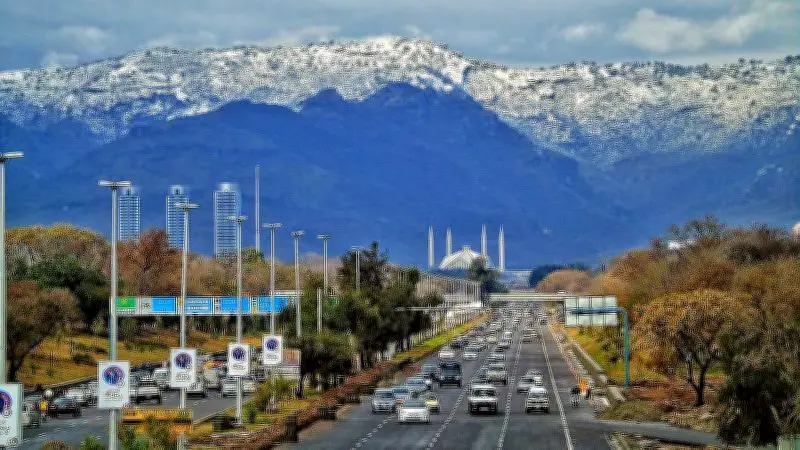
I used to visit Islamabad in the 1990s as a boy between 14 and 17 years old to spend time with my childhood buddy. The city felt magical — wide, tree-lined avenues, clean air, and a calm rhythm that stayed with you. No honks, no rush hours. In 2008, in my twenties, I became a more or less permanent resident when I started work here. Those were good years. I remember how the Blue Area would turn into a giant open stadium during Pakistan’s cricket semi-finals and finals. The whole area became a no-traffic zone, hundreds of people gathered in front of the big screen at the Islamabad Stock Exchange, and everyone celebrated together. It felt like a real community. Everyone cared, cherished and respected the city’s ambience and its ecosystem. Now, in my thirties and forties, I see a completely different Islamabad. From an almost unpolluted era, it has become one of the most polluted. It has become one of the noisiest and most populous cities. The air quality index drops alarmingly in winter, heatwaves cross 50°C in summer, frequent fires rage through the Margalla Hills, rainfall has decreased, green acres continue to disappear under new buildings, and pedestrian areas are either unsafe or completely missing, with roads lacking proper sidewalks. All these issues have taken over the city that still yearns for its peaceful and enchanting beauty, the beauty it has gradually lost.

Pedestrian Neglect
Yet Islamabad still endures. It never fully lets you down. Even as I write these lines late at night, a robin sits near my balcony, pouring out hundreds of different tunes every hour, in joyful conversation with another perched on a tree branch a few yards away in the children’s park. The cats still stroll around with their usual grace, day and night, from one neighbour’s house to another. But stray dogs, which were not so common before, have increased noticeably, and no one seems to be raising an eyebrow. What pains me most is how car-first thinking has taken over everything. Footpaths are broken or completely missing on hundreds of streets. Where they exist, they are occupied by parked cars, pushcarts, or other encroachments. Commercial areas, school zones, and residential streets all seem to be broken down. There is no distinction between highways and pedestrian spaces. People with disabilities, the elderly, and children are unsafe in a city where roads and flyovers are built in record time, while sidewalks and children’s parks have to wait for decades to be repaired. It would not be an overstatement to say that pedestrians feel like an oddity in a city that was never planned this way, one that now prioritises the elite instead of the ecosystem.
A Call for Pedestrian-First Vision
Islamabad needs a pedestrian-first vision, just like we have mobile-first standards in web design. Commercial hubs should be car-free zones. Parking spaces or plazas should be available near every commercial hub. School zones must have traffic wardens and proper speed breakers. Every street should have functional pavements. Without this basic shift, we are failing the very people the city is meant for. Islamabad is much closer to my heart than the city I was born in. It has given me respect, dignity, opportunities and a better future. That is why it deeply pains me to see it downgraded — moving away from being environment-centric and becoming increasingly elite-centric.
The Need for Local Government
Islamabad needs a proper local government more than any other city in the country. With its unique status as the capital, rapid growth, and special ecological position at the foot of the Margalla Hills, it cannot be run effectively through the Capital Development Authority alone. The absence of an elected mayor and local bodies has left day-to-day issues, from stray animals and waste management to footpaths and streetlights, unattended. The Capital Development Authority does big projects well, but the small, everyday things that make life livable are slipping away. Local government is the lifeblood of a city, and Islamabad seems to be lacking it for ages. Local government is what gives a city its character, keeps it alive, and directly connects with the people. We are damaging not just the ecosystem but the soul of this city. Yet there is still time.
Collective Action for a Better Future
In my opinion, as a concerned citizen, architects, environmentalists, tech-savvy professionals, non-governmental organisations, academia, and lawmakers must sit together for this great cause. Perhaps we can hold competitions in different segments — inviting fresh ideas for humane animal management, pedestrian-friendly zones, green corridors and sustainable urban planning. Only through such collective wisdom and collaboration can we find real solutions. This city has given me memories and people I cherish. It still sings through its birds at night and offers moments of unexpected beauty. Let us not allow it to slip further from beautiful to woeful. Let us work together to bring it back to what it was always meant to be — where cats can cross the road safely, stray dogs have sanctuaries, cars drive respectfully, and people can walk leisurely in pedestrian zones, making it truly “Islamabad the Beautiful”.