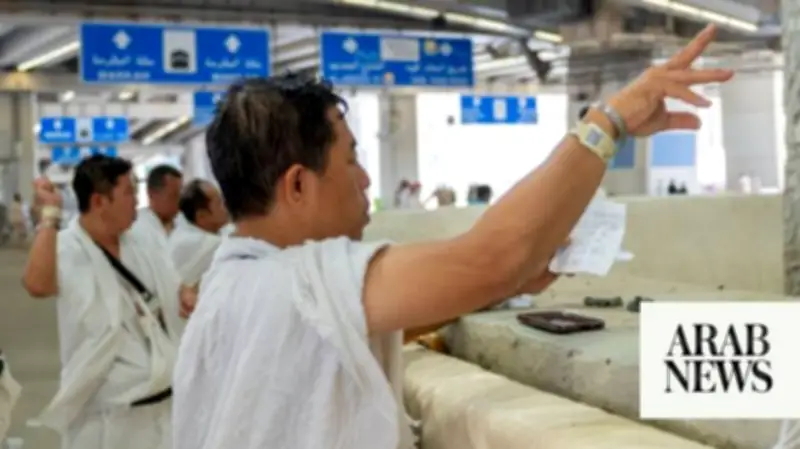
On Eid Al-Adha, pilgrims moved between Mina and Makkah to perform Tawaf Al-Ifadah at the Grand Mosque after completing the symbolic stoning of the devil at the Jamarat complex. This marks the beginning of the final phase of Hajj and the start of Eid celebrations for Muslims worldwide.
Eid Day Rituals
Eid day began with crowds of pilgrims gathering at the Jamarat complex in Mina to perform the stoning ritual. This ritual commemorates Prophet Ibrahim's rejection of Satan's temptations and is among the most spiritually significant and logistically complex rites of Hajj. Pilgrims threw pebbles at Jamrat Al-Aqaba, the largest of the three stone structures, before proceeding with other rituals including animal sacrifice, shaving or trimming hair for men, and Tawaf Al-Ifadah.
In temperatures approaching 44°C, according to the National Center for Meteorology (NCM), pilgrim movement toward the Jamarat Bridge and surrounding areas proceeded in an organized, gradual flow, with groups distributed over different levels in accordance with the operational plan. NCM reported that its monitoring stations achieved a forecast-to-observation accuracy rate exceeding 98 percent over the holy sites, covering temperature, humidity, wind speed, and other weather variables.

Pilgrims Express Satisfaction
Labiq Sayyad, an Indian pilgrim, told Arab News that this Hajj season was very well organized. His companion, Maryam, expressed gratitude to Saudi Arabia and satisfaction with the services provided. Iraqi pilgrim Samar Adnan Hashim said: "Since we arrived here, the organization has been very good … they are in fact excellent. May Allah bless you all for the service you are offering, and may Allah reward you all." When asked about shortcomings, she noted that the organization of Hajj is being carried out at a very high standard. Her compatriot, Hussein Taher, told Arab News that everything was excellent and services are improving every year. Regarding difficulties, Taher said: "None at all. There were no shortcomings or difficulties. Our brothers here are making everything easier and facilitating all matters."
Smooth Movement and Crowd Management
Pilgrims' return to accommodation sites was smooth and well-coordinated, reflecting effective crowd management and operational flexibility. Overall, traffic in Mina was fluid, ensuring efficient mobility for pilgrims and vehicles across the area.
Tawaf Al-Ifadah
Tawaf Al-Ifadah, one of the essential pillars of Hajj, involves circumambulating the Kaaba seven times inside the Grand Mosque in Makkah. The ritual symbolizes spiritual devotion and is a key transition in the pilgrimage as pilgrims move into the final days of Hajj. The Grand Mosque and its courtyards catered to a large movement of pilgrims performing Tawaf in a deeply spiritual atmosphere marked by tranquility and devotion, amid direct field monitoring by various Hajj-operating sectors. These entities deployed their human and technical resources to serve pilgrims and facilitate their movement within the Grand Mosque.
After performing Tawaf Al-Ifadah, pilgrims will continue their Hajj rituals in Mina during the days of Tashreeq, when they stone the three Jamarat. They then conclude their pilgrimage with Tawaf Al-Wada, or the farewell circumambulation, before leaving Makkah.
Jamarat Bridge: Engineered for Safety and Efficiency
The modern Jamarat facility is one of Saudi Arabia's most significant development projects in the holy sites, designed to improve crowd management and ensure pilgrim safety during peak periods. With a capacity exceeding 300,000 pilgrims per hour, the five-level complex stretches 950 meters in length and 80 meters in width. It features hundreds of escalators, multidirectional bridges, designated entry and exit routes, emergency exits, cooling systems, and advanced surveillance technologies to maintain smooth crowd flow.

Once known for severe congestion caused by narrow pathways surrounding small stone pillars, the Jamarat area has undergone decades of expansion and redevelopment. According to the Royal Commission for Makkah City and the Holy Sites, the first bridge over the Jamarat pillars was built in 1975, while the current multilevel bridge was completed in phases between 2006 and 2010. The facility now operates through an integrated management system involving field teams working around the clock to provide security, medical, and guidance services in coordination with government agencies. Multilingual guidance screens and modern monitoring systems are also used to enhance safety and crowd movement.
As part of this year's preparations, Kidana Development Co., the executive arm of the Royal Commission for Makkah City and the Holy Sites, implemented several projects aimed at improving the pilgrim experience and reducing heat stress. Among the initiatives was the installation of 200 mist fans in the eastern courtyard of the Jamarat facility to help lower temperatures for pilgrims exposed to direct sunlight. The company also launched the "Towards Mina" initiative, a color-coded guidance system designed to improve navigation, reduce the number of lost pilgrims, and facilitate access to camps and facility levels. The Jamarat facility has increasingly become a global model for large-scale crowd management, reflecting Saudi Arabia's continued investment in infrastructure and technology to support pilgrims and ensure the safe performance of Hajj rituals.
Essential Goods Widely Available
Ministry of commerce inspection teams carried out field visits and market monitoring operations at the holy sites to verify high levels of supply availability and ensure markets are prepared to meet the needs of pilgrims. The inspections confirmed abundant stocks of essential food items, consumables, and basic commodities, with more than 622 million units supplied since the beginning of Dhul Hijjah. These included bread, bottled water, dairy products, juices, soft drinks, and ice. The ministry noted that more than 83.8 million loaves of bread were delivered to retail outlets, while bottled drinking water exceeded 291 million units. In addition, more than 226.6 million items of dairy products, juices, and soft drinks were supplied, along with more than 21.2 million ice blocks.