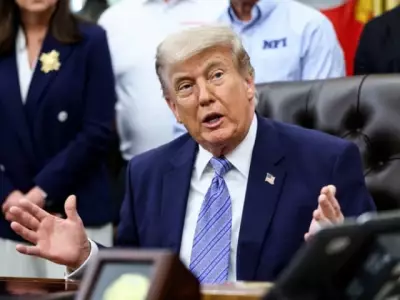
The US House of Representatives narrowly defeated a Democratic-led resolution aimed at stopping the Iran war unless hostilities are authorized by Congress. The effort to rein in President Donald Trump's military campaign failed by the closest possible margin, with a vote of 212 to 212.
Key Details of the Vote
The resolution needed a majority to pass, but the tie meant it failed. Three Republicans — Tom Barrett of Michigan, Brian Fitzpatrick of Pennsylvania, and Thomas Massie of Kentucky — supported the resolution, while one Democrat, Jared Golden of Maine, opposed it. This marked the third House vote this year on an Iran war powers resolution and the first since the conflict hit a 60-day deadline on May 1 for Trump to seek congressional approval. Trump had declared a ceasefire had "terminated" hostilities against Iran.
There have also been seven failed votes in the Senate. The votes have been getting tighter, with Trump's fellow Republicans holding slim majorities in both chambers. The last House war powers resolution failed on April 16 by 213-214, with one member voting "present." In that vote, only one Republican supported the resolution. Senate votes have also narrowed; a war powers resolution was blocked by 50-49 on Wednesday, with three Republicans joining every Democrat except one to advance the measure.

Democratic Arguments
Democrats have called on Trump to seek congressional authorization for the use of military force in the Iran conflict, citing the US Constitution, which grants Congress the power to declare war. They warned that Trump may have dragged the country into a prolonged conflict without a clear strategy and criticized higher prices for gasoline, food, and other products since the joint US-Israeli air strikes on Iran on February 28. Affordability has become a central theme of Democrats' economic message ahead of the November midterm elections, which will determine whether Republicans retain control of Congress. US producer prices saw their biggest increase in four years in April, driven by soaring costs for goods and services since the war began. Representative Gregory Meeks, the top Democrat on the House Foreign Affairs Committee, stated during debate, "It is time for the president to come to us, and it is time for us, I believe, to end this war."
Republican and White House Positions
Republicans and the White House argue that Trump's actions are legal and within his rights as commander-in-chief to protect the US by ordering limited military operations when the country faces an imminent threat. Some congressional Republicans accused Democrats of filing war powers resolutions solely due to partisan opposition to Trump. Representative Brian Mast of Florida, chairman of the Foreign Affairs Committee, said during debate, "It is 100 percent about theatrics." He accused Democrats of giving hope to Iran's Islamic Revolutionary Guard Corps by filing such resolutions.