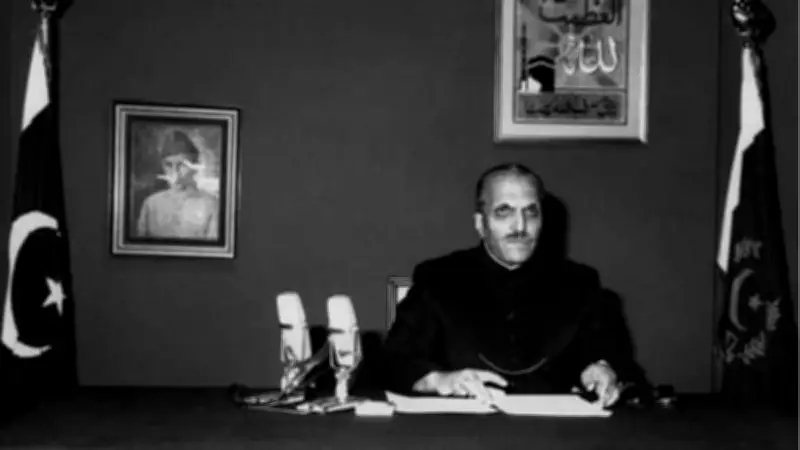
General Muhammad Zia-ul-Haq's eleven-year dictatorship (1977-1988) is widely regarded as the most catastrophic pivot point in Pakistan's history. Coming to power through a midnight coup on 5 July 1977 under the banner of Operation Fairplay, Zia did not merely suspend a government; he fundamentally re-engineered the genetic makeup of the Pakistani state. Over more than a decade, his regime systematically dismantled the democratic, constitutional, and cultural foundations laid down by the country's founders, replacing them with institutionalised religious extremism, legal chaos, and social regression. By weaponising faith to legitimise an illegal occupation of power, Zia's policies permanently altered the nation's complexion, dragged a progressive society centuries backwards, and left a toxic legacy that continues to bleed modern Pakistan.
Constitutional Destruction and Judicial Subjugation
To understand the scale of Zia's destruction, one must look at his complete disdain for the supreme law of the land. The 1973 Constitution, achieved through a hard-fought, unanimous consensus among all political and religious factions under Zulfikar Ali Bhutto, was the bedrock of Pakistan's federal unity. Zia treated this sacred covenant with open contempt, famously declaring that the Constitution was nothing more than a piece of paper that he could tear up at his whim. When the judiciary initially resisted his martial law, Zia struck back with surgical precision. In 1981, he promulgated the Provisional Constitutional Order (PCO). This draconian decree completely stripped civilian courts of their power to challenge martial law regulations or review military tribunals' decisions. Supreme Court and provincial High Court judges were forced either to take a humiliating new oath of allegiance to the military dictator or face immediate dismissal. This calculated purge broke the Pakistani judiciary's spine, turning the halls of justice into rubber stamps for military directives and legalising the judicial murder of the country's first popularly elected Prime Minister.
The Eighth Amendment and Hyper-Presidentialism
By 1985, seeking a civilian façade for his absolute rule, Zia orchestrated a non-party-based general election. Before handing over partial power to a handpicked parliament, he unilaterally enacted the Revival of the Constitution Order (RCO), altering dozens of clauses and hundreds of articles of the 1973 Constitution in a single afternoon. Zia's manipulation, or rather mutilation, was permanently codified into law through the infamous Eighth Amendment, introducing Article 58(2)(b), a structural weapon that gave the President unilateral authority to dissolve the National Assembly and dismiss the Prime Minister. With a stroke of a pen, Zia transformed Pakistan from a parliamentary democracy into a fragile, hyper-presidential state where elected prime ministers ruled at the pleasure of the army chief. He took a young, diverse, and culturally vibrant country that was striving towards modernity and pushed it into a dark age of polarisation, bigotry, and structural violence.


State-Sponsored Islamisation
Zia-ul-Haq lacked political legitimacy and a popular base. To sustain his rule, he wrapped his dictatorship in the holy shroud of religion, introducing a state-sponsored programme called Nizam-e-Mustafa (The System of the Prophet). However, his version of Islamisation was not rooted in the Islamic values of social justice, equality, or compassion; instead, it was a calculated strategy of coercion, public terror, and medieval penal codes designed to subjugate the populace. The introduction of the Hudood Ordinances in 1979 marked a horrific regression for human rights, particularly for women. These laws replaced sections of the secular Pakistan Penal Code with archaic punishments, including public floggings, amputations, and stoning, mostly aimed against women in particular. This systemic misogyny effectively reduced women to second-class citizens. Simultaneously, Zia amended colonial-era religious laws to introduce severe, sweeping blasphemy laws. These laws quickly became tools for settling personal vendettas, grabbing property, and terrorising Pakistan's vulnerable religious minorities. To bypass the traditional legal system entirely, Zia established the Federal Shariat Court, a parallel judicial entity with the power to strike down any secular law passed by Parliament if it was deemed un-Islamic, permanently fracturing the country's legal unity.
Geopolitical Fallout: The Afghan Jihad and Its Domestic Consequences
Zia's domestic oppression was supercharged by geopolitical events. The 1979 Soviet invasion of neighbouring Afghanistan turned the international pariah into a vital strategic ally for the United States and Saudi Arabia. As billions of dollars in foreign aid, covert funding, and sophisticated weaponry poured into Pakistan, Zia used the Inter-Services Intelligence (ISI) to orchestrate the anti-Soviet Afghan jihad. This short-sighted proxy war had catastrophic domestic consequences, introducing the infamous Kalashnikov and heroin culture to Pakistan. Automatic weapons and cheap narcotics flooded urban centres and rural valleys alike. To feed the war machine with highly indoctrinated foot soldiers, the regime actively sponsored, financed, and expanded a massive network of hard-line religious seminaries (madrasas). These institutions ceased to be traditional centres of theological learning; instead, they became ideological factories producing armed militants, resulting in the upsetting of the country's delicate sectarian balance and tearing Pakistan's social fabric to shreds.
War on Culture, Education, and Free Thought
To prevent any democratic resistance or intellectual defiance, the Zia regime launched a total war on culture, free thought, and intellectual expression. Student unions—the traditional nurseries for democratic leadership and political awareness—were strictly banned across all colleges and universities, leaving a leadership vacuum that was quickly filled by violent, armed student wings of religious political parties. The state enforced suffocating censorship across the media, arts, and literature. Independent journalists were publicly whipped, imprisoned, and tortured for writing against the dictatorship. Television programming was subjected to strict, puritanical codes: women anchors were forced to cover their heads, romantic expressions were scrubbed from dramas, and classical dance and liberal music were banned from state airwaves. Most insidiously, Zia ordered a complete overhaul of the national educational curriculum. School textbooks were systematically rewritten, replacing actual history, geography, and scientific inquiry with an aggressive, state-vetted narrative of religious nationalism and xenophobia. Generations of Pakistani children were raised on a diet of revisionist history that glorified militarism and demonised religious diversity, permanently warping the collective intellect of the nation and pushing its societal mindset centuries backwards into intolerance.
The End of an Era and Enduring Legacy
Zia-ul-Haq's reign of terror ended abruptly (though mercifully) on 17 August 1988, when his presidential C-130 aircraft exploded in mid-air near Bahawalpur under mysterious circumstances. While his sudden death removed the dictator from the scene and allowed a fragile return to civilian politics, the toxic infrastructure of his eleven-year rule remained deeply embedded in the state's foundations. Zia did not just rule Pakistan for eleven years; he altered its civilisational trajectory. He took a young, diverse, and culturally vibrant country that was striving towards modernity and pushed it into a dark age of polarisation, bigotry, and structural violence. The contemporary crises that haunt modern Pakistan—ranging from rampant violent extremism and deeply institutionalised intolerance to a castrated judiciary and an overbearing military establishment—are the direct harvest of the seeds planted during Zia's dark decade. The country remains locked in a bitter, ongoing struggle to sanitise its legal, constitutional, and social systems of his regressive ghost and reclaim the original, untainted vision of a pluralistic, harmonious, and progressive homeland.