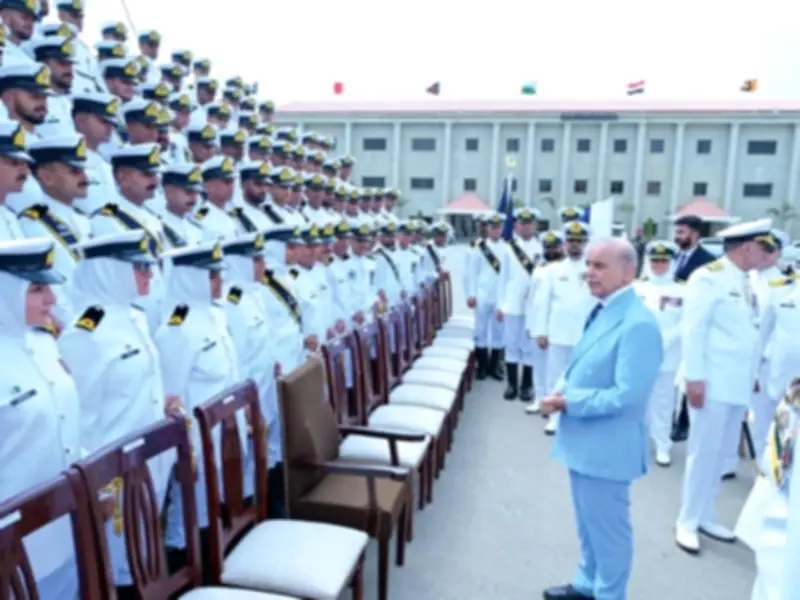
Prime Minister Shehbaz Sharif on Saturday accused India of resorting to covert tactics and proxies to destabilize Pakistan after suffering a humiliating setback in last year's war. Speaking at a passing-out parade of the 125th Midshipmen Course and 33rd Short Service Commission Course at the Pakistan Naval Academy in Karachi, the premier highlighted multi-faceted security challenges facing the nation.
India's Covert Tactics
"Our eastern neighbour, having suffered a humiliating setback in the conflict in May last year, has increasingly resorted to covert tactics and the use of proxies in an attempt to undermine the hard-earned peace and stability in our country," PM Shehbaz said. He noted that Pakistan is navigating a dangerous combination of international and internal threats.
Western Border Threats
Referring to the Afghan insurgency, the premier stated, "Our valiant armed forces continue to confront the menace of foreign-sponsored terrorism emanating from our western borders." He affirmed the nation's solidarity with its armed forces and reiterated an "iron resolve" to defeat enemy designs while pursuing peace, dialogue, and diplomacy to resolve outstanding disputes.

Global Developments and Peace Efforts
PM Shehbaz highlighted that the address took place amid monumental global developments affecting lives in unimaginable ways. "Pakistan stands proud as a peacemaker in the comity of nations. Pakistan's sincere mediation efforts with the support of brotherly and friendly countries led to the historic signing of the Islamabad Memorandum of Understanding (MoU) between the United States and Iran," he emphasized.
He paid tribute to Chief of Defence Forces and Chief of Army Staff, Field Marshal Asim Munir, for his relentless efforts toward regional peace. Commenting on Iranian President Masoud Pezeshkian's recent visit to Pakistan, the PM said, "It was not only a manifestation of the strong brotherly ties between Pakistan and Iran but also an acknowledgement of Pakistan's important role to promote peace in the region."
Maritime Security and Naval Modernization
The premier stressed the evolving regional situation and highlighted maritime security's importance for the global economy and international supply chains. "Today, the right of free passage and freedom of navigation are no longer luxuries but have become an absolute necessity for the entire world," he said.
He reiterated the government's commitment to strengthening the navy as a "potent and effective force" capable of national defence and acting as a stabilising force in the wider maritime region. He noted that the strategic naval force produced "tangible operational results" during operations Marka-e-Haq and Bunyanum Marsoos against India.
Kashmir, Palestine, and Cadets' Role
Advocating the Kashmir and Palestine causes, PM Shehbaz reaffirmed Pakistan's unwavering commitment to these "just" causes. Addressing the cadets, he said they joined the maritime force at a time of profound transformation, underscoring the importance of modernising naval capabilities, especially in artificial intelligence (AI) and unmanned systems, to meet emerging challenges.
Concluding, he congratulated the cadets: "The rank you wear on your shoulders today carries immense responsibility. As you embark on this noble profession, always remember: calm waters do not test a sailor nor do fair winds define a captain. It is the rough seas and strong winds that test one's mettle." Cadets from Turkey, Bahrain, Bangladesh, Sri Lanka, Iraq, and Djibouti were among the passing-out officers.